Chemistry

Get insights from 6.9k questions on Chemistry, answered by students, alumni, and experts. You may also ask and answer any question you like about Chemistry

Follow Ask Question
6.9k

Questions

0

Discussions

32

Active Users

0

Followers

New answer posted

9 months ago

0 Follower 12 Views

V
Vishal Baghel

Contributor-Level 10

Ammonical AgNO3   

New answer posted

9 months ago

0 Follower 9 Views

V
Vishal Baghel

Contributor-Level 10

Zero acidic hydrogen present in anionic part of (R)

New answer posted

9 months ago

0 Follower 5 Views

V
Vishal Baghel

Contributor-Level 10

(Cr, Mn) -> Thermite reduction

New answer posted

9 months ago

0 Follower 113 Views

V
Vishal Baghel

Contributor-Level 10

A ( g ) ? 2 B ( g ) .

E m 2 m o l V l 4 m o l V l

N e w E q m 4 x V 4 + 2 x V

V * 2 4 x 2 V 4 2 x 2 V

New Eqm 4 x y 2 V 4 + 2 x + 2 y 2 V

= 4 Z 2 V = 4 + 2 Z 2 V ( Z = x + y )

Now, KC =  [ B ] 2 [ A ] = constant

o r , ( 4 V ) 2 ( 2 V ) = ( 4 + 2 Z 2 V ) ( 4 Z 2 V ) Z = 1 . 2 9

 mole of B at new Eqm = 4 + 2Z = 6.58

New answer posted

9 months ago

0 Follower 3 Views

V
Vishal Baghel

Contributor-Level 10

Sucrose D (+) glucose + D (-) Fructose

  [ α ] = + 6 6 . 5 ° [ α ] = + 5 2 . 5 ° [ α ] = 9 2 . 8 °

Thus rotation changes from positive to negative after hydrolysis. Due to this reason hydrolysis of sucrose is known as inversion and mixture after hydrolysis is known as invert sugar.

Therefore option (B) is correct.

New answer posted

9 months ago

0 Follower 59 Views

V
Vishal Baghel

Contributor-Level 10

[ Z n ( g l y ) 2 ] is optically active compound

New answer posted

9 months ago

0 Follower 28 Views

V
Vishal Baghel

Contributor-Level 10

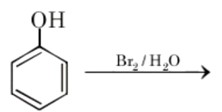
In H2O (polar solvent) dibromophenol derivative and in CS2 (non-polar solvent moneobromo phenol derivate is obtained.

New answer posted

9 months ago

0 Follower 34 Views

V
Vishal Baghel

Contributor-Level 10

Z = P V m R T 0 . 5 = 2 4 * V m 2 4

V m = 0 . 5 l / m o l e

( P + a V m 2 ) ( V m b ) = R T

( 2 4 + a 0 . 5 2 ) ( 0 . 5 0 . 1 ) = 2 4

2 4 + a 0 . 5 2 = 6 0

a 0 . 5 2 = 3 6

a = 3 6 * 0 . 5 2 = 9 a t m l 2 m o l 2
 

New answer posted

9 months ago

0 Follower 11 Views

V
Vishal Baghel

Contributor-Level 10

The blue color of the solution is due to the ammoniated electron which absorbs energy in infrared region of light

New answer posted

9 months ago

0 Follower 2 Views

V
Vishal Baghel

Contributor-Level 10

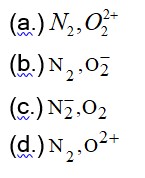
Therefore option (b) is correct.

Get authentic answers from experts, students and alumni that you won't find anywhere else

Sign Up on Shiksha

On Shiksha, get access to

  • 66k Colleges
  • 1.2k Exams
  • 700k Reviews
  • 1850k Answers

Share Your College Life Experience

×
×

This website uses Cookies and related technologies for the site to function correctly and securely, improve & personalise your browsing experience, analyse traffic, and support our marketing efforts and serve the Core Purpose. By continuing to browse the site, you agree to Privacy Policy and Cookie Policy.