

Class 11th
Get insights from 8k questions on Class 11th, answered by students, alumni, and experts. You may also ask and answer any question you like about Class 11th
Follow Ask QuestionQuestions
Discussions
Active Users
Followers
New answer posted
a year agoContributor-Level 10
This is because acceleration depends on both force and mass (F = ma).
We know that from Newton's Third Law. While action-reaction forces are always equal, the objects they act on usually have very different masses.
If you consider a falling stone and the Earth as an action-reaction pair. The Third Law tells us,
Earth pulls stone down with force F
Stone pulls Earth up with equal force F
But Earth's mass is enormous, so its acceleration is tiny (F/huge mass = tiny acceleration)
Stone's mass is small, so its acceleration is large (F/small mass = large acceleration)
Result: Stone falls noticeably, Earth's motion is unnoticeable.
New answer posted
a year agoContributor-Level 10
The third law of motion by Newton may confuse you into thinking that action causes reaction in sequence. This is incorrect.
In reality, both forces exist at the exact same moment. When you push a wall, your hand pushes the wall. At the same time, the wall pushes back simultaneously. Not one, then the other. Just note that there's no time delay between them.
New answer posted
a year agoContributor-Level 10
Action-reaction forces act on different objects. That's why they don't or cannot cancel out.
For instance, when you push a wall, you can observe two things.
Your hand pushes the wall (action)
The wall pushes your hand (reaction)
These are equal and opposite. But a close scientific examination will tell you that they are indeed acting on different things. To find your hand's motion, only consider the force on your hand (wall pushing back). The force from your hand affects the wall's motion, which is not yours.
New question posted
a year agoNew question posted
a year agoNew question posted
a year agoNew answer posted
a year agoContributor-Level 10
Internal forces in an isolated system do not affect the total momentum. But do note that the mutual forces between pairs of particles in the system can cause individual particles to change their momentum. Now, these internal forces are always equal and opposite, as you can recall from Newton's Third Law.
Due to that, the individual momentum changes cancel out in pairs. What happens is that the total momentum of the system remains unchanged. That further allows the Second Law of Motion to be applied to a body or a system of particles. The internal forces sum to a force that is mathematically nulled out.
New answer posted
a year agoContributor-Level 10
An isolated system is one that has no external force acting on it. This means that for the total momentum to remain unchanged, there must be no net force originating from outside the system. This net external force should not be able to influence the motion of the isolated system, as per the law of conservation of momentum.
New answer posted
a year agoContributor-Level 10
Case – I : When disk slides down
Case – II : When disk rolls down
New answer posted
a year agoContributor-Level 10
Using conservation of linear momentum, we can write
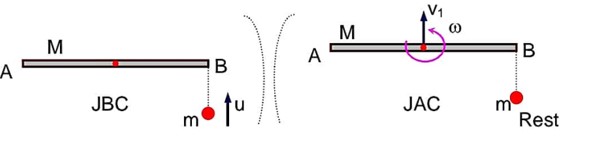
Using conservation of angular momentum about centre of mass of Rod, we can write
Using definition of e, we can write
Taking an Exam? Selecting a College?
Get authentic answers from experts, students and alumni that you won't find anywhere else
Sign Up on ShikshaOn Shiksha, get access to
- 67k Colleges
- 1.2k Exams
- 717k Reviews
- 1850k Answers