Class 12th

Get insights from 12k questions on Class 12th, answered by students, alumni, and experts. You may also ask and answer any question you like about Class 12th

Follow Ask Question
12k

Questions

0

Discussions

28

Active Users

0

Followers

New answer posted

a year ago

0 Follower 2 Views

R
Raj Pandey

Contributor-Level 9

HCF = HCF of  (81, 27, 9) LCM of  (16, 20, 40) = 9 8 0  

New answer posted

a year ago

0 Follower 1 View

R
Raj Pandey

Contributor-Level 9

Quantitative Aptitude Prep Tips for MBA

= ( l 2 + b 2 + h 2 ) = 1 0 0 + 1 0 0 + 2 2 5 =425=517 m

New answer posted

a year ago

0 Follower 1 View

A
alok kumar singh

Contributor-Level 10

Vitamin B1 is thiamine while vitamin B6 is pyridoxine

New answer posted

a year ago

0 Follower 1 View

R
Raj Pandey

Contributor-Level 9

4 1 7 4 gives a remainder of 1.

New answer posted

a year ago

0 Follower 2 Views

A
alok kumar singh

Contributor-Level 10

Reducing power for group-15 hydrides increases down the group, so BiH3 is the strongest reducing agent.

New answer posted

a year ago

0 Follower 2 Views

R
Raj Pandey

Contributor-Level 9

For all numbers which are in the form  x1/x and all x is greater than 3, the one with the greatest base is the smallest number.

New answer posted

a year ago

0 Follower 7 Views

A
alok kumar singh

Contributor-Level 10

Sulphide ion (s2-) form ores commonly with Pb & Ag as PbS and Ag2S
New answer posted

a year ago

0 Follower 2 Views

A
alok kumar singh

Contributor-Level 10

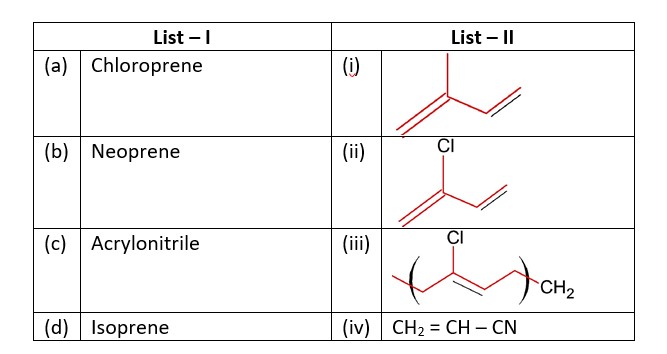
Kindly go through the solution


New answer posted

a year ago

0 Follower 30 Views

V
Vishal Baghel

Contributor-Level 10

f (t) = t3 – 6t2 + 9t + 3


⇒ f ' ( t ) = 3 t 2 − 1 2 t + 9 = 3 ( t − 1 ) ( t − 3 )

∴ f ' ( t ) = 0 ⇒ t = 1 , 3

⇒ f ( 1 ) = 1 , f ( 3 ) = − 3

g ( x ) = { f ( x ) , 0 ≤ x < 1 1 , 1 ≤ x ≤ 3     g ( x )     i s     c o n t i n u o u s 4 − x , 3 < x ≤ 4

Hence g (x) is not differentiable at only x = 3.

New answer posted

a year ago

0 Follower 6 Views

V
Vishal Baghel

Contributor-Level 10

1 α ( α + 1 ) ( α + 2 ) . . . . . . . . . . ( α + 2 0 ) = A 0 α + A 1 α + 1 + A 2 α + 2 + . . . . . . + A 2 0 α + 2 0

Solving by partial fraction, we get

A 1 3 = − 1 1 4 ! 7 ! , A 1 4 = − 1 1 4 ! 6 !     a n d     A 1 5 = − 1 1 4 ! 5 !

∴ A 1 4 + A 1 5 A 1 3 = 3 1 0 ⇒ ( A 1 4 + A 1 5 A 1 3 ) 2 = ( 3 1 0 ) 2 ⇒ 1 0 0 ( A 1 4 + A 1 5 A 1 3 ) 2 = 9

Get authentic answers from experts, students and alumni that you won't find anywhere else

Sign Up on Shiksha

On Shiksha, get access to

  • 67k Colleges
  • 1.2k Exams
  • 717k Reviews
  • 1850k Answers

Share Your College Life Experience

×

This website uses Cookies and related technologies for the site to function correctly and securely, improve & personalise your browsing experience, analyse traffic, and support our marketing efforts and serve the Core Purpose. By continuing to browse the site, you agree to Privacy Policy and Cookie Policy.