

Class 12th
Get insights from 12k questions on Class 12th, answered by students, alumni, and experts. You may also ask and answer any question you like about Class 12th
Follow Ask QuestionQuestions
Discussions
Active Users
Followers
New question posted
a year agoNew answer posted
a year agoContributor-Level 10
This is a multiple choice answer as classified in NCERT Exemplar
Correct option (i)
Fluorine is the most reactive element, forming hydrogen fluoride when it combines with hydrogen gas.
Due to the shorter bond length between the two atoms, it takes a lot of energy to break the link between hydrogen and fluorine.
As a result, as we move down the group, the bond dissociation energy drops.
New answer posted
a year agoContributor-Level 10
This is a Fill in the Blanks Type Questions as classified in NCERT Exemplar
Sol:
New answer posted
a year agoContributor-Level 10
This is a multiple choice answer as classified in NCERT Exemplar
Correct option (i)
The compound has the following number of electrons:
NO3- = 32e-
CO32- = 32e-
ClO3- = 42e-
SO3 - = 42e-
Hence, NO3- and CO32- are isoelectronic
New answer posted
a year agoContributor-Level 10
This is a Fill in the Blanks Type Questions as classified in NCERT Exemplar
Sol:
New answer posted
a year agoContributor-Level 10
This is a multiple choice answer as classified in NCERT Exemplar
Correct option (iii)
If an electron pair is donated to a vacant orbital on one atom and a lone pair of electrons on the other, the bonding is designated pπ-dπ depending on the orbital to which the electron pair is donated and the orbital from which the electron pair is donated.
Because their valence shells lack d-orbitals, nitrogen, carbon, and boron cannot form a pi bond. Phosphorus, on the other hand, can produce pi bonds.
New answer posted
a year agoContributor-Level 10
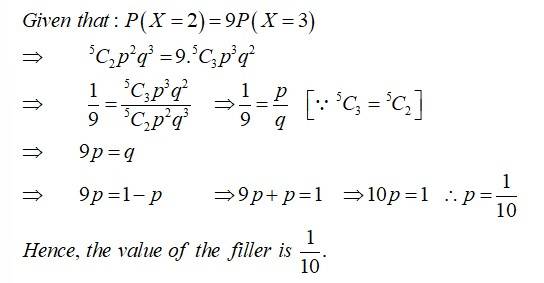
This is a Fill in the Blanks Type Questions as classified in NCERT Exemplar
Sol:
New answer posted
a year agoContributor-Level 10
This is a multiple choice answer as classified in NCERT Exemplar
Correct option is (iii)
H3PO2, H3PO4, H3PO4, and other oxoacids are formed by phosphorus. P is tetrahedrally surrounded by other atoms in phosphorus oxoacids. At least one P-H bond and an O-H bond are known to form in all of them.

New answer posted
a year agoContributor-Level 10
This is a Fill in the Blanks Type Questions as classified in NCERT Exemplar
Sol:
New answer posted
a year agoContributor-Level 10
This is a multiple choice answer as classified in NCERT Exemplar
Correct option (ii)
When H2S is passed through an aqueous solution of salt acidified with dil. HCl in qualitative analysis, a black precipitate is produced. When the precipitate is boiled with dil. HNO3, a blue solution results. When an excess of ammonia aqueous solution is added to this solution, it produces a deep blue [Cu (NH3)4]2+ solution.
Taking an Exam? Selecting a College?
Get authentic answers from experts, students and alumni that you won't find anywhere else
Sign Up on ShikshaOn Shiksha, get access to
- 67k Colleges
- 1.2k Exams
- 718k Reviews
- 1850k Answers