Class 12th

Get insights from 12k questions on Class 12th, answered by students, alumni, and experts. You may also ask and answer any question you like about Class 12th

Follow Ask Question
12k

Questions

0

Discussions

25

Active Users

0

Followers

New answer posted

a year ago

0 Follower 13 Views

P
Payal Gupta

Contributor-Level 10

This is a multiple choice answer as classified in NCERT Exemplar

Correct option is (iii)

The C-atom in the CO32-  ion undergoes sp2 hybridization. BF4, NH4+  and SO42-  have a tetrahedral structure, whereas it has a triangular planar structure.

New answer posted

a year ago

0 Follower 9 Views

A
alok kumar singh

Contributor-Level 10

This is a Long Answer Type Question as classified in NCERT Exemplar

Sol:
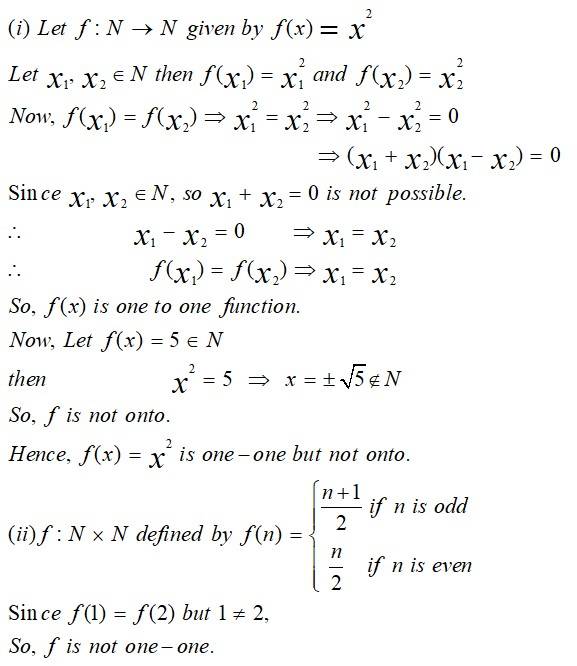
(i)  Given  that −1≤x≤1  Let  x1, x2  ∈  f(x)                                         f(x1)  =  1x1     and      f(x2)  =  1x2                                         f(x1)  =  f(x2)       ⇒       1x1  =  1x2        ⇒     x1  =  x2  So,  f(x)  is  one−one  function.  Let                           f(x)  =y  =  x2     ⇒  x  =  2y  For  y=1,  x=2 ∉  [−1,1]   So,f(x)  is  not  onto.  Hence,  f(x)  is  not  bijective  function.  (ii)  Here,                          g(x)=|x|                                                g(x1)=g(x2)         ⇒    |x1|=|x2|       ⇒     x1=±x2  So,  g(x)  is  not  one−one  function.  Let  g(x)=y=|x|     ⇒x=±y ∉A ∀ y∈A  So,  g(x)  is  not  onto  function.  Hence,  g(x)  is  not  bijective  function.  (iii)  Here,            h(x)=x|x|                                   h(x1)=h(x2)  ⇒                          x1|x1|=x2|x2|       ⇒      x1=x2  So,  h(x)  is  one−one  function.  Now,  let             h(x)=y=x|x|=x2  or  −x2  ⇒                            &thi


New answer posted

a year ago

0 Follower 7 Views

P
Payal Gupta

Contributor-Level 10

This is a multiple choice answer as classified in NCERT Exemplar

Correct option is (iii)

Na (H2)PO2

1+ (2x+1)+ x +2 (−2)=0

x−1=0

x=1

New answer posted

a year ago

0 Follower 6 Views

A
alok kumar singh

Contributor-Level 10

This is a Long Answer Type Question as classified in NCERT Exemplar

Sol:
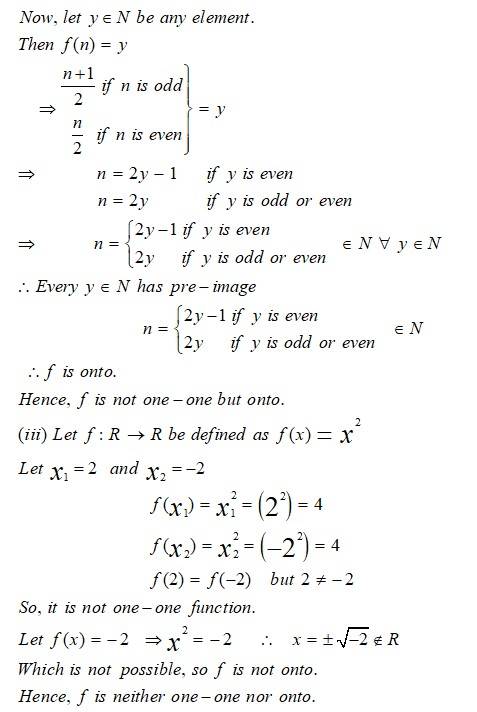
  Here,  A∈ R −{3},  B  = R  −  {1}  Given  that  f: A → B defined byf(x) = x−2x−3  ∀  x  ∈  A.  Let  x1, x2  ∈  f(x)  ∴                                         f(x1)  =  f(x2)  ⇒                                     x1−2x1−3  =  x2−2x2−3  ⇒                              (x1 −2)  (x1 −3)  =   (x2 −2)  (x2 −3)  ⇒                                             −x1  =  −x2         ⇒       x1  =  x2  So,  it  is  injective  function.  Now,  Let              y  =  x−2x−3  ⇒    xy  −3y  =  x  −2      ⇒  xy  −x  =  3y  −2  ⇒  x(y−1)  =  3y  −2       ⇒  x  =  3y−2y−1  f(x)  =  x−2x−3  =  3y−2y−1−23y−2y−1−3       ⇒  3y−2−2y+23y−2−3y+3  ⇒  y  ⇒        f(x)  =  y  ∈  B.  So,  f(x)  is  surjective  function.  Hence,  f(x)  is  bijective  function.

New answer posted

a year ago

0 Follower 5 Views

P
Payal Gupta

Contributor-Level 10

This is a multiple choice answer as classified in NCERT Exemplar

Correct option is (i)

The catalytic oxidation of ammonia produces NO gas, which is used to make HNO3. 4 moles of NH3 created 4 moles of NO in the equation below. As a result, the moles of NO produced by oxidising two moles of NH3 will be two moles.

4NH3 + 5O2→4NO + 6H2O.

New answer posted

a year ago

0 Follower 6 Views

A
alok kumar singh

Contributor-Level 10

This is a Long Answer Type Question as classified in NCERT Exemplar

Sol:

New answer posted

a year ago

0 Follower 7 Views

P
Payal Gupta

Contributor-Level 10

This is a multiple choice answer as classified in NCERT Exemplar

Correct option is (i)

We get N2 in both situations when we heat ammonium dichromate and barium azide separately.

(NH4)2Cr2O7→Cr2O3 + 4H2O + N2

Ba (N3)2→Ba + 3N2.

New answer posted

a year ago

0 Follower 8 Views

A
alok kumar singh

Contributor-Level 10

This is a Long Answer Type Question as classified in NCERT Exemplar

Sol:

    Here,     A  =  {2,  3,  4}        and     B={2,  5,  6,  7}  (i)    Let  f :  A  →  B  be  the  mapping  from  A  to  B           f  =  {(x,  y)  :  y  =  x  +  3}           ∴  f  =  {(2,  5),  (3,  6),  (4,  7)}  which  is  an  injective  mapping.  (ii)    Let  g :  A  →  B  be  the  mapping  from  A  →  B  such  that           ∴  g  =  {(2,  5),  (3,  5),  (4,  2)}  which  is  not  an  injective  mapping.    (iii)  Let  h :  B  →  A  be  the  mapping  from  B  to  A              h  =  {(y,  x)  :  x  =y−2}           ∴  h  =  {(5,  3),  (6,  4),  (7,  3)}  which  is  the  mapping  from  B  to  A.

New answer posted

a year ago

0 Follower 7 Views

P
Payal Gupta

Contributor-Level 10

This is a multiple choice answer as classified in NCERT Exemplar

Correct option is (ii)

Bismuth is the sole element that has an inert pair effect. Only generates trihalides and has a +3 oxidation state. Florine, on the other hand, is small and has a high electronegativity.

New answer posted

a year ago

0 Follower 7 Views

A
alok kumar singh

Contributor-Level 10

This is a Long Answer Type Question as classified in NCERT Exemplar

Sol:

    Given??  that  x∈ N,  y∈N  and  2x + y=41       ∴     Domain  of  R  =  {1, 2, 3, 4, 5,  …,  20}    and                   Range  =  {39, 37, 35, 33, 31,  …,  1}    Here,                   (3,  3)  ∉  R    as                      2* 3 + 3  ≠  41    So,  R  is  not  reflexive.    R  is  not  symmetric  as  (2,  37)  ∈  R  but  (37,  2)  ∉  R    R  is  not  transitive  as  (11,  19)  ∈  R  and  (19,  3)  ∈  R    but  (11,  3)  ∉  R.    Hence,  R  is  neither  reflexive,  nor  symmetric  and  nor  transitive.

Get authentic answers from experts, students and alumni that you won't find anywhere else

Sign Up on Shiksha

On Shiksha, get access to

  • 67k Colleges
  • 1.2k Exams
  • 718k Reviews
  • 1850k Answers

Share Your College Life Experience

×

This website uses Cookies and related technologies for the site to function correctly and securely, improve & personalise your browsing experience, analyse traffic, and support our marketing efforts and serve the Core Purpose. By continuing to browse the site, you agree to Privacy Policy and Cookie Policy.