Class 12th

Get insights from 11.9k questions on Class 12th, answered by students, alumni, and experts. You may also ask and answer any question you like about Class 12th

Follow Ask Question
11.9k

Questions

0

Discussions

45

Active Users

0

Followers

New answer posted

a year ago

0 Follower 2 Views

V
Vishal Baghel

Contributor-Level 10

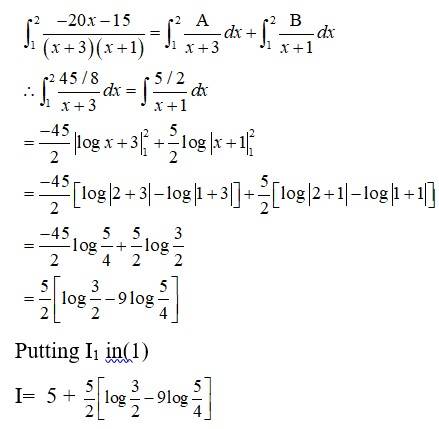
231xdx=231xdx= [logx]23=log3log2=log32

New answer posted

a year ago

0 Follower 17 Views

P
Payal Gupta

Contributor-Level 10

This is a multiple choice answer as classified in NCERT Exemplar

(b) When the A stops moving the current in B become zero, it is possible only if the current in A is constant. If the current in A would be variable, there must be an induced emf (current) in B even if the A stops moving.

New answer posted

a year ago

0 Follower 2 Views

A
alok kumar singh

Contributor-Level 10

This is a Multiple Choice Questions as classified in NCERT Exemplar

Answer- (a, c, d)

Explanation- Electrostatic shielding is the phenomenon to block the effects of an electric field. The conducting shell can block the effects of an external field on its internal content or the effect of an internal field on the outside environment.

Magnetostatic shielding is done by using an enclosure made of a high permeability

magnetic material to prevent a static magnetic field outside the enclosure from reaching

objects inside it or to confine a magnetic field with in the enclosure.

New answer posted

a year ago

0 Follower 6 Views

P
Payal Gupta

Contributor-Level 10

This is a multiple choice answer as classified in NCERT Exemplar

(b) When cylindrical bar magnet is rotated about its axis, no change in flux linked with the circuit takes place, consequently no emf induces and hence, no current flows through the ammeter A.

New answer posted

a year ago

0 Follower 4 Views

A
alok kumar singh

Contributor-Level 10

This is a Multiple Choice Questions as classified in NCERT Exemplar

Answer- (a, d)

Explanation- for solenoid H=nI

H= 1000 * 1= 1000 Am

Thus H is a constant, so it is nearly unchanged

B= μ 0 μ r n I

So B μ r

( )m)fero = 103

( )m)para = 10-5

( ( ) m ) f e r o ( ( ) m ) p a r a = 10 3 10 - 5 = 108

New answer posted

a year ago

0 Follower 3 Views

A
alok kumar singh

Contributor-Level 10

This is a Multiple Choice Questions as classified in NCERT Exemplar

Answer- (a, d)

Explanation- The primary origin of magnetism lies in the fact that the electrons are revolving and spinning of an atom, which gives rise to current called atomic current.

This atomic current gives rise to magnetism. The revolving and spinning about nucleus of

An atom is called intrinsic spin of electron.

New answer posted

a year ago

0 Follower 4 Views

P
Payal Gupta

Contributor-Level 10

This is a multiple choice answer as classified in NCERT Exemplar

=B.A

And A= A1+A2= (L2k+L2i)

B= Bo (i+k)T

=B.A= Bo (i+k) (L2k+L2i)

= 2BoL2Wb

New answer posted

a year ago

0 Follower 4 Views

A
alok kumar singh

Contributor-Level 10

This is a Multiple Choice Questions as classified in NCERT Exemplar

Answer – (a, d)

Explanation – magnetic field lines for magnetic induction B form continuous lines. So lines of B are necessarily continuous across S.

Also H varies inside and outside. So lines of H cannot all be continuous across S

New answer posted

a year ago

0 Follower 10 Views

A
alok kumar singh

Contributor-Level 10

This is a Multiple Choice Questions as classified in NCERT Exemplar

Answer- (b)

Explanation- as curie law explains B B ( m a g n e t i c f i e l d i n d u c t i o n ) t ( t e m p i n k e l v i n )

I 2 I 1 = B 2 B 1 * t 1 t 2

I 1 =8Am-1, B1= 0.6T, t1=4K

B2= 0.2T, t2=16K

So after solving we get I2= 2/3Am-

New answer posted

a year ago

0 Follower 2 Views

V
Vishal Baghel

Contributor-Level 10

11 (x+1)dx=11.xdx+11dx= [x22]11+ [x]11= [122 (1)22]+ [1 (1)].= [1212]+ [1+1]=2.

Get authentic answers from experts, students and alumni that you won't find anywhere else

Sign Up on Shiksha

On Shiksha, get access to

  • 66k Colleges
  • 1.2k Exams
  • 705k Reviews
  • 1850k Answers

Share Your College Life Experience

×
×

This website uses Cookies and related technologies for the site to function correctly and securely, improve & personalise your browsing experience, analyse traffic, and support our marketing efforts and serve the Core Purpose. By continuing to browse the site, you agree to Privacy Policy and Cookie Policy.