
Conic Sections
Get insights from 199 questions on Conic Sections, answered by students, alumni, and experts. You may also ask and answer any question you like about Conic Sections
- 199
Questions
- 0
Discussions
- 0
Active Users
- 0
Followers
Have a question about Conic Sections? Ask our experts
Keep it short & simple. Type complete word. Avoid abusive language.
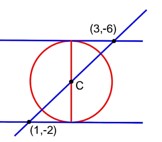
Let a circle C touch the lines L1 : 4x – 3y + K1 = 0 and L2 : 4x – 3y + K2 = 0, K1, K2 <!--[endif]--><!-- [if gte mso 9]><xml>
Let a circle C touch the lines L1 : 4x – 3y + K1 = 0 and L2 : 4x – 3y + K2 = 0, K1, K2 <!--[endif]--><!-- [if gte mso 9]><xml>
The locus of the mid- point of the line segment joining the focus of the parabola y2 = 4ax to a moving point of the parabola, is another parabola whose directrix is:
The locus of the mid- point of the line segment joining the focus of the parabola y2 = 4ax to a moving point of the parabola, is another parabola whose directrix is:
k = at ……… (ii)
From (i) & (ii)
Equation of directrix x – a/2 = -a/2Þ x = 0
 Upvote

The value of 2 cos 20º cos 40° cos 80° is equal to __________
The value of 2 cos 20º cos 40° cos 80° is equal to __________
cos 20° cos 40° cos 80°
= (2 sin 20° cos 20° cos 40° cos 80°) / (2 sin 20°)
= (2 sin 40° cos 40° cos 80°) / (2² sin 20°)
= (2 sin 80° cos 80°) / (2³ sin 20°)
= 1/8
Upvote The eccentricity of the conic represented by the parametric equation x = p - t + 1, y = p + t + 1
<!-- [if !supportLineBreakNewLine]-->
<!--[endif]-->
The eccentricity of the conic represented by the parametric equation x = p - t + 1, y = p + t + 1
<!-- [if !supportLineBreakNewLine]-->
<!--[endif]-->
x = t² - t + 1 . (i)
y = t² + t + 1 . (ii)
(i) + (ii)
x + y = 2 (t² + 1) . (iii)
(i) – (ii)
x - y = -2t . (iv)
from (iii) and (iv)
x² – 2xy + y² – 2x – 2y + 4 = 0
Here H² = ab and Δ≠ 0
This is parabola, so e = 1
Upvote Let E be an ellipse whose axes are parallel to the co-ordinates axes, having its center at (3,-4), one focus at (4,-4) and one vertex at (5,-4). If mx - y = 4, m > 0 is a tangent to the ellipse E, then the value of 5m² is equal to……….
Let E be an ellipse whose axes are parallel to the co-ordinates axes, having its center at (3,-4), one focus at (4,-4) and one vertex at (5,-4). If mx - y = 4, m > 0 is a tangent to the ellipse E, then the value of 5m² is equal to……….
Equation of the ellipse
(x−3)²/a² + (y+4)²/b² = 1
a=2
ae=1⇒e=1/2
⇒b²=3
Equation of tangent
y+4=m (x−3)±√4m²+3
⇒mx−y=4+3m±√4m²+3
⇒3m±√4m²+3=0
⇒9m²=4m²+3
⇒5m²=3
Upvote Consider a circle C which touches the y-axis at (0, 6) and cuts off an intercept 6√5 on the x-axis. Then the radius of the circle C is equal to :
Consider a circle C which touches the y-axis at (0, 6) and cuts off an intercept 6√5 on the x-axis. Then the radius of the circle C is equal to :
Co-ordinate of Q (b+2, a)
⇒ 1/√2 + 7i/√2 = (b+2+ai)e^ (iπ/4)
= (b+2+ai) (cos (π/4)+isin (π/4)
⇒ b−a+2=−1
b+2+a=7
⇒a=4
b=1
⇒2a+b=9
Upvote A circle of radius 2 unit passes through the vertex and the focus of the parabola y2 = 2x and touches the parabola y = 2x and touches the parabola y = (x-1/4)2 + a, where a > 0. Then (4α - 8)2 is equal to.
A circle of radius 2 unit passes through the vertex and the focus of the parabola y2 = 2x and touches the parabola y = 2x and touches the parabola y = (x-1/4)2 + a, where a > 0. Then (4α - 8)2 is equal to.
Let the equation of circle be
x (x-1/2) + y² + λy = 0
=> x² + y² - x/2 + λy = 0
Radius = √ (1/16 + λ²/4) = 2
=> λ² = 63/4 => (x-1/4)² + (y+λ/2)² = 4
∴ This circle and parabola
y-α = (x-1/4)² touch each other, so
α = -λ/2 + 2 => α-2 = -λ/2 => (α-2)² = λ²/4 = 63/16
(4α–8)² = 63
Upvote A rectangle R with end points of one of its sides as (1, 2) and (3, 6) is inscribed in a circle. If the equation of a diameter of the circle is 2x - y + 4 = 0, then the area of R is.
A rectangle R with end points of one of its sides as (1, 2) and (3, 6) is inscribed in a circle. If the equation of a diameter of the circle is 2x - y + 4 = 0, then the area of R is.
As slope of line joining (1, 2) and (3, 6) is 2 given diameter is parallel to side
∴ a = √ (3-1)²+ (6-2)² = √20 and
b/ (a/2) = 4/a => b = 8/√5
Area
ab = 2√5 * 8/√5 = 16
Upvote Let the eccentricity of an ellipse x2/a2 + y2/b2 = 1, a>b, be 1/4. If this ellipse passes through the point (-4√(2/5), 3), then a2 + b2 is equal to:
<!-- [if !supportLineBreakNewLine]-->
<!--[endif]-->
Let the eccentricity of an ellipse x2/a2 + y2/b2 = 1, a>b, be 1/4. If this ellipse passes through the point (-4√(2/5), 3), then a2 + b2 is equal to:
<!-- [if !supportLineBreakNewLine]-->
<!--[endif]-->
x²/a² + y²/b² = 1
(-4/√5)²)/a² + (2/√5)²)/b² = 1
=> 32/a² + 9/b² = 1
=> 32/ (5a²) + 9/b² = 1 . (i)
From (i)
6/b² + 9/b² = 1 => b²=15 & a²=16
a²+b² = 15+16=31
Upvote