
Conic Sections
Get insights from 199 questions on Conic Sections, answered by students, alumni, and experts. You may also ask and answer any question you like about Conic Sections
- 199
Questions
- 0
Discussions
- 0
Active Users
- 0
Followers
Have a question about Conic Sections? Ask our experts
Keep it short & simple. Type complete word. Avoid abusive language.
The tangent at a point where eccentric angle 60° on the ellipse x2/a2 + y2/b2 = 1(a > b) meet the auxiliary circle at L and M. If LM subtends a right angle at the centre, then eccentricity of the ellipse is:
<!-- [if !supportLineBreakNewLine]-->
<!--[endif]-->
The tangent at a point where eccentric angle 60° on the ellipse x2/a2 + y2/b2 = 1(a > b) meet the auxiliary circle at L and M. If LM subtends a right angle at the centre, then eccentricity of the ellipse is:
<!-- [if !supportLineBreakNewLine]-->
<!--[endif]-->
Equation of tangent is (x/a) (1/2) + (y/b) (√3/2) = 1
Equation of auxiliary circle is x² + y² = a²
Homogenising (ii) with (i) and making coefficient of x² + coefficient of y² = 0
⇒ (3a²/4b²) - (7/4) = 0 ⇒ e = 2/√7
 Upvote

The parabola y = x2 – 9 and y = kx2 intersect each other at the points A and B. If the length AB is equal to 10 units then the value of k is:
<!-- [if !supportLineBreakNewLine]-->
<!--[endif]-->
The parabola y = x2 – 9 and y = kx2 intersect each other at the points A and B. If the length AB is equal to 10 units then the value of k is:
<!-- [if !supportLineBreakNewLine]-->
<!--[endif]-->
Solving, x² – 9 = kx² ⇒ x² (k − 1) + 9 = 0 ⇒ x? + x? = 0 and x? = 9 / (k-1)
|x? - x? | = 10 = √ (x? + x? )² - 4x? x? ) ⇒ k = 16/25
Upvote If two distinct chords of a parabola y2 = 4ax passing through (a, 2a) are bisected on the line x + y = 1, then the sum of integral values of the length of possible latus rectums is equal to
If two distinct chords of a parabola y2 = 4ax passing through (a, 2a) are bisected on the line x + y = 1, then the sum of integral values of the length of possible latus rectums is equal to
Any point on x + y = 1 can be taken as (t, 1 – t) The equation of chord with this as mid-point is y (1 – t) -2a (x + t) = (1 – t)2 – 4at
It passes through (a, 2a)
So, t2 – 2t + 2a2 – 2a + 1 = 0
This should have two distinct real roots.
So D > 0
So, length of latus
Upvote Normals of parabola y2 = 4x at P and Q meets at R(x2, 0) and tangents at P and Q meets at T(x1, 0). If x2 = 3, then find the area of quadrilateral PTQR.
Normals of parabola y2 = 4x at P and Q meets at R(x2, 0) and tangents at P and Q meets at T(x1, 0). If x2 = 3, then find the area of quadrilateral PTQR.
PQ is focal chord.
Quadrilateral PTQR is square.
Area = (PQ × TR) / 2 = (4 × 4) / 2 = 8
Upvote A circle passes through the points (2, 2) and (9, 9) and touches the x-axis. The absolute value of the difference of possible x-coordinate of the point of contact is ______
A circle passes through the points (2, 2) and (9, 9) and touches the x-axis. The absolute value of the difference of possible x-coordinate of the point of contact is ______
Family of circle through (2, 2) and (9, 9), (x-2) (x-9) + (y-2) (y-9) + λ (y-x) = 0
Touches y=0 (x-axis)
(x-2) (x-9) + 18 - λx = 0
x² - 11x - λx + 36 = 0
x² - (11+λ)x + 36 = 0 has repeated roots
D = 0 ⇒ λ = 1, λ = -23
x = 6 or x = -6
Difference = 12
Upvote 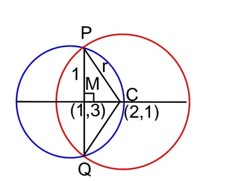
The equation of the common tangent touching the circle (x-3)2 + y2 = 9 and the parabola y2 = 4x above the x-axis, is
<!-- [if !supportLineBreakNewLine]-->
<!--[endif]-->
The equation of the common tangent touching the circle (x-3)2 + y2 = 9 and the parabola y2 = 4x above the x-axis, is
<!-- [if !supportLineBreakNewLine]-->
<!--[endif]-->
y² = 4x
(x - 3)² + y² = 9
y = mx + 1/m
(3, 0), r = 3
|3m + 1/m| / √ (1+m²) = 3
9m² + 1/m² + 6 = 9 (1+m²)
9m² + 1/m² + 6 = 9 + 9m²
1/m² = 3 ⇒ m = ±1/√3
m = 1/√3 in first quadrant
y = x/√3 + √3 ⇒ √3y = x + 3
Upvote The area (in sq. units) of the part of the circle <!-- [if gte mso 9]><xml>
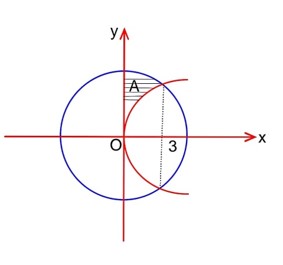
The area (in sq. units) of the part of the circle <!-- [if gte mso 9]><xml>
x2 + y2 = 36 ……(i)
y2 = 9x .(ii)
Solving (i) & (ii)
x2 + 9x – 36 = 0
(x + 12) (x – 3) = 0
x = 3
Let
Required area =
&
Upvote