
Conic Sections
Get insights from 199 questions on Conic Sections, answered by students, alumni, and experts. You may also ask and answer any question you like about Conic Sections
- 199
Questions
- 0
Discussions
- 0
Active Users
- 0
Followers
Have a question about Conic Sections? Ask our experts
Keep it short & simple. Type complete word. Avoid abusive language.
An ellipse whose length of minor axis is equal to half of length between foci, then eccentricity is
An ellipse whose length of minor axis is equal to half of length between foci, then eccentricity is
ae = 2b
Or 4 (1 – e2) = e2
4 = 5e2 ->
 Upvote

The range of r for which circles (x + 1)2 + (y + 2)2 = r2 and x2 + y2 – 4x – 4y + 4 = 0 coincide at two distinct points
The range of r for which circles (x + 1)2 + (y + 2)2 = r2 and x2 + y2 – 4x – 4y + 4 = 0 coincide at two distinct points
If two circles intersect at two distinct points
->|r1 – r2| < C1C2 < r1 + r2
| r – 2| < < r + 2
|r – 2| < 5 and r + 2 > 5
–5 < r – 2 < 5 r > 3 … (2)
–3 < r < 7 … (1)
From (1) and (2)
3 < r < 7
Upvote If hyperbola and ellipse x2 – y2cosec2q = 5 and ellipse x2cosec2q + y2 = 5 has eccentricity eH and ee respectively and eH = <!-- [if gte mso 9]><xml>
If hyperbola and ellipse x2 – y2cosec2q = 5 and ellipse x2cosec2q + y2 = 5 has eccentricity eH and ee respectively and eH = <!-- [if gte mso 9]><xml>
x2 – y2 cosec2q = 5
x2 cosec2q + y2 = 5
and &n
Upvote A parabola has vertex (2, 3), equation of directrix is 2x – y = 1 and equation of ellipse is <!-- [if gte mso 9]><xml>
A parabola has vertex (2, 3), equation of directrix is 2x – y = 1 and equation of ellipse is <!-- [if gte mso 9]><xml>
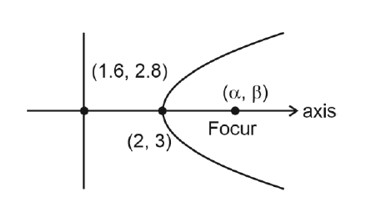
Slope of axis =
⇒ 2y – 6 = x – 2
⇒ 2y – x – 4 = 0
2x + y – 6 = 0
4x + 2y – 12 = 0
α + 1.6 = 4 ⇒ α = 2.4
β + 2.8 = 6 ⇒
Upvote The locus of the point of intersection of the lines = 0 is a conic, whose eccentricity is…………………
The locus of the point of intersection of the lines = 0 is a conic, whose eccentricity is…………………
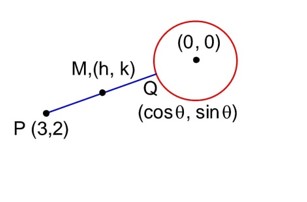
Let A(1, 4) and B(1, -5) be two points. Let P be a point on the circle <!-- [if gte mso 9]><xml>
Let A(1, 4) and B(1, -5) be two points. Let P be a point on the circle <!-- [if gte mso 9]><xml>
= 2 cos2 θ + 2 sin2 θ + 6 sin θ + 45
= 6 sin θ + 47
for maximum of PA2 + PB2, sin q = 1
then P (1, 2)
Hence P, A & B will lie on a straight line.
Upvote Let C be a circle passing through the points A(2, -1) and B(3, 4). The line segment AB is not a diameter of C. If r is the radius of C and its centre lies on the circle , then r2 is equal to:
Let C be a circle passing through the points A(2, -1) and B(3, 4). The line segment AB is not a diameter of C. If r is the radius of C and its centre lies on the circle , then r2 is equal to:
Equation of perpendicular bisector of AB is
Solving it with equation of given circle
But
because AB is not the diameter.
So, centre will be
Now,
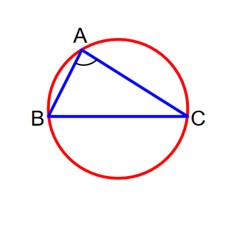
Upvote Let a triangle ABC be inscribed in the circle such that If the length of side AB is then the area of the is equal to:
Let a triangle ABC be inscribed in the circle such that If the length of side AB is then the area of the is equal to:
Let P : y2 = 4ax, a > 0 be a parabola with focus S. Let the tangents to the parabola P make an angle of with the line y = 3x + 5 touch the parabola P at A and B. Then the value of a for which A, B and S are collinear is
Let P : y2 = 4ax, a > 0 be a parabola with focus S. Let the tangents to the parabola P make an angle of with the line y = 3x + 5 touch the parabola P at A and B. Then the value of a for which A, B and S are collinear is
Tangents making angle with y = 3x + 5.
So, these tangents are . So ASB is a focal chord.
Upvote Let a triangle ABC be inscribed in the circle such that If the length of side AB is then the area of the is equal to:
Let a triangle ABC be inscribed in the circle such that If the length of side AB is then the area of the is equal to:
here AB = , BC = 2, AC =
area =
Upvote