
Equilibrium
Get insights from 241 questions on Equilibrium, answered by students, alumni, and experts. You may also ask and answer any question you like about Equilibrium
- 241
Questions
- 0
Discussions
- 0
Active Users
- 0
Followers
Have a question about Equilibrium? Ask our experts
Keep it short & simple. Type complete word. Avoid abusive language.
An equilibrium mixture contains 2.0 moles of A(g) and 4.0 moles of B(g). Now, 2.0 moles of A(g) is added in this equilibrium mixture and the system is allowed to re-achieve equilibrium at constant volume and temperature. Now, the volume of system is doubled at constant temperature. What should be the moles of B(g) at new equilibrium? The reaction involved is
.
New Eqm
=
Now, KC = constant
mole of B at new Eqm = 4 + 2Z = 6.58
 Upvote

From Reaction
Δn? = 2 – 1 = 1
Kp = Kc (RT)^Δn?
Kp = Kc (RT)¹
Kc = Kp (RT)? ¹
Upvote Arrange the following solutions in the decreasing order of pH :
(1) 0.1 NaOH
(2) 0.1 M NaCl
(3) 0.1 M H2SO4
(4) 0.1 M NH4Cl
Arrange the following solutions in the decreasing order of pH :
(1) 0.1 NaOH
(2) 0.1 M NaCl
(3) 0.1 M H2SO4
(4) 0.1 M NH4Cl
All have same molarity, pH ∝ 1/ (Acidic strength) ∝ Basic strength
H? SO? → Acidic
NH? Cl (Salt of weak base and strong acid)
Acidic but less than H? SO?
NaCl → (Neutral solution)
NaOH → Basic (Strong Base)
So NaOH > NaCl > NH? Cl > H? SO?
Upvote The increasing order of pk_b values of the following compounds is:
<!-- [if !supportLineBreakNewLine]--><!--[endif]-->
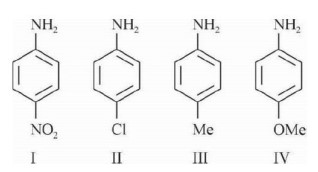
The increasing order of pk_b values of the following compounds is:
<!-- [if !supportLineBreakNewLine]--><!--[endif]-->
and basic strength ∝ 1/pK? ∝ K? ∝ +R ∝ 1/ (-R) ∝ +I ∝ 1/ (-I)
So basic strength order ⇒ IV > III > II > I, so pK? order is IV < III < II < I
Upvote At 1990K and 1 atm pressure, there are equal number of Cl2 molecules and Cl atoms in the reaction mixture. The value of KP for the reaction Cl2(g) <!-- [if gte mso 9]><xml>
At 1990K and 1 atm pressure, there are equal number of Cl2 molecules and Cl atoms in the reaction mixture. The value of KP for the reaction Cl2(g) <!-- [if gte mso 9]><xml>
Initially -> 1 mol -
At eq.
Upvote 0.25 M solution of pyridinium chloride C₅H₆N⁺Cl⁻ was found to have a pH of 2.699. if the value of Kₑ of pyridine C₅H₅N is a × 10⁻¹⁰, then the value of a is (given, 10⁻².⁶⁹⁹ = 2 × 10⁻³)
0.25 M solution of pyridinium chloride C₅H₆N⁺Cl⁻ was found to have a pH of 2.699. if the value of Kₑ of pyridine C₅H₅N is a × 10⁻¹⁰, then the value of a is (given, 10⁻².⁶⁹⁹ = 2 × 10⁻³)
BCl → B? + Cl?
B? + H? O? BOH + H? , K? = K? /K?
0.25 – –
(0.25 – x) x
Given, pH = 2.7 = [H? ] = 2 × 10? ³
∴ x²/ (0.25) = (10? ¹? )/K?
= 4 × 10? × 4 × K? = 10? ¹?
= K? = (1/16) × 10? = 6.25 × 10? ¹?
Upvote Given below are two statements:
Statement I: A unit formed by the attachment of a base to 1' position of sugar is known as nucleoside
Statement II: When nucleoside is linked to phosphorous acid at 5'-position of sugar moiety, we get nucleotide.
In the light of the above statements, choose the correct answer from the options given below:
<!-- [if !supportLineBreakNewLine]-->
<!--[endif]-->
Given below are two statements:
Statement I: A unit formed by the attachment of a base to 1' position of sugar is known as nucleoside
Statement II: When nucleoside is linked to phosphorous acid at 5'-position of sugar moiety, we get nucleotide.
In the light of the above statements, choose the correct answer from the options given below:
<!-- [if !supportLineBreakNewLine]-->
<!--[endif]-->
When nucleoside is linked to phosphoric acid at 5 '-position of sugar moiety, we get nucleotide.
Upvote Match List - I with List - II
<!--[endif]-->
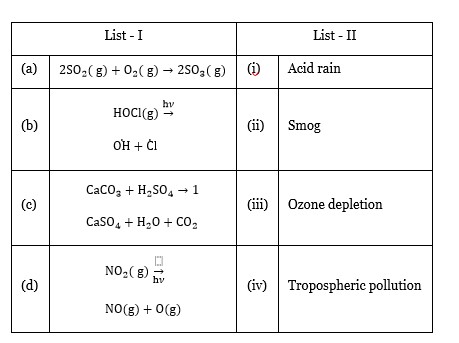
Choose the correct answer from the options given below.
<!-- [if !supportLineBreakNewLine]-->
<!--[endif]-->
Match List - I with List - II
<!--[endif]-->
Choose the correct answer from the options given below.
<!-- [if !supportLineBreakNewLine]-->
<!--[endif]-->
| List-I | | List-II |
| :- | :- | :- |
| (a) 2SO? (g) + O? (g) → 2SO? (g) | (iv) | Tropospheric pollution |
| (b) HOCl (g) - (hν)->? H +? l | (iii) | Ozone depletion |
| (c) CaCO? + H? SO? → | (i) CaSO? + H? O + CO? | Acid rain |
| (d) NO? (g) - (hν)-> NO (g) + O (g) | (ii) | Smog |
Upvote The major product formed in dehydrohalogenation reaction of 2-Bromo pentane is Pent-2-ene. This product formation is based on?
<!-- [if !supportLineBreakNewLine]-->
<!--[endif]-->
The major product formed in dehydrohalogenation reaction of 2-Bromo pentane is Pent-2-ene. This product formation is based on?
<!-- [if !supportLineBreakNewLine]-->
<!--[endif]-->
(Pent-2-ene)
(Major product by Saytzeff's rule)
Upvote