
General Principles & Processes of Isolating Elemen
Get insights from 111 questions on General Principles & Processes of Isolating Elemen, answered by students, alumni, and experts. You may also ask and answer any question you like about General Principles & Processes of Isolating Elemen
- 111
Questions
- 0
Discussions
- 0
Active Users
- 0
Followers
Have a question about General Principles & Processes of Isolating Elemen? Ask our experts
Keep it short & simple. Type complete word. Avoid abusive language.
To an aqueous solution containing ions such as Al³⁺, Zn²⁺, Ca²⁺, Fe³⁺, Ni²⁺, Ba²⁺ and Cu²⁺ was added conc. HCl, followed by H₂S.
The total number of cations precipitated during this reaction is / are:
To an aqueous solution containing ions such as Al³⁺, Zn²⁺, Ca²⁺, Fe³⁺, Ni²⁺, Ba²⁺ and Cu²⁺ was added conc. HCl, followed by H₂S.
The total number of cations precipitated during this reaction is / are:
(H? S + dil HCl) is 2nd group reagent so Cu²? get precipitated as CuS.
 Upvote

The addition of silica during the extraction of copper from its sulphide ore
The addition of silica during the extraction of copper from its sulphide ore
FeO (Impurities) + SiO? (Flux) → FeSiO? (Iron silicate) Slag
Upvote On balancing the given redox reaction, aCr₂O₇²⁻(aq) + bSO₃²⁻(aq) + cH⁺(aq) → 2aCr³⁺(aq) + bSO₄²⁻(aq) + c/2H₂O(l) the coefficients a, b and c are found to be, respectively:
On balancing the given redox reaction, aCr₂O₇²⁻(aq) + bSO₃²⁻(aq) + cH⁺(aq) → 2aCr³⁺(aq) + bSO₄²⁻(aq) + c/2H₂O(l) the coefficients a, b and c are found to be, respectively:
Reduction half reaction.
Cr? O? ²? + 14H? + 6e? → 2Cr? ³ + 7H? O
Oxidation half reaction
SO? ²? + H? O → SO? ²? + 2e? ] × 3
Oxygen is balanced by adding water and hydrogen is balanced by adding H? and the charge is balanced by electrons.
Add ( eq. (i) + (3 × eq. (ii) )
Cr? O? ²? + 3SO? ²? + 8H? → 2Cr? ³ +
Upvote Match List - I with List - II
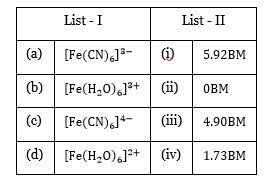
Choose the correct answer from the options given below.
<!-- [if !supportLineBreakNewLine]-->
<!--[endif]-->
Match List - I with List - II
Choose the correct answer from the options given below.
<!-- [if !supportLineBreakNewLine]-->
<!--[endif]-->
[Fe (CN)? ]? ³ Fe? ³ = 3d?
Unpaired electron = 1, μ = 1.7BM
[Fe (H? O)? ]? ³ Fe? ³ = 3d?
Unpaired electrons = 5, μ = 5.9BM
[Fe (CN)? ]? Fe? ² = 3d?
Unpaired electron = 0, μ = 0BM
[Fe (H? O)? ]? ² Fe? ² = 3d?
Unpaired electrons = 4, μ = 4.9BM
Upvote Match List -I with List -II
List -I (Ores)
(a) Haematite
(b) Magnetite
(c) Calamine
(d) Kaolinite
List-II (Composition)
(i) Fe₃O₄
(ii) ZnCO₃
(iii) Fe₂O₃
(iv) [Al₂(OH)₄Si₂O₅]
Choose the correct answer from the options given below:
Match List -I with List -II
List -I (Ores)
(a) Haematite
(b) Magnetite
(c) Calamine
(d) Kaolinite
List-II (Composition)
(i) Fe₃O₄
(ii) ZnCO₃
(iii) Fe₂O₃
(iv) [Al₂(OH)₄Si₂O₅]
Choose the correct answer from the options given below:
Hematite: Fe? O?
Magnetite: Fe? O?
Calamine: ZnCO?
Kaolinite: [Al? (OH)? Si? O? ]
Upvote The process that involves the removal of sulphur from the ores is:
The process that involves the removal of sulphur from the ores is:
Roasting is a process in which sulphur is removed as SO? gas from sulphide ores on heating in excess of oxygen.
Upvote Which of the following reduction reaction CANNOT be carried out with coke?
Which of the following reduction reaction CANNOT be carried out with coke?
The reduction of aluminum oxide (Al? O? ) is performed through an electrolytic process in its molten state. This method is necessary because Al? O? is a highly ionic and stable compound.
Upvote Match List – I with List – II:
| List – I | List – II |
| :--- | :--- |
| (a) Mercury | (i) Vapour phase refining |
| (b) Copper | (ii) Distillation Refining |
| (c) Silicon | (iii) Electrolytic Refining |
| (d) Nickel | (iv) Zone Refining
Choose the most appropriate answer from the option given below:
<!-- [if !supportLineBreakNewLine]-->
<!--[endif]-->
Match List – I with List – II:
| List – I | List – II |
| :--- | :--- |
| (a) Mercury | (i) Vapour phase refining |
| (b) Copper | (ii) Distillation Refining |
| (c) Silicon | (iii) Electrolytic Refining |
| (d) Nickel | (iv) Zone Refining
Choose the most appropriate answer from the option given below:
<!-- [if !supportLineBreakNewLine]-->
<!--[endif]-->
The following depicts a chemical reaction leading to a Major Product Y.
Mercury has low boiling point so is refined by distillation method.
Copper refining is done through electrolytic refining.
Silicon is refined by zone refining method.
Nickel is refined by vapour phase refining.
Upvote The chemical that is added to reduce the melting point of the reaction mixture during the extraction of aluminium is:
<!-- [if !supportLineBreakNewLine]-->
<!--[endif]-->
The chemical that is added to reduce the melting point of the reaction mixture during the extraction of aluminium is:
<!-- [if !supportLineBreakNewLine]-->
<!--[endif]-->
When we add cryolite (Na? AlF? ) in the extraction of aluminium, the melting point of alumina decreases
Upvote The point of intersection and sudden increase in the slope, in the diagram given below, respectively, indicates:
<!-- [if !supportLineBreakNewLine]-->
<!--[endif]-->
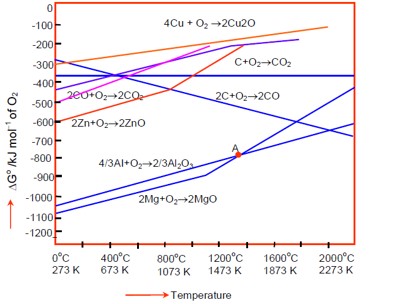
The point of intersection and sudden increase in the slope, in the diagram given below, respectively, indicates:
<!-- [if !supportLineBreakNewLine]-->
<!--[endif]-->
At the point of intersection in an Ellingham diagram? G for two processes becomes equal, so? G for the reduction becomes zero. A sudden increase in the slope indicates a change in the state of the metal oxide, i.e., from solid to liquid or liquid to vapor.
Upvote