
Haloalkanes and Haloarenes
Get insights from 278 questions on Haloalkanes and Haloarenes, answered by students, alumni, and experts. You may also ask and answer any question you like about Haloalkanes and Haloarenes
- 278
Questions
- 0
Discussions
- 0
Active Users
- 0
Followers
Have a question about Haloalkanes and Haloarenes? Ask our experts
Keep it short & simple. Type complete word. Avoid abusive language.
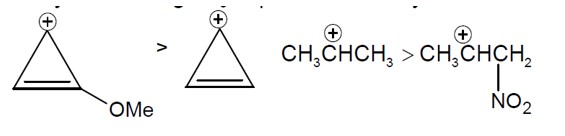
The decreasing order of reactivity of the following organic molecules towards AgNO3 solution is:
(A) Cl
(B) Cl OMe
(C) CH3CHCH3 Cl
(D) CH3CHCH2NO2 Cl

The decreasing order of reactivity of the following organic molecules towards AgNO3 solution is:
(A) Cl
(B) Cl OMe
(C) CH3CHCH3 Cl
(D) CH3CHCH2NO2 Cl
Reactivity towards AgNO? depend on stability of carbocation formed
 Upvote

A mixture of one mole each of <!-- [if gte msEquation 12]>V
<!-- [if !supportLineBreakNewLine]-->
<!--[endif]-->
A mixture of one mole each of <!-- [if gte msEquation 12]>
<!-- [if !supportLineBreakNewLine]-->
<!--[endif]-->
as & constant So
So,
Upvote 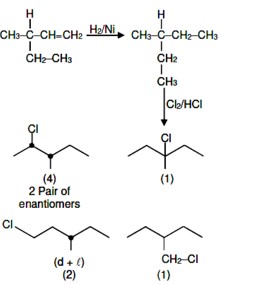
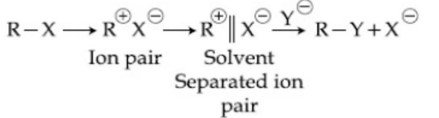
The mechanism of S?1 reaction is given as:
<!-- [if !supportLineBreakNewLine]-->(a) The reaction is favoured by weak nucleophiles.
(b) R⊕ would be easily formed if the substituents are bulky.
(c) The reaction is accompanied by racemization.
(d) The reaction is favoured by non-polar solvents.
Which observations are correct?
<!-- [if !supportLineBreakNewLine]-->
<!--[endif]-->
<!--[endif]-->
The mechanism of S?1 reaction is given as:
<!-- [if !supportLineBreakNewLine]-->(a) The reaction is favoured by weak nucleophiles.
(b) R⊕ would be easily formed if the substituents are bulky.
(c) The reaction is accompanied by racemization.
(d) The reaction is favoured by non-polar solvents.
Which observations are correct?
<!-- [if !supportLineBreakNewLine]-->
<!--[endif]-->
<!--[endif]-->
Above reaction is S?1 reaction as it proceed via formation of carbocation. Polar solvent is more suitable for S?1 and racemisation takes place.
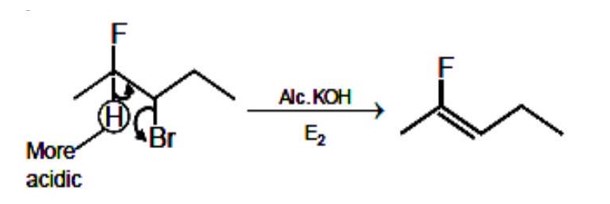
Upvote The major product obtained from E?-elimination of 3-bromo-2-fluoropentane is
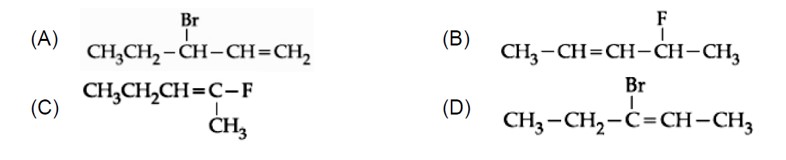
The major product obtained from E?-elimination of 3-bromo-2-fluoropentane is
E2 elimination. Most acidic proton is removed. Fluorine is more electronegative.
Upvote Consider the reaction sequence given below:
<!-- [if !supportLineBreakNewLine]-->
<!--[endif]-->
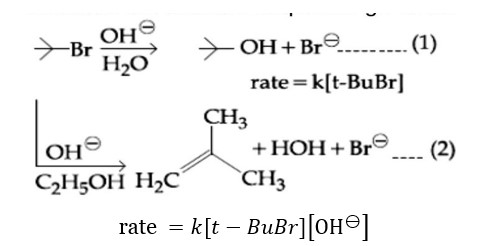
Consider the reaction sequence given below:
<!-- [if !supportLineBreakNewLine]-->
<!--[endif]-->
Reaction (1) is SN1 (rate independent of [OH? ]). Reaction (2) is E2 (rate depends on [OH? ]).
Statement (B) is correct. Changing concentration of base will have no effect on reaction (1).
Upvote