
Haloalkanes and Haloarenes
Get insights from 278 questions on Haloalkanes and Haloarenes, answered by students, alumni, and experts. You may also ask and answer any question you like about Haloalkanes and Haloarenes
- 278
Questions
- 0
Discussions
- 0
Active Users
- 0
Followers
Have a question about Haloalkanes and Haloarenes? Ask our experts
Keep it short & simple. Type complete word. Avoid abusive language.
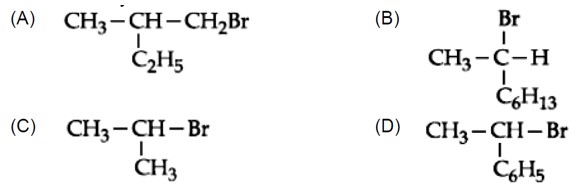
Which of the following compounds will show retention in configuration on nucleophile substitution by OH? ion?
<!-- [if !supportLineBreakNewLine]-->
<!--[endif]-->
Which of the following compounds will show retention in configuration on nucleophile substitution by OH? ion?
<!-- [if !supportLineBreakNewLine]-->
<!--[endif]-->
Reaction path is SN2 because OH? is strong nucleophile, but hydroxyl ion will not attack on chiral centres and so there is retension of configuration.
 Upvote

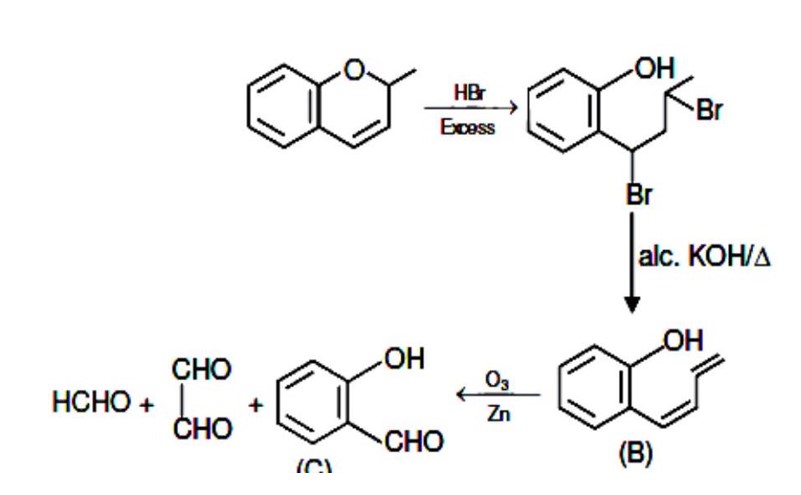
The major aromatic product C<!--[endif]--><!--[endif]--> in the following reaction sequence will be :
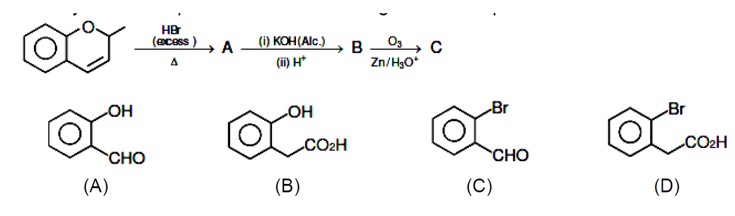
The major aromatic product C<!--[endif]--><!--[endif]--> in the following reaction sequence will be :
For the reaction Fe₂N(s) + (3/2)H₂(g) ⇌ 2Fe(s) + NH₃(g)
For the reaction Fe₂N(s) + (3/2)H₂(g) ⇌ 2Fe(s) + NH₃(g)
Δng=-1/2. Kp=Kc (RT)? ¹/². Kc=Kp (RT)¹/².
Upvote For the following reactions:
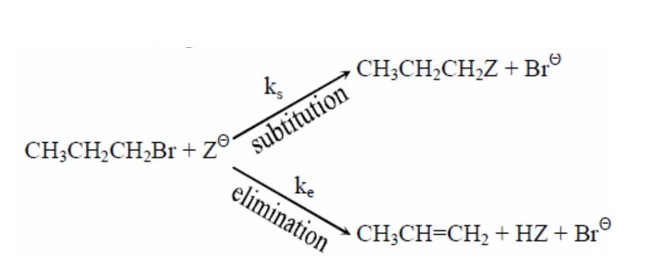
where,
<!-- [if !supportLineBreakNewLine]-->
<!--[endif]-->
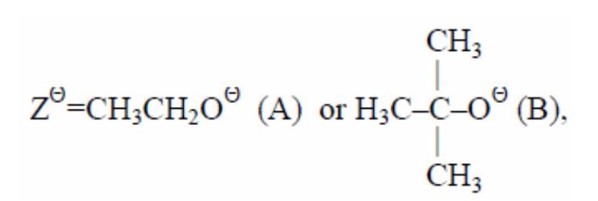
For the following reactions:
where,
<!-- [if !supportLineBreakNewLine]-->
<!--[endif]-->
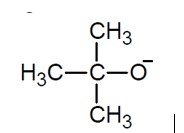
Is bulky base, so elimination is dominating.
Upvote In the following reaction sequence, structures of and respectively will be
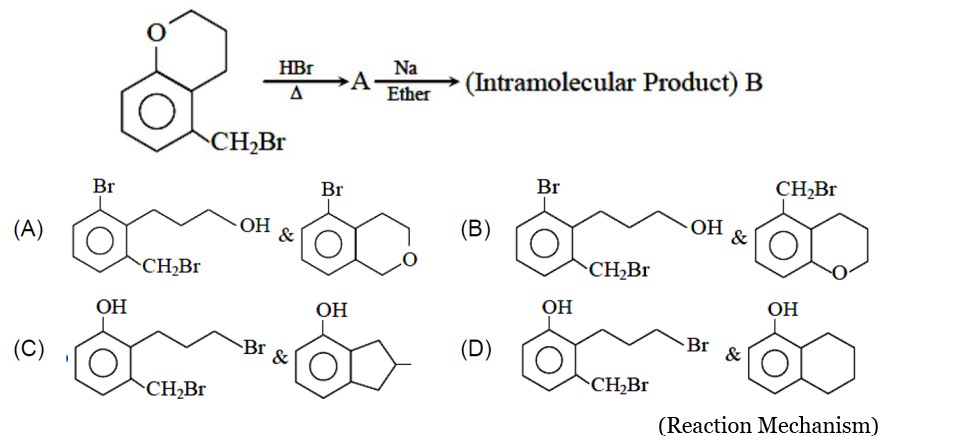
In the following reaction sequence, structures of and respectively will be

Consider the following reactions:
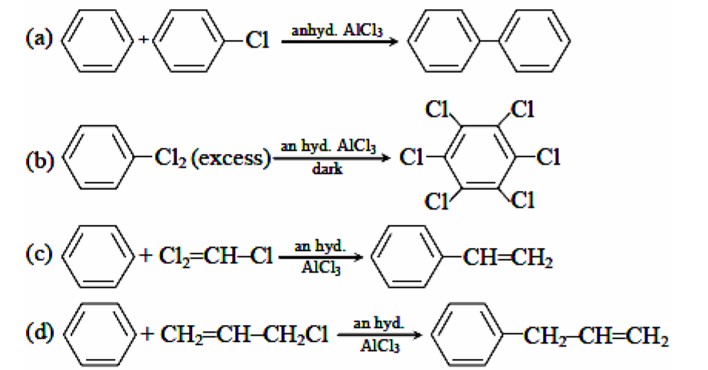
Which of these reactions are possible?
Consider the following reactions:
Which of these reactions are possible?
Carbon-chlorine bond cleavage is not possible in
Upvote An organic compound is subjected to chlorination to get compound A using 5.0 g of chlorine. When 0.5 g of compound A is reacted with AgNO₃ [Carius Method], the percentage of chlorine in compound A is _______ when it forms 0.3849 g of AgCl (Round off to the Nearest integer) (Atomic masses of Ag and Cl are 107.87 and 35.5 respectively)
An organic compound is subjected to chlorination to get compound A using 5.0 g of chlorine. When 0.5 g of compound A is reacted with AgNO₃ [Carius Method], the percentage of chlorine in compound A is _______ when it forms 0.3849 g of AgCl (Round off to the Nearest integer) (Atomic masses of Ag and Cl are 107.87 and 35.5 respectively)
Organic compound + Cl? → A (Containing Cl)
5gm
A + AgNO? → AgCl
0.5 gm → 0.3849gm
Mole of AgCl = 0.3849 / 143.32
Mass of Cl = (0.3849/143.32) × 35.5 ≈ 0.095
% of Cl in A = (0.095/0.5) × 100 = 19%
Upvote
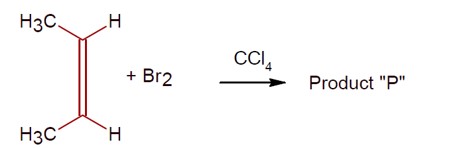
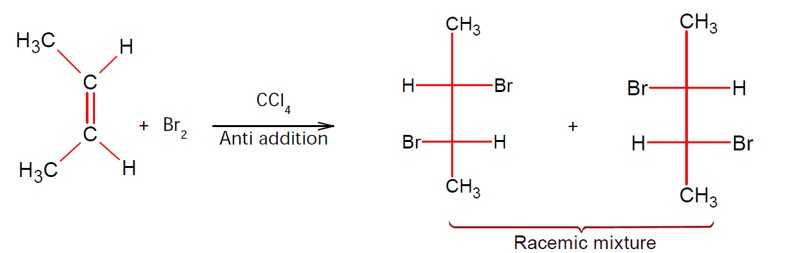
Consider the above chemical reaction. The total number of stereoisomers possible for product 'P' is __________.
Consider the above chemical reaction. The total number of stereoisomers possible for product 'P' is __________.
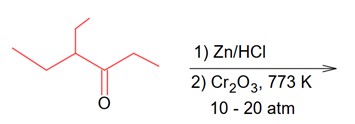
Considering the above reaction, the major product among the following is:
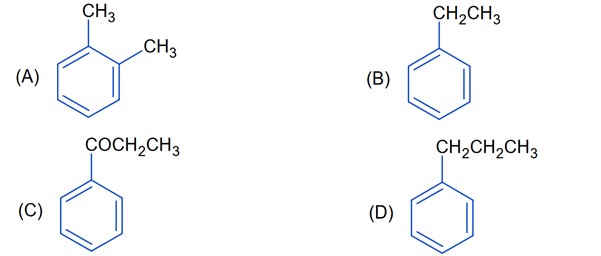
Considering the above reaction, the major product among the following is:
Kindly consider the following figure
Upvote 
Kindly consider the following figure
Upvote