
Haloalkanes and Haloarenes
Get insights from 278 questions on Haloalkanes and Haloarenes, answered by students, alumni, and experts. You may also ask and answer any question you like about Haloalkanes and Haloarenes
- 278
Questions
- 0
Discussions
- 0
Active Users
- 0
Followers
Have a question about Haloalkanes and Haloarenes? Ask our experts
Keep it short & simple. Type complete word. Avoid abusive language.
Find out total possible optical isomers of 2-chlorobutane.
Find out total possible optical isomers of 2-chlorobutane.
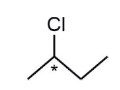
There is one chiral centre present in given compound which is unsymmetrical.
Total number of isomers = 2n
n = number of stereogenic centre
 Upvote

Assertion (A): KCN react with R-X to give cyanide and AgCN reacts with R - X to give isocyanide mainly.
Reason (R): KCN and AgCN both are ionic compounds
Assertion (A): KCN react with R-X to give cyanide and AgCN reacts with R - X to give isocyanide mainly.
Reason (R): KCN and AgCN both are ionic compounds
KCN
R – X + KCN
R – X + AgCN
KCN is ionic th
Upvote
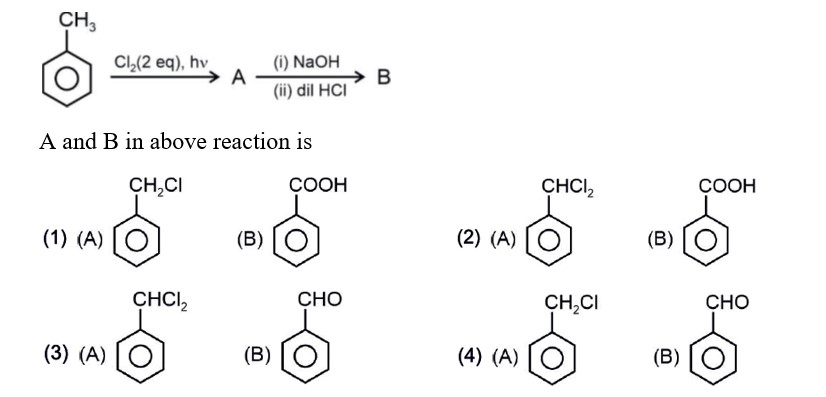
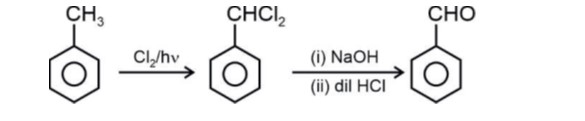
A and B in above reaction:
A and B in above reaction:
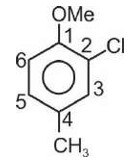
Which of the following is most likely attacked by electrophile?
Which of the following is most likely attacked by electrophile?
Order of reactivity towards electrophile
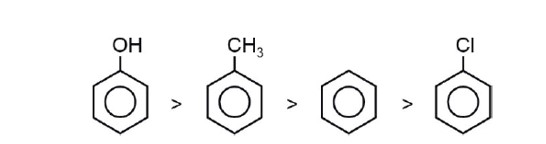
Strength of +M/+R : –OH > –CH3 > –Cl
In case of halogens, their –I effect dominates over
+M hence –Cl is deactivating and is lesser reactive than for incoming electrophile.
Upvote What is the product formed in the below given reaction?
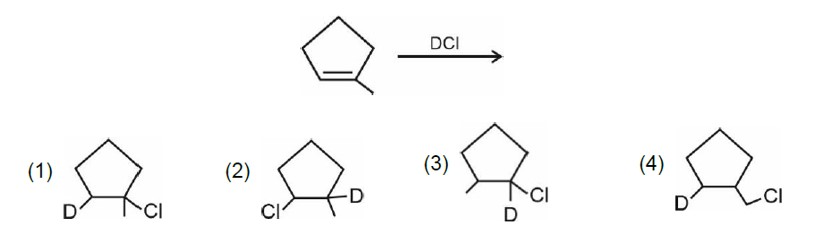
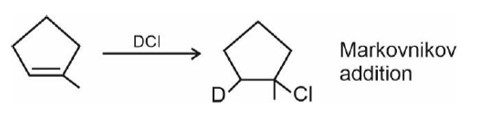
What is the product formed in the below given reaction?
Which of the following compounds is optically active?
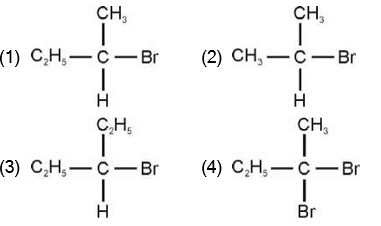
Which of the following compounds is optically active?
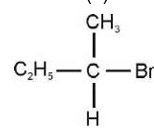
is optically active as it does not contain any element of symmetry.
Upvote Benzotrichloride on reaction with aq. KOH followed by hydrolysis gives
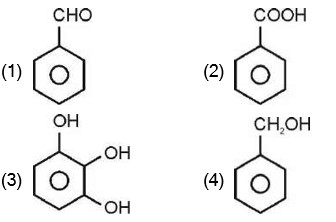
Benzotrichloride on reaction with aq. KOH followed by hydrolysis gives

Consider the following chlorides
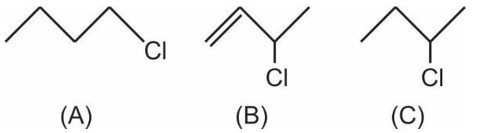
The correct order of reactivity towards SN1 reaction is
Consider the following chlorides
The correct order of reactivity towards SN1 reaction is
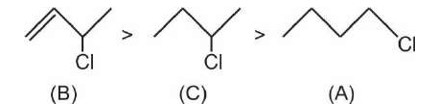
Higher is the stability of carbocation, greater is the reactivity towards SN1.
Therefore, Correct order of reactivity towards SN1 reaction is
Upvote 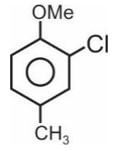
0.16 g of an organic compound gave 0.094 g of AgBr by Carius method. The percentage of Br in the compound is (Atomic mass of Ag = 108 u, Br = 80 u)
0.16 g of an organic compound gave 0.094 g of AgBr by Carius method. The percentage of Br in the compound is (Atomic mass of Ag = 108 u, Br = 80 u)
Percentage Br = 80*0.094/188*0.16*100=25%
Upvote