
Hydrocarbons
Get insights from 111 questions on Hydrocarbons, answered by students, alumni, and experts. You may also ask and answer any question you like about Hydrocarbons
- 111
Questions
- 0
Discussions
- 0
Active Users
- 0
Followers
Have a question about Hydrocarbons? Ask our experts
Keep it short & simple. Type complete word. Avoid abusive language.
In the following questions two or more options may be correct.
(i) CH4 + O2 → CO2 (g) + 2H2O (l)
(ii) CH4 + O2 → C (s) + 2H2O (l)
(iii) CH4 + O2  HCHO + H2O
(iv) 2CH4 + O2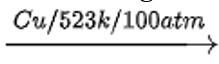 2CH3OH
In the following questions two or more options may be correct.
(i) CH4 + O2 → CO2 (g) + 2H2O (l)
(ii) CH4 + O2 → C (s) + 2H2O (l)
(iii) CH4 + O2 HCHO + H2O
(iv) 2CH4 + O22CH3OH
This is a multiple choice answer as classified in NCERT Exemplar
(iii) & (iv) Methane is a controlled oxidation reaction that leads to giving formaldehyde and methanol.
 Upvote

Which of the following reactions of methane is incomplete combustion:
(i) 2CH4 + O2 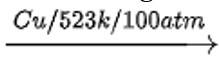 2CH3OH
(ii) CH4 + O2 HCHO + H2O
(iii) CH4 + O2 → C (s) + 2H2O (l)
(iv) CH4 + O2 → CO2 (g) + 2H2O (l)
Which of the following reactions of methane is incomplete combustion:
(i) 2CH4 + O2 2CH3OH
(ii) CH4 + O2 HCHO + H2O
(iii) CH4 + O2 → C (s) + 2H2O (l)
(iv) CH4 + O2 → CO2 (g) + 2H2O (l)
This is a multiple choice answer as classified in NCERT Exemplar
(iii) As the unburn carbon left out in this reaction thus it is an incomplete reaction
Upvote Arrange the following alkyl halides in decreasing order of the rate of β– elimination reaction with alcoholic KOH.
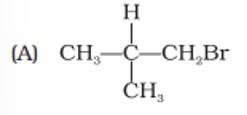
(B) CH3—CH2—Br
(C) CH3—CH2—CH2—Br
(i) A > B > C
(ii) C > B > A
(iii) B > C > A
(iv) A> C > B
Arrange the following alkyl halides in decreasing order of the rate of β– elimination reaction with alcoholic KOH.

(B) CH3—CH2—Br
(C) CH3—CH2—CH2—Br
(i) A > B > C
(ii) C > B > A
(iii) B > C > A
(iv) A> C > B
This is a multiple choice answer as classified in NCERT Exemplar
(iv) The order of reactivity of β– elimination reaction is 3o>2o>1o
Upvote Arrange the following carbanions in order of their decreasing stability.
(A) H3C - C ≡ C -(B) H - C ≡ C - (C) H3C - CH2
(i) A > B > C
(ii) B > A > C
(iii) C > B > A
(iv) C > A > B
Arrange the following carbanions in order of their decreasing stability.
(A) H3C - C ≡ C -(B) H - C ≡ C - (C) H3C - CH2
(i) A > B > C
(ii) B > A > C
(iii) C > B > A
(iv) C > A > B
This is a multiple choice answer as classified in NCERT Exemplar
(ii) The electronegativity of sp hybridization is higher than that of sp3 hybridization.
The +I effect destabilizes the carbanion.
Upvote Arrange the following hydrogen halides in order of their decreasing reactivity with propene.
(i) HCl>HBr> HI
(ii) HBr> HI >HCl
(iii) HI >HBr>HCl
(iv) HCl> HI >HBr
Arrange the following hydrogen halides in order of their decreasing reactivity with propene.
(i) HCl>HBr> HI
(ii) HBr> HI >HCl
(iii) HI >HBr>HCl
(iv) HCl> HI >HBr
This is a multiple choice answer as classified in NCERT Exemplar
(iii) The addition of alkyl halides to propene depends upon the H-X bond strength i.e. lesser the bond strength higher will be the reactivity of the alkyl halide. As down the group size of the halogens increases thus the bond stre
Upvote Which of the following will not show geometrical isomerism?
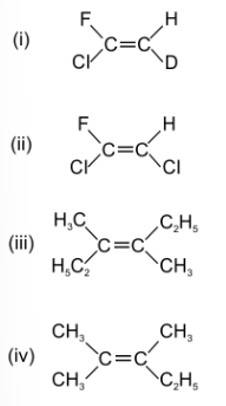
Which of the following will not show geometrical isomerism?

This is a multiple choice answer as classified in NCERT Exemplar
(iv) The two substituents attached to the same C atom of the C=C bond should be different to exhibit geometrical isomerisms.
Upvote The addition of HBr to 1-butene gives a mixture of products A, B and C
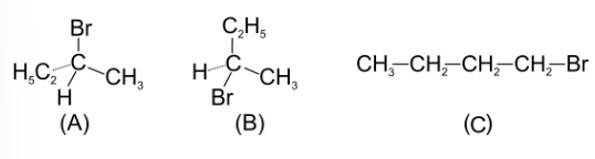
The mixture consists of
(i) A and B as major and C as minor products
(ii) B as major, A and C as minor products
(iii) B as minor, A and C as major products
(iv) A and B as minor and C as major products
The addition of HBr to 1-butene gives a mixture of products A, B and C
The mixture consists of
(i) A and B as major and C as minor products
(ii) B as major, A and C as minor products
(iii) B as minor, A and C as major products
(iv) A and B as minor and C as major products
This is a multiple choice answer as classified in NCERT Exemplar
(i) The reaction follows Markovnikov's rule leading to giving 2o carbocation as an intermediate.
Upvote The correct IUPAC name of the following alkane is
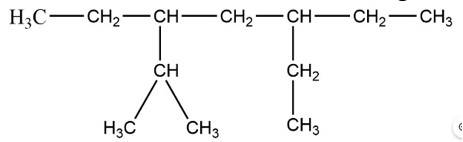
(i) 3, 6 – Diethyl – 2 – methyl octane
(ii) 5 – Isopropyl – 3 – ethyl octane
(iii) 3 – Ethyl – 5 – isopropyl octane
(iv) 3 – Isopropyl – 6 – ethyl octane
The correct IUPAC name of the following alkane is
(i) 3, 6 – Diethyl – 2 – methyl octane
(ii) 5 – Isopropyl – 3 – ethyl octane
(iii) 3 – Ethyl – 5 – isopropyl octane
(iv) 3 – Isopropyl – 6 – ethyl octane
This is a multiple choice answer as classified in NCERT Exemplar
(i) 3, 6 – Diethyl – 2 – methyl octane
Octane is the longest chain here and the side chain follows the lowest sum rule.
Upvote The increasing order of reduction of alkyl halides with zinc and dilute HCl is
(i) R–Cl< R–I < R–Br
(ii) R–Cl< R–Br < R–I
(iii) R–I < R–Br < R–Cl
(iv) R–Br< R–I < R–Cl
The increasing order of reduction of alkyl halides with zinc and dilute HCl is
(i) R–Cl< R–I < R–Br
(ii) R–Cl< R–Br < R–I
(iii) R–I < R–Br < R–Cl
(iv) R–Br< R–I < R–Cl
This is a multiple choice answer as classified in NCERT Exemplar
(ii) R–Cl< R–Br < R–I
The reduction of alkyl halides depends upon the C-X bond strength i.e. lesser the bond strength higher will be the reactivity of alkyl halide. As down the group size of the halogens increases thus the bond strength decreases.
Upvote Arrange the halogens F2, Cl2, Br2, I2, in order of their increasing reactivity with alkanes.
(i) I2< Br2< Cl2< F2
(ii) Br2< Cl2< F2< I2
(iii) F2< Cl2< Br2< I2
(iv) Br2< I2 < Cl2< F2
Arrange the halogens F2, Cl2, Br2, I2, in order of their increasing reactivity with alkanes.
(i) I2< Br2< Cl2< F2
(ii) Br2< Cl2< F2< I2
(iii) F2< Cl2< Br2< I2
(iv) Br2< I2 < Cl2< F2
This is a multiple choice answer as classified in NCERT Exemplar
(i) I2< Br2< Cl2< F2
The reactivity of halogens with alkanes depends on the electronegativity i.e. higher the electronegativity higher would be the reaction. As down the group reactivity decrease so thus its reactivity.
Upvote