
Hydrocarbons
Get insights from 111 questions on Hydrocarbons, answered by students, alumni, and experts. You may also ask and answer any question you like about Hydrocarbons
- 111
Questions
- 0
Discussions
- 0
Active Users
- 0
Followers
Have a question about Hydrocarbons? Ask our experts
Keep it short & simple. Type complete word. Avoid abusive language.
Arrange the following in decreasing order of their boiling points.
(A) n–butane
(B) 2–methylbutane
(C) n-pentane
(D) 2,2–dimethylpropane
(i) A > B > C > D
(ii) B > C > D > A
(iii) D > C > B > A
(iv) C > B > D > A
Arrange the following in decreasing order of their boiling points.
(A) n–butane
(B) 2–methylbutane
(C) n-pentane
(D) 2,2–dimethylpropane
(i) A > B > C > D
(ii) B > C > D > A
(iii) D > C > B > A
(iv) C > B > D > A
This is a multiple choice answer as classified in NCERT Exemplar
(iv) C > B > D > A
The boiling point increases with the increase in the length of the side chain. However, with the branching, the boiling point decreases due to the decrease in the surface area.
 Upvote

An alkane C8H18 is obtained as the only product on subjecting a primary alkyl halide to Wurtz reaction. On monobromination this alkane yields a single isomer of a tertiary bromide. Write the structure of alkane and the tertiary bromide.
An alkane C8H18 is obtained as the only product on subjecting a primary alkyl halide to Wurtz reaction. On monobromination this alkane yields a single isomer of a tertiary bromide. Write the structure of alkane and the tertiary bromide.
This is a short answer type question as classified in NCERT Exemplar
The reaction is

The alkane is

The tertiary bromide is
 Upvote
Write hydrocarbon radicals that can be formed as intermediates during monochlorination of 2-methylpropane? Which of them is more stable? Give reasons
Write hydrocarbon radicals that can be formed as intermediates during monochlorination of 2-methylpropane? Which of them is more stable? Give reasons
This is a short answer type question as classified in NCERT Exemplar
The 2-methylpropane would lead to two types of radicals.
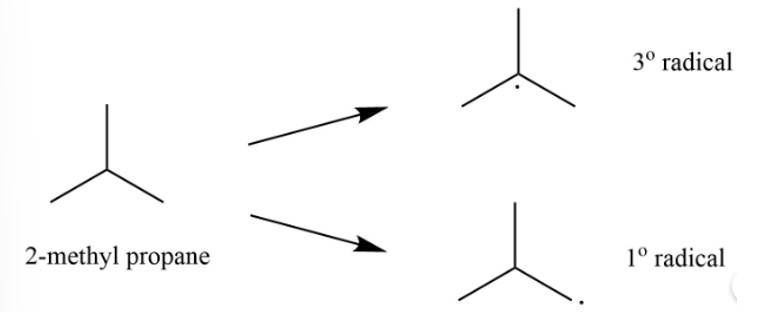
Among the two 3o radical is most stable as it contains 9 ∝ -hydrogen whereas 1o radical contains only 1 ∝ -hydrogen.
Upvote Write the structures and names of products obtained in the reactions of sodium with a mixture of 1-iodo-2-methylpropane and 2-iodopropane.
Write the structures and names of products obtained in the reactions of sodium with a mixture of 1-iodo-2-methylpropane and 2-iodopropane.
This is a short answer type question as classified in NCERT Exemplar
It is a Wurtz reaction where alkane is formed.

 Upvote
The relative reactivity of 1°, 2°, 3° hydrogen’s towards chlorination is 1 : 3.8 : 5. Calculate the percentages of all monochlorinated products obtained from 2-methylbutane.
The relative reactivity of 1°, 2°, 3° hydrogen’s towards chlorination is 1 : 3.8 : 5. Calculate the percentages of all monochlorinated products obtained from 2-methylbutane.
This is a short answer type question as classified in NCERT Exemplar
The structure of 2-methylbutane is

2-methylbutane
Total number | Total amount of monochlorinated Product | % of monochlorinated product | |
1° | 9 | 9 | 41.7 |
2° | 2 | 7.6 | 35.2 |
3° | 1 | 5 | 23.1 |
Upvote Nucleophiles and electrophiles are reaction intermediates having electron rich and electron deficient centres respectively. Hence, they tend to attack electron deficient and electron rich centres respectively. Classify the following species as electrophiles and nucleophiles.

Nucleophiles and electrophiles are reaction intermediates having electron rich and electron deficient centres respectively. Hence, they tend to attack electron deficient and electron rich centres respectively. Classify the following species as electrophiles and nucleophiles.

This is a short answer type question as classified in NCERT Exemplar
Electrophiles | Nucleophiles |
(iii), (iv), (v) | (i), (ii), (vi), (vii), (viii) |
Upvote Predict the major product (s) of the following reactions and explain their formation.
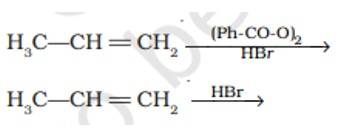
Predict the major product (s) of the following reactions and explain their formation.

This is a short answer type question as classified in NCERT Exemplar
In presence of (Ph-CO-O)2it lead to CH3-CH2-CH2Br as the reaction undergo by free radical mechanism
However in absence of (Ph-CO-O)2 the reaction undergo by carbocation intermediate thus lead to give CH3-CHBr-CH3
Upvote Suggest a route for the preparation of nitrobenzene starting from acetylene?
Suggest a route for the preparation of nitrobenzene starting from acetylene?
This is a short answer type question as classified in NCERT Exemplar
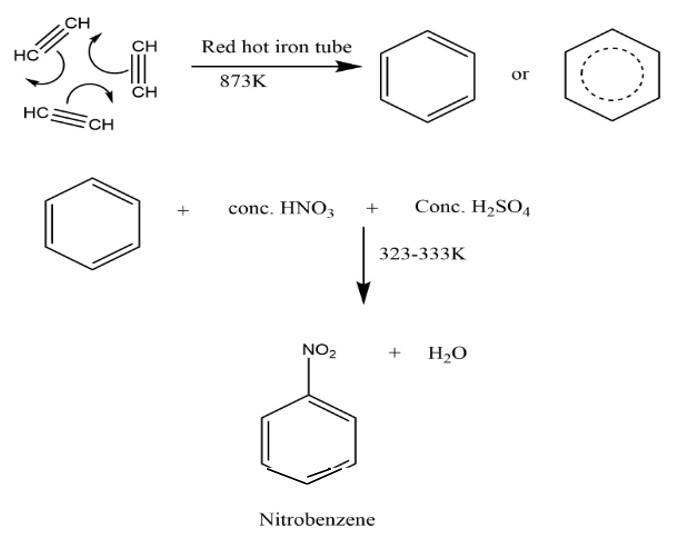
Upvote Why does presence of a nitro group make the benzene ring less reactive in comparison to the unsubstituted benzene ring. Explain.
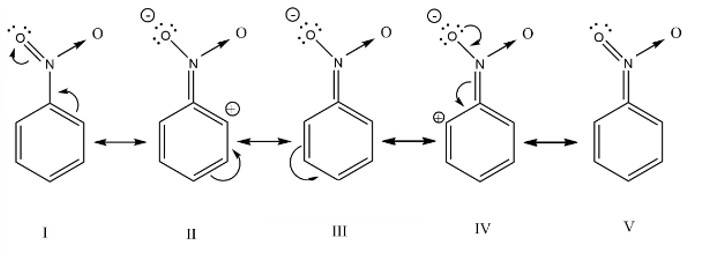
Why does presence of a nitro group make the benzene ring less reactive in comparison to the unsubstituted benzene ring. Explain.
This is a short answer type question as classified in NCERT Exemplar
The nitro group strongly deactivate the benzene towards the electrophilic substitution reaction due to the -R and -I effect
 Upvote
Despite their - I effect, halogens are o- and p-directing in haloarenes. Explain.
Despite their - I effect, halogens are o- and p-directing in haloarenes. Explain.
This is a short answer type question as classified in NCERT Exemplar
Due to the +R effect halogens are ortho and para directing groups.
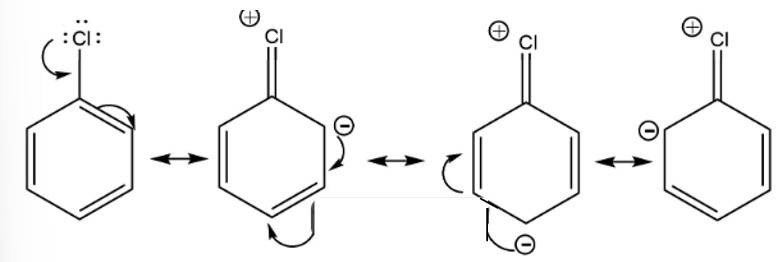 Upvote