
Hydrocarbons
Get insights from 111 questions on Hydrocarbons, answered by students, alumni, and experts. You may also ask and answer any question you like about Hydrocarbons
- 111
Questions
- 0
Discussions
- 0
Active Users
- 0
Followers
Have a question about Hydrocarbons? Ask our experts
Keep it short & simple. Type complete word. Avoid abusive language.
<p><strong>1-methyl ethylene oxide when treated with an excess of <math></math> , produces</strong></p>
<div class="photo-widget-full">
<div class="figure"><picture><source srcset="" media="(max-width: 500px)"><img src="https://images.shiksha.com/mediadata/images/1755771351phpaqOqdO.jpeg" alt="" width="789" height="217" loading="lazy"></picture></div>
</div>
In <!-- [if gte mso 9]><xml>
In <!-- [if gte mso 9]><xml>
Kindly consider the following figure
 Upvote

The formula of a gaseous hydrocarbon which requires 6 times of its own volume of O2 for complete oxidation and produces 4 times its own volume of CO2 is CxHy. The value of y is…………….
The formula of a gaseous hydrocarbon which requires 6 times of its own volume of O2 for complete oxidation and produces 4 times its own volume of CO2 is CxHy. The value of y is…………….
V 6V - -
- - 4V
Volume of CO2 = 4 ×
Vx = 4V
x = 4
Volume of O2 = 6 ×
y = 8
Upvote Which one of the following carbonyl compound cannot be prepared by addition of water on an alkyne in the presence of HgSO2 and H2SO4?
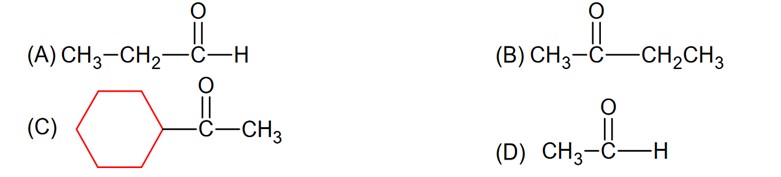
Which one of the following carbonyl compound cannot be prepared by addition of water on an alkyne in the presence of HgSO2 and H2SO4?
Hence
CH3 – CH2 – CHO can’t be formed.
In case of unsymmetrical alkynes, more positive charge stabilizing carbon attacked by H2O and finally converted into carbonyl.
Upvote In the following structures, which one is a having staggered conformation with maximum diheldral angle?
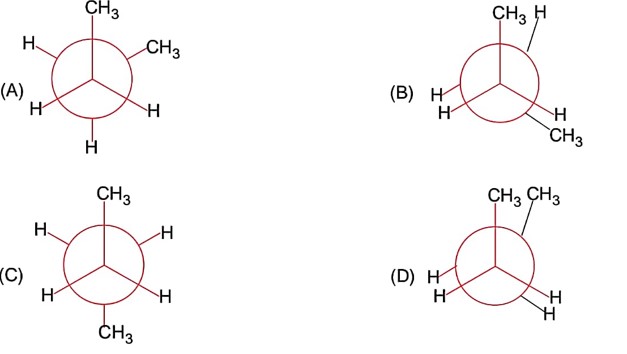
In the following structures, which one is a having staggered conformation with maximum diheldral angle?
(A) and (C) are staggered conformation. In (A) dihedral angle is 60° and in (C) dihedral angle is 180°.
Dihedral angle is angle between two specified groups.
In (C) it has maximum angle.
Upvote Two isomers ‘A’ and ‘B’ with molecular formula C4H8 give different products on oxidation with KMnO4 is acidic medium. Isomer ‘A’ on reaction with KMnO4/H+ results in effervescence of a gas and given ketone. The compound ‘A’ is

Two isomers ‘A’ and ‘B’ with molecular formula C4H8 give different products on oxidation with KMnO4 is acidic medium. Isomer ‘A’ on reaction with KMnO4/H+ results in effervescence of a gas and given ketone. The compound ‘A’ is
C4H8 (DOU = 1 so 1 double bond exist since it gives KMnO4 test)

Upvote <!-- [if gte mso 9]><xml>
A and B in the above atmosphere reaction step are:
<!-- [if gte mso 9]><xml>
A and B in the above atmosphere reaction step are: