
Hydrocarbons
Get insights from 111 questions on Hydrocarbons, answered by students, alumni, and experts. You may also ask and answer any question you like about Hydrocarbons
- 111
Questions
- 0
Discussions
- 0
Active Users
- 0
Followers
Have a question about Hydrocarbons? Ask our experts
Keep it short & simple. Type complete word. Avoid abusive language.
In bromination of Propyne, with Bromine 1, 1, 2, 2-tetrabromopropane is obtained in 27% yield. The amount of 1, 1, 2, 2- tetrabromopropane obtained from 1g of Bromine in this reaction is_______________× 10-1g. (Nearest integer) (Molar mass: Bromine = 80g / mol)
In bromination of Propyne, with Bromine 1, 1, 2, 2-tetrabromopropane is obtained in 27% yield. The amount of 1, 1, 2, 2- tetrabromopropane obtained from 1g of Bromine in this reaction is_______________× 10-1g. (Nearest integer) (Molar mass: Bromine = 80g / mol)
Reaction is
Mass of product, 1, 2, 2- tetrobromopropane obtained
=
= 3.30375
= 3.0375 × 10⁻¹
 Upvote

Assertion (A): Among isomeric pentanes, 2, 2-dimethylpentane has highest boiling point.
Reason (R): Branching does not affect the boiling point.
(i) Both A and R are correct and R is the correct explanation of A.
(ii) Both A and R are correct but R is not the correct explanation of A.
(iii) Both A and R are not correct.
(iv) A is not correct but R is correct.
This is a assertion and reason answer type question as classified in NCERT Exemplar
(iii) With the branching the boiling decreases due to the decrease in surface area which leads to decrease its van there Waals force.
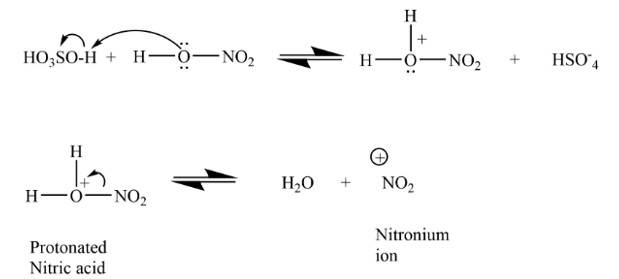
Upvote Assertion (A): Nitration of benzene with nitric acid requires the use of concentrated sulphuric acid.
Reason (R): The mixture of concentrated sulphuric acid and concentrated nitric acid produces the electrophile, NO2 +.
(i) Both A and R are correct and R is the correct explanation of A.
(ii) Both A and R are correct but R is not the correct explanation of A.
(iii) Both A and R are not correct.
(iv) A is not correct but R is correct.
Assertion (A): Nitration of benzene with nitric acid requires the use of concentrated sulphuric acid.
Reason (R): The mixture of concentrated sulphuric acid and concentrated nitric acid produces the electrophile, NO2 +.
(i) Both A and R are correct and R is the correct explanation of A.
(ii) Both A and R are correct but R is not the correct explanation of A.
(iii) Both A and R are not correct.
(iv) A is not correct but R is correct.
This is a assertion and reason answer type question as classified in NCERT Exemplar
(i) The sulphuric acid helps in furnishing NO2+ (electrophile).

 Upvote
Assertion (A): Toluene on Friedal Crafts methylation gives o– and p–xylene.
Reason (R): CH3-group bonded to benzene ring increases electron density at o– and p– position.
(i) Both A and R are correct and R is the correct explanation of A.
(ii) Both A and R are correct but R is not the correct explanation of A.
(iii) Both A and R are not correct.
(iv) A is not correct but R is correct.
This is a assertion and reason answer type question as classified in NCERT Exemplar
(i) The -CH3 group is an activating group and it directs the upcoming substituent to the ortho and para position.
Upvote It is cyclic and has conjugated 8π-electron system but it is not an aromatic compound.
Reason (R) : (4n + 2) π electrons rule does not hold good and ring is not planar.
(i) Both A and R are correct and R is the correct explanation of A.
(ii) Both A and R are correct but R is not the correct explanation of A.
(iii) Both A and R are not correct.
(iv) A is not correct but R is correct.
It is cyclic and has conjugated 8π-electron system but it is not an aromatic compound.
Reason (R) : (4n + 2) π electrons rule does not hold good and ring is not planar.
(i) Both A and R are correct and R is the correct explanation of A.
(ii) Both A and R are correct but R is not the correct explanation of A.
(iii) Both A and R are not correct.
(iv) A is not correct but R is correct.
This is a assertion and reason answer type question as classified in NCERT Exemplar
(i) Because cyclooctatetraene is tubbed shaped.
Upvote Match the reactions given in Column I with the reaction types in Column II.
Column I
Column II
(i) CH2=CH2 + H2O CH3CH2OH
(a) Hydrogenation
(ii) CH2 ≡ CH2 + H2 CH3CH3
(b) Halogenation
(iii) CH2 ≡ CH2 + Cl2 → ClCH2CH2Cl
(c) Polymerisation
(iv) 3CH ≡ CH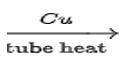 C6H6
(d) Hydration
(e) Condensation
Match the reactions given in Column I with the reaction types in Column II.
|
Column I |
Column II |
|
(i) CH2=CH2 + H2O |
(a) Hydrogenation |
|
(ii) CH2 ≡ CH2 + H2 |
(b) Halogenation |
|
(iii) CH2 ≡ CH2 + Cl2 → ClCH2CH2Cl |
(c) Polymerisation |
|
(iv) 3CH ≡ CH |
(d) Hydration |
|
(e) Condensation |
This is a matching answer type question as classified in NCERT Exemplar
(i) → (d); (ii) → (a); (iii) → (b) : (iv) → (c)
Upvote Match the following reactants in Column I with the corresponding reaction products in Column II.
Column I
Column II
(i) Benzene + Cl2
(a) Benzoic acid
(ii)Benzene + CH3Cl
(b) Methyl phenyl ketone
(iii)Benzene + CH3COCl
(c) Toluene
(iv)Toluene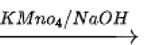
(d) Chlorobenzene
(e) Benzene hexachloride
Match the following reactants in Column I with the corresponding reaction products in Column II.
|
Column I |
Column II |
|
(i) Benzene + Cl2 |
(a) Benzoic acid |
|
(ii)Benzene + CH3Cl |
(b) Methyl phenyl ketone |
|
(iii)Benzene + CH3COCl |
(c) Toluene |
|
(iv)Toluene |
(d) Chlorobenzene |
|
(e) Benzene hexachloride |
This is a matching answer type question as classified in NCERT Exemplar
(i) → (d); (ii) → (c); (iii) → (b) : (iv) → (a)
Upvote