
Hydrocarbons
Get insights from 111 questions on Hydrocarbons, answered by students, alumni, and experts. You may also ask and answer any question you like about Hydrocarbons
- 111
Questions
- 0
Discussions
- 0
Active Users
- 0
Followers
Have a question about Hydrocarbons? Ask our experts
Keep it short & simple. Type complete word. Avoid abusive language.
Match the hydrocarbons in Column I with the boiling points given in Column II.
Column I
Column II
(i) n-pentane
(a) 282.5 K
(ii) iso-pentane
(b) 309 K
(iii) neo-pentane
(c) 301 K
Match the hydrocarbons in Column I with the boiling points given in Column II.
|
Column I |
Column II |
|
(i) n-pentane |
(a) 282.5 K |
|
(ii) iso-pentane |
(b) 309 K |
|
(iii) neo-pentane |
(c) 301 K |
This is a matching answer type question as classified in NCERT Exemplar
(i) → (b); (ii) → (c); (iii) → (a)
 Upvote

Match the reagent from Column I which on reaction with
CH3 – CH=CH2 gives some product given in Column II as per the codes given below:
Column I
Column II
(i) O3/Zn + H2O
(a) Acetic acid and CO2
(ii) KMnO4/H+
(b) Propan-1-ol
(iii) KMnO4/OH-
(c) Propan-2-ol
(iv) H2O/H+
(d) Acetaldehyde and formaldehyde
(v) B2H6/NaOH and H2O2
(e) Propan-1,2-diol
Match the reagent from Column I which on reaction with
CH3 – CH=CH2 gives some product given in Column II as per the codes given below:
|
Column I |
Column II |
|
(i) O3/Zn + H2O |
(a) Acetic acid and CO2 |
|
(ii) KMnO4/H+ |
(b) Propan-1-ol |
|
(iii) KMnO4/OH- |
(c) Propan-2-ol |
|
(iv) H2O/H+ |
(d) Acetaldehyde and formaldehyde |
|
(v) B2H6/NaOH and H2O2 |
(e) Propan-1,2-diol |
This is a matching answer type question as classified in NCERT Exemplar
(i) → (d); (ii) → (a); (iii) → (e) : (iv) → (c) : (v) → (b)
Upvote The molecules having dipole moment are __________.
(i) 2,2-Dimethylpropane
(ii) Trans-Pent-2-ene
(iii) Cis-Hex-3-ene
(iv) 2, 2, 3, 3 - Tetramethylbutane.
The molecules having dipole moment are __________.
(i) 2,2-Dimethylpropane
(ii) Trans-Pent-2-ene
(iii) Cis-Hex-3-ene
(iv) 2, 2, 3, 3 - Tetramethylbutane.
This is a multiple choice answer as classified in NCERT Exemplar
(ii) & (iii)
 Upvote
Four structures are given in options (i) to (iv). Examine them and select the aromatic structures.
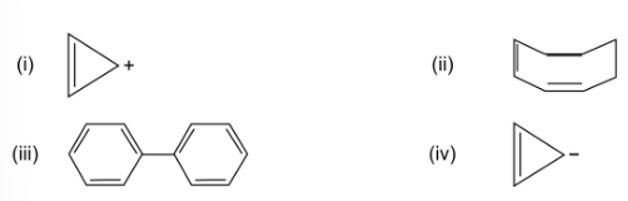
Four structures are given in options (i) to (iv). Examine them and select the aromatic structures.

This is a multiple choice answer as classified in NCERT Exemplar
(i) & (iii)
The structures that follow the (4n+2) Huckle rule of aromaticity is considered to be aromatic
Upvote
Which of the following are correct?
(i) CH3—O—CH2⊕ is more stable than CH3—CH2⊕
(ii) (CH3)2CH⊕ is less stable than CH3—CH2—CH2⊕
(iii) CH2=CH—CH2⊕ is more stable than CH3—CH2—CH2⊕
(iv) CH2=CH⊕is more stable than CH3—CH2⊕
(i) CH3—O—CH2⊕ is more stable than CH3—CH2⊕
(ii) (CH3)2CH⊕ is less stable than CH3—CH2—CH2⊕
(iii) CH2=CH—CH2⊕ is more stable than CH3—CH2—CH2⊕
(iv) CH2=CH⊕is more stable than CH3—CH2⊕
This is a multiple choice answer as classified in NCERT Exemplar
(i) & (iii)
The +I effect of the -OCH3 group stabilizes the carbocation.
The two resonating structure of CH2=CH-CH2⊕↔⊕CH2-CH=CH2 makes it more stable
Upvote In an electrophilic substitution reaction of nitrobenzene, the presence of nitro group ________.
(i) Deactivates the ring by inductive effect.
(ii) Activates the ring by inductive effect.
(iii) Decreases the charge density at ortho and para position of the ring relative to meta position by resonance.
(iv) Increases the charge density at meta position relative to the ortho and para positions of the ring by resonance
In an electrophilic substitution reaction of nitrobenzene, the presence of nitro group ________.
(i) Deactivates the ring by inductive effect.
(ii) Activates the ring by inductive effect.
(iii) Decreases the charge density at ortho and para position of the ring relative to meta position by resonance.
(iv) Increases the charge density at meta position relative to the ortho and para positions of the ring by resonance
This is a multiple choice answer as classified in NCERT Exemplar
(i) & (iii) The nitro group strongly deactivate the ring due to the -R effect and -I effect
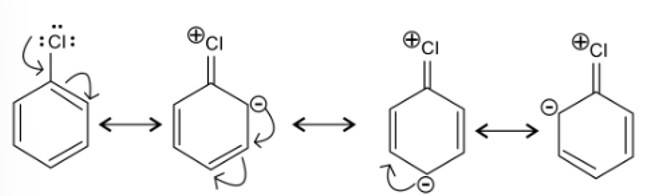
Upvote For an electrophilic substitution reaction, the presence of a halogen atom in the benzene ring _______.
(i) Deactivates the ring by inductive effect
(ii) Deactivates the ring by resonance
(iii) Increases the charge density at ortho and para position relative to meta position by resonance
(iv) Directs the incoming electrophile to meta position by increasing the charge density relative to ortho and para position.
For an electrophilic substitution reaction, the presence of a halogen atom in the benzene ring _______.
(i) Deactivates the ring by inductive effect
(ii) Deactivates the ring by resonance
(iii) Increases the charge density at ortho and para position relative to meta position by resonance
(iv) Directs the incoming electrophile to meta position by increasing the charge density relative to ortho and para position.
This is a multiple choice answer as classified in NCERT Exemplar
(i) & (iii)
The halogens atom weakly deactivate the ring due to the -I effect and directs the incoming group to the ortho and para position due to the +R effect.
Upvote Which are the correct IUPAC names of the following compound?
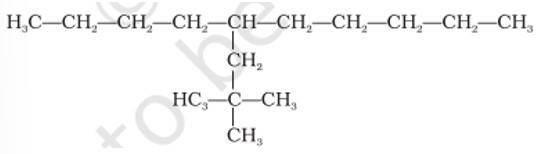
Which are the correct IUPAC names of the following compound?
This is a multiple choice answer as classified in NCERT Exemplar
(i) & (iv) The longest carbon chain is of 10 carbon atom
Upvote Which are the correct IUPAC names of the following compound?
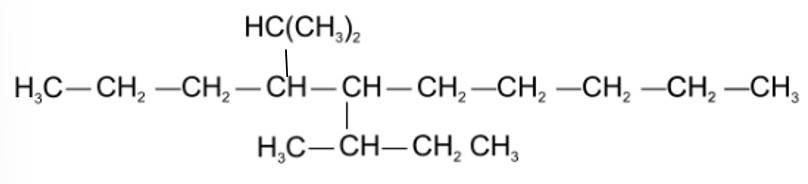
(i) 5– Butyl – 4– isopropyldecane
(ii) 5– Ethyl – 4– propyldecane
(iii) 5– sec-Butyl – 4– iso-propyldecane
(iv) 4–(1-methylethyl)– 5 – (1-methylpropyl)-decane
Which are the correct IUPAC names of the following compound?

(i) 5– Butyl – 4– isopropyldecane
(ii) 5– Ethyl – 4– propyldecane
(iii) 5– sec-Butyl – 4– iso-propyldecane
(iv) 4–(1-methylethyl)– 5 – (1-methylpropyl)-decane
This is a multiple choice answer as classified in NCERT Exemplar
(iii) & (iv) The longest carbon chain is of 10 carbon atom
Upvote Which of the following alkenes on ozonolysis give a mixture of ketones only?
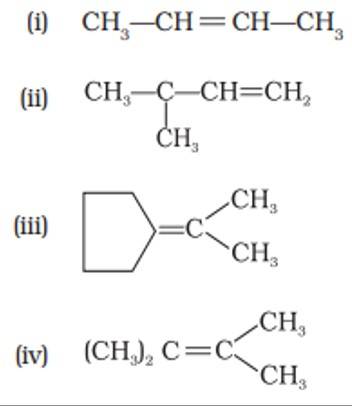
Which of the following alkenes on ozonolysis give a mixture of ketones only?

This is a multiple choice answer as classified in NCERT Exemplar
(iii) & (iv) When only the alkyl group is attached to the C atom of the C=C bond then only it would lead to giving only ketone on ozonolysis.
Upvote