Integrals

Get insights from 366 questions on Integrals, answered by students, alumni, and experts. You may also ask and answer any question you like about Integrals

  • 366

    Questions

  • 0

    Discussions

  • 0

    Active Users

  • 0

    Followers

Have a question about Integrals? Ask our experts

Ask Your Question

Keep it short & simple. Type complete word. Avoid abusive language.

New answer posted•a year ago
S
a year ago

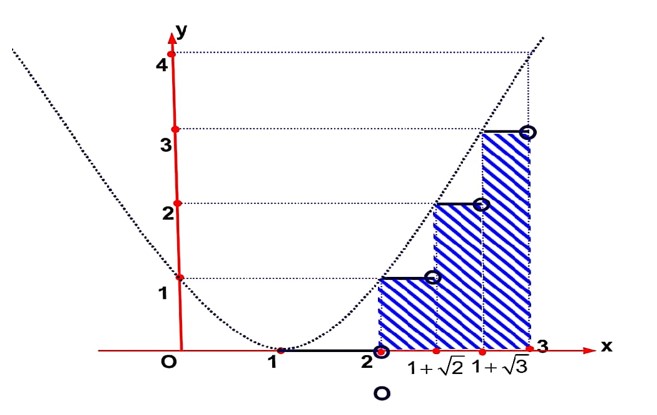
l = ∫ 1 3 [ x 2 − 2 x + 1 − 3 ] d x = ∫ 1 3 [ ( x − 1 ) 2 − 3 ] d x = ∫ 1 3 [ ( x − 1 ) 2 ] d x − 3 ∫ 1 3 d x  .(A)

l 1 = ∫ 1 3 [ ( x − 1 ) 2 ] d x P u t ( x − 1 ) 2 = t

l 1 = 1 2 [ 0 ∫ 0 1 d t t ∫ 1 2 d t t + 2 ∫ 2 3 d t t + 3 ∫ 3 4 d t t ] = 1 2 { | t − 1 2 + 1 − 1 2 + 1 | 1 2 | + 2 t − 1 2 + 1 − 1 2 + 1 | 2 3 + 3 t − 1 2 + 1 − 1 2 + 1 ] 3 4 }      = 5 − 2 − 3  

Hence from (A)

= 5 − 2 − 3 − 3 − 6 = − 1 − 2 − 3

2nd method       

∫ 1 3 [ ( x − 1 ) 2 ] d x − 6 . . . . . . . . . . . . . . ( A )

From (A), l=5−2−3−6=−1−2−3  


...Read more

Thumbs Up IconUpvote Thumbs Down Icon
New answer posted•a year ago
S
a year ago

Let sinθ= t ∫ s i n θ ( 2 s i n θ . c o s θ ) ( s i n 6 θ + s i n 4 θ + s i n 2 θ ) 2 s i n 4 θ + 3 s i n 2 θ + 6 2 s i n 2 θ dθ

sinθ = t

cos θ. dθ = dt

∫ u 1 / 2 1 2 d u = u 3 / 2 1 8 + C = ( 2 t 6 + 3 t 4 + 6 t 2 ) 3 / 2 1 8 + C = ( 2 s i n 6 θ + 3 s i n 4 θ + 6 s i n 2 θ ) 3 / 2 1 8 + C

Thumbs Up IconUpvote Thumbs Down Icon
New answer posted•a year ago
S
a year ago

l i m n → ∞ ( 1 + 1 + 1 2 + . . . . . . . + 1 n n 2 ) n limit is in the form of 1 ∞  

l = e x p ( l i m n → ∞ 1 + 1 2 + 1 3 + . . . . . + 1 n n 2 )             

0 ≤ 1 + 1 2 + 1 3 + . . . . . + 1 n ≤ 1 + 1 2 + 1 3 + . . . . + 1 n ≤ 2 n − 1        

Taking limit   ( n → ∞ )

l = exp (0) (from sandwich)

  l = 1          

Second Method :

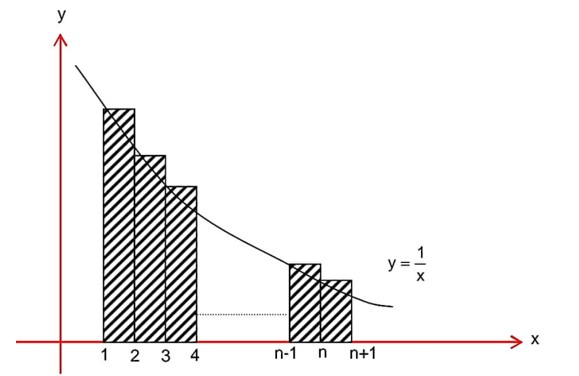
1 + 1 2 + 1 3 + . . . . + 1 n ≥ l n ( n + 1 ) . . . . . . . ( i )
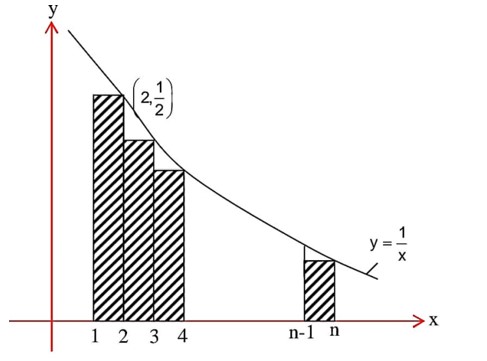
1 + 1 2 + 1 3 + . . . . . + 1 n ≤ 1 + ∫ 1 2 1 2 d x ≤ 1 + l n n . . . . . . . . . . ( i i )

From (i) & (ii)

l n ( n + 1 ) ≤ 1 + 1 2 + 1 3 + . . . . + 1 n ≤ 1 + I n n , ∀ n ∈ N , n ≥ 2            Views|Posted a year ago

Asked by Payal Gupta
S
a year ago

l = ∫ 8 x 3 + 2 0 x 2 x 4 + 5 x 3 − 7 x 2 d x = 4 ∫ 2 x + 5 x 2 + 5 x − 7 d x = 4 l n | x 2 + 5 x − 7 | + c

Thumbs Up IconUpvote Thumbs Down Icon
New answer posted•a year ago

If In = ∫π4π2cotnx dx,  then:

2 Views|Posted a year ago
Asked by Payal Gupta
S
a year ago

ln=∫π/4π/2cotnxdx=∫π/4π/2cotn−2x(cosec2x−1)dx

=[−cotn−1xn−1]π/4π/2−ln−2=1n−1−ln−2

ln+ln−2=1n−1

n=4⇒l4+l2=13n=5⇒l5+l3=14n=6⇒l6+l4=15}⇒1l2+l4,1l3+l5,1l4+l6 are in A.P.

Thumbs Up IconUpvote Thumbs Down Icon
New answer posted•a year ago
S
a year ago

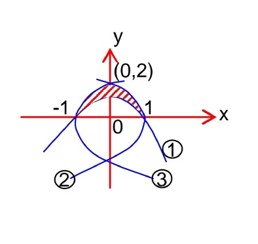
x 2 = − 2 ( y − 1 2 )  

y2 = -4 (x – 1)

Required area = 2 ∫ − 1 0 [ 2 x + 1 − 1 − x 2 2 ] d x  

= 2 [ 4 3 ( x + 1 ) 3 2 − 1 2 ( x − x 3 3 ) ] − 1 0          

= 2


...Read more

Thumbs Up IconUpvote Thumbs Down Icon
New answer posted•a year ago
S
a year ago

∫ s i n 2 x d x e { x π } = l

f ( x ) = s i n 2 x e { x π } is periodic with period =

l = 1 0 0 ∫ 0 π s i n 2 x e x / π d x .

= 5 0 ∫ 0 π 1 − c o s 2 x e x / π d x = 5 0 ∫ 0 π e − x / π d x − 5 0 ∫ 0 π e − x / π c o s 2 x d x

= 5 0 π ( 1 − 1 e ) [ 1 − 1 1 + 4 π 2 ] = 5 0 ( 1 − 1 e ) 4 π 3 1 + 4 π 2

∴ α = 2 0 0 ( 1 − 1 e )

Thumbs Up IconUpvote Thumbs Down Icon
New answer posted•a year ago
S
a year ago

1 α ( α + 1 ) ( α + 2 ) . . . . . . . . . . ( α + 2 0 ) = A 0 α + A 1 α + 1 + A 2 α + 2 + . . . . . . + A 2 0 α + 2 0

Solving by partial fraction, we get

A 1 3 = − 1 1 4 ! 7 ! , A 1 4 = − 1 1 4 ! 6 !     a n d     A 1 5 = − 1 1 4 ! 5 !

∴ A 1 4 + A 1 5 A 1 3 = 3 1 0 ⇒ ( A 1 4 + A 1 5 A 1 3 ) 2 = ( 3 1 0 ) 2 ⇒ 1 0 0 ( A 1 4 + A 1 5 A 1 3 ) 2 = 9

Thumbs Up IconUpvote Thumbs Down Icon
New answer posted•a year ago
S
a year ago

A = − y x + 2 s i n x + 2  

∴ d y d x + y x = 2 s i n x + 2 . (i)

⇒ l . F = e ∫ ! l n     x d x = x from (i) d (xy) = 2 ∫ x s i n     x d x + 2 ∫ x d x

xy = 2 [-xcos x + sin x] + x2 + c       . (ii)

according to question, we get c = 0 ∴ y ( π 2 ) = 4 π + π 2

...Read more

Thumbs Up IconUpvote Thumbs Down Icon
New answer posted•a year ago
S
a year ago

l i m x → 1 x n f ( 1 ) − f ( x ) x − 1  

= l i m x → 1 9 x n − ( x 6 + 2 x 4 + x 3 + 2 x + 3 ) x − 1                

= 9n – 19 = 44 -> n = 7

...Read more

Thumbs Up IconUpvote Thumbs Down Icon