
Ncert Solutions Chemistry Class 11th
Get insights from 2k questions on Ncert Solutions Chemistry Class 11th, answered by students, alumni, and experts. You may also ask and answer any question you like about Ncert Solutions Chemistry Class 11th
- 2k
Questions
- 0
Discussions
- 0
Active Users
- 29
Followers
Have a question about Ncert Solutions Chemistry Class 11th? Ask our experts
Keep it short & simple. Type complete word. Avoid abusive language.
Most suitable salt which can be used for efficient clotting of blood will be:
Most suitable salt which can be used for efficient clotting of blood will be:
Blood – Negatively charged colloid.
According to Hardy – Schulze Rule
FeCl3 is more efficient for blood clotting
 Upvote

What is the correct order of the following elements with respect to their density?
What is the correct order of the following elements with respect to their density?
Density =
Cu > Co > Fe > Cr > Zn
Upvote The average S – F bond energy in kJ mol-1 of SF6 is………… (Rounded off to the nearest integer) [Given : The values of standard enthalpy of formation of SF6(g), S(g) and F(g) are – 1100, 275 and 80 kJ mol-1 respectively.]
The average S – F bond energy in kJ mol-1 of SF6 is………… (Rounded off to the nearest integer) [Given : The values of standard enthalpy of formation of SF6(g), S(g) and F(g) are – 1100, 275 and 80 kJ mol-1 respectively.]
= (-1100) - (275) -6 (80) = -1855
Upvote Oxide Nature
CaO Basic
B2O3 Acidic
SiO2
Upvote Kindly go through the solution
S > Se > Te > O
Upvote Calgon is used for water treatment. Which of the following statement is NOT true about Calgon?
Calgon is used for water treatment. Which of the following statement is NOT true about Calgon?
It does not contains 2nd most abundant element by weight in earth crust because that is Si Calgon -> Na2 [Na4 (PO3)6]
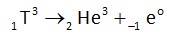
Upvote Which of the following forms of hydrogen emits low energy b - particles?
Which of the following forms of hydrogen emits low energy b - particles?
Tritium is radioactive and it decays into He3 during emission of b-radiation
Upvote 2.2g of nitrous oxide (N2O) gas is cooled at a constant pressure of 1 atm from 310 K to 270 K causing the compression of the gas from 217.1mL to 167.75mL. The change in thermal energy of the process, is ‘-x’ J. The value of ‘x’ is________. [Nearest Integer]
(Given : atomic mass of N = 14 g mol-1 and of O = 16 g mol-1.
Molar heat capacity of N2O is 100 J K-1 mol-1)
2.2g of nitrous oxide (N2O) gas is cooled at a constant pressure of 1 atm from 310 K to 270 K causing the compression of the gas from 217.1mL to 167.75mL. The change in thermal energy of the process, is ‘-x’ J. The value of ‘x’ is________. [Nearest Integer]
(Given : atomic mass of N = 14 g mol-1 and of O = 16 g mol-1.
Molar heat capacity of N2O is 100 J K-1 mol-1)
A box contains 0.90g of liquid water in equilibrium with water vapour at 27°C. The equilibrium vapour pressure of water at 27°C is 32.0 Torr. When the volume of the box is increased, some of the liquid water evaporates to maintain the equilibrium pressure. If all the liquid water evaporates, then the volume of the box must be________ litre. [Nearest Integer]
(Given : R = 0.082 L atm K-1 mole-1)
(Ignore the volume of the liquid water and assume water vapours behave as an ideal gas.)
A white precipitate was formed when BaCl2 was added to water extract of an inorganic salt. Further, a gas ‘X’ with characteristic odour was released when the formed white precipitate was dissolved in dilute HCl. The anion present in the inorganic salt is
A white precipitate was formed when BaCl2 was added to water extract of an inorganic salt. Further, a gas ‘X’ with characteristic odour was released when the formed white precipitate was dissolved in dilute HCl. The anion present in the inorganic salt is