
Ncert Solutions Chemistry Class 11th
Get insights from 2k questions on Ncert Solutions Chemistry Class 11th, answered by students, alumni, and experts. You may also ask and answer any question you like about Ncert Solutions Chemistry Class 11th
- 2k
Questions
- 0
Discussions
- 1
Active Users
- 29
Followers
Have a question about Ncert Solutions Chemistry Class 11th? Ask our experts
Keep it short & simple. Type complete word. Avoid abusive language.
Which method can be used to find out strength of reductant/oxidant in a solution? Explain with an example.
Which method can be used to find out strength of reductant/oxidant in a solution? Explain with an example.
This is a Long answer type question as classified in NCERT Exemplar
We can Measure the electrode potential of the given species by connecting the redox couple of the given species with standard hydrogen electrode. If it is positive, the electrode of the given species acts as reductant and if it is ne
 Upvote
Find out the oxidation number of chlorine in the following compounds and arrange them in increasing order of oxidation number of chlorine. NaClO4 , NaClO3 , NaClO, KClO2 , Cl2O7 , ClO3 , Cl2O, NaCl, Cl2 , ClO2 . Which oxidation state is not present in any of the above compounds?
Find out the oxidation number of chlorine in the following compounds and arrange them in increasing order of oxidation number of chlorine. NaClO4 , NaClO3 , NaClO, KClO2 , Cl2O7 , ClO3 , Cl2O, NaCl, Cl2 , ClO2 . Which oxidation state is not present in any of the above compounds?
This is a Long answer type question as classified in NCERT Exemplar
We can calculate the oxidation states by - ]
NaClO4 Oxidation no. of chlorine = +7
Suppose oxidation number of chlorine is x then, 1 + x + 4 × (−2) = 0
∴ x - 7 = 0
x = +7
We can cal
Upvote Write redox couples involved in the reactions (i) to (iv) given in question 2.
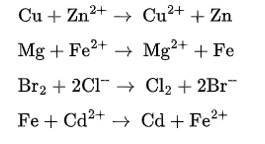
Write redox couples involved in the reactions (i) to (iv) given in question 2.
This is a Long answer type question as classified in NCERT Exemplar
Redox couple are given as
Cu2+/Cu and Zn2+/Zn
Mg2+/Mg and Fe2+ /Fe
Br2/Br- and Cl2 / Cl-
Fe2+ /Fe and Cd2+/Cd
Upvote Why does fluorine not show disproportionate reaction?
Why does fluorine not show disproportionate reaction?
This is a Long answer type question as classified in NCERT Exemplar
Disproportionate is defined as the reaction in which one compound of intermediate oxidation state converts to two compounds, one of higher and one of lower oxidation states So, to occur such type of redox reaction, the element should
Upvote On the basis of standard electrode potential values, suggest which of the following reactions would take place? (Consult the book for E V value).
(i) Cu + Zn2+ → Cu2+ + Zn
(ii) Mg + Fe2+ → Mg2+ + Fe
(iii) Br2 + 2Cl– → Cl2 + 2Br–
(iv) Fe + Cd2+ → Cd + Fe2+
On the basis of standard electrode potential values, suggest which of the following reactions would take place? (Consult the book for E V value).
(i) Cu + Zn2+ → Cu2+ + Zn
(ii) Mg + Fe2+ → Mg2+ + Fe
(iii) Br2 + 2Cl– → Cl2 + 2Br–
(iv) Fe + Cd2+ → Cd + Fe2+
This is a Long answer type question as classified in NCERT Exemplar
On the basis of standard reduction potential suggested in the reactivity series (ii) reaction can take place as Mg has more negative value of E? cell. Hence, Mg will be oxidized by losing electron and iron will be reduced by gaining
Upvote Explain redox reactions on the basis of electron transfer. Give suitable examples.
Explain redox reactions on the basis of electron transfer. Give suitable examples.
This is a Long answer type question as classified in NCERT Exemplar
The given reaction is a redox change.
2Na (s)+H2 (g)→2NaH (s)
The half reaction is:
2Na (s)→2Na+ (g)+2e-
The other half reaction is:
H2 (g)+2e-→2H- (g)
This splitting of the reaction into two half-reactions automati
Upvote 11.55 Give the chemical reaction as evidence for each of the following observations.
(i) Tin (II) is a reducing agent whereas lead (II) is not.
(ii) Gallium (I) undergoes disproportionation reaction.
11.55 Give the chemical reaction as evidence for each of the following observations.
(i) Tin (II) is a reducing agent whereas lead (II) is not.
(ii) Gallium (I) undergoes disproportionation reaction.
(i) Due to inert pair effect Pb2+ is more stable than Pb4+. Whereas Sn4+ is more stable than Sn2+.
(ii) 3Ga+ —–> 2Ga + Ga3+
This is because Ga3+ is more stable than Ga+
Upvote | Fullerenes are the allotropes of carbon. Its structure is like a soccer ball. They are prepared by heating graphite in electric arc in presence of inert gases such as helium or argon. |
Upvote 11.53 CO2 is gas while SiO2 is solid at room temperature. Give reason.
11.53 CO2 is gas while SiO2 is solid at room temperature. Give reason.
The molecules of CO2 are held together by weak van der Waals forces of attraction which can be easily overcome by collisions of the molecules at room temperature. Consequently, CO2 is a gas.
On the other hand, silicon atom forms four single covalent bonds with O-atom which are tetrahedrally
Upvote Carbon dioxide can be obtained as a solid in the form of dry ice by allowing the liquified CO2 to expand rapidly.
Unlike ordinary ice it does not melt and hence does not wet the surface on which it is kept. Thus, it is called dry ice.
Upvote