
Ncert Solutions Chemistry Class 11th
Get insights from 2k questions on Ncert Solutions Chemistry Class 11th, answered by students, alumni, and experts. You may also ask and answer any question you like about Ncert Solutions Chemistry Class 11th
- 2k
Questions
- 0
Discussions
- 1
Active Users
- 29
Followers
Have a question about Ncert Solutions Chemistry Class 11th? Ask our experts
Keep it short & simple. Type complete word. Avoid abusive language.
In the following questions a statement of assertion (A) followed by a statement of reason (R) is given. Choose the correct option out of the choices given below each question.
Assertion (A) : Among halogens fluorine is the best oxidant.
Reason (R) : Fluorine is the most electronegative atom.
(i) Both A and R are true and R is the correct explanation of A.
(ii) Both A and R are true but R is not the correct explanation of A.
(iii) A is true but R is false.
(iv) Both A and R are false.
This is a Assertion and Reason Type Questions as classified in NCERT Exemplar
Option (i) is the correct answer.
Fluorine is most electronegative element that is why it is best oxidant among halogens
 Upvote

Match the items in Column I with relevant items in Column II.
Column I
Column II
(i) Ions having positive charge
(a) +7
(ii) The sum of oxidation number of all atoms in a neutral molecule.
(b) –1
(iii) Oxidation number of hydrogen ion (H+).
(c) +1
(iv) Oxidation number of fluorine in NaF.
(d) 0
(v) Oxidation number of fluorine in NaF.
(e) Cation
(f) Anion
Match the items in Column I with relevant items in Column II.
|
Column I |
Column II |
|
(i) Ions having positive charge |
(a) +7 |
|
(ii) The sum of oxidation number of all atoms in a neutral molecule. |
(b) –1 |
|
(iii) Oxidation number of hydrogen ion (H+). |
(c) +1 |
|
(iv) Oxidation number of fluorine in NaF. |
(d) 0 |
|
(v) Oxidation number of fluorine in NaF. |
(e) Cation |
|
(f) Anion |
This is a Matching Type Questions as classified in NCERT Exemplar
(i) → (e); (ii) → (d); (iii) → (c); (iv) → (b); (v) → (f).
Upvote Match Column I with Column II for the oxidation states of the central atoms.
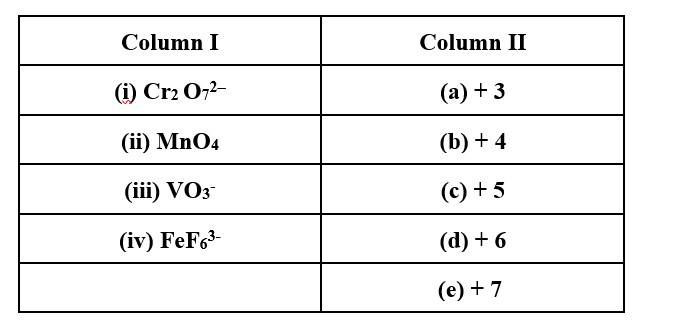
Match Column I with Column II for the oxidation states of the central atoms.

This is a Matching Type Questions as classified in NCERT Exemplar
(i) → (d); (ii) → (e); (iii) → (c); (iv) → (a)
Upvote Which of the following electrodes will act as anodes, when connected to Standard Hydrogen Electrode?
(i) Al/Al3+ Eᶱ V = –1.66
(ii) Fe/Fe2+ Eᶱ V= – 0.44
(iii) Cu/Cu2+ Eᶱ V= + 0.34
(iv) F2 (g)/2F– (aq) Eᶱ V= + 2.87
Which of the following electrodes will act as anodes, when connected to Standard Hydrogen Electrode?
(i) Al/Al3+ Eᶱ V = –1.66
(ii) Fe/Fe2+ Eᶱ V= – 0.44
(iii) Cu/Cu2+ Eᶱ V= + 0.34
(iv) F2 (g)/2F– (aq) Eᶱ V= + 2.87
This is a Multiple Choice Questions as classified in NCERT Exemplar
Option (i) and (ii) are the correct answers.
The ones which will act as anodes when connected to standard hydrogen electrode as they have more negative standard reduction potential as compared to standard hydrogen electrode. The one w
Upvote Identify the correct statements with reference to the given reaction.
P4 + 3OH– + 3H2O → PH3 + 3H2PO2
(i) Phosphorus is undergoing reduction only.
(ii) Phosphorus is undergoing oxidation only.
(iii) Phosphorus is undergoing oxidation as well as reduction.
(iv) Hydrogen is undergoing neither oxidation nor reduction.
Identify the correct statements with reference to the given reaction.
P4 + 3OH– + 3H2O → PH3 + 3H2PO2
(i) Phosphorus is undergoing reduction only.
(ii) Phosphorus is undergoing oxidation only.
(iii) Phosphorus is undergoing oxidation as well as reduction.
(iv) Hydrogen is undergoing neither oxidation nor reduction.
This is a Multiple Choice Questions as classified in NCERT Exemplar
Hence, option (iii) and (iv) are the correct answers.
The given reaction is as below-
P4+3OH- +3H2O→PH3 + 3H2PO2-
The above reaction is a kind of disproportionate reaction in which phosphorous is being reduced as well as oxidized wherea
Upvote The exhibition of various oxidation states by an element is also related to the outer orbital electronic configuration of its atom. Atom(s) having which of the following outermost electronic configurations will exhibit more than one oxidation state in its compounds.
(i) 3s 1
(ii) 3d 1 4s 2
(iii) 3d2 4s2
(iv) 3s2 3p3
The exhibition of various oxidation states by an element is also related to the outer orbital electronic configuration of its atom. Atom(s) having which of the following outermost electronic configurations will exhibit more than one oxidation state in its compounds.
(i) 3s 1
(ii) 3d 1 4s 2
(iii) 3d2 4s2
(iv) 3s2 3p3
This is a Multiple Choice Questions as classified in NCERT Exemplar
Option (ii), (iii) and (iv) are the correct answers.
Elements that are having only s-electrons in the valence shell do not show more than one oxidation state (shows only one oxidation state of +1). Hence, (b), (c) having incompl
Upvote Identify the correct statement (s) in relation to the following reaction:
Zn + 2HCl → ZnCl2 + H2
(i) Zinc is acting as an oxidant
(ii) Chlorine is acting as a reductant
(iii) Hydrogen ion is acting as an oxidant
(iv) Zinc is acting as a reductant
Identify the correct statement (s) in relation to the following reaction:
Zn + 2HCl → ZnCl2 + H2
(i) Zinc is acting as an oxidant
(ii) Chlorine is acting as a reductant
(iii) Hydrogen ion is acting as an oxidant
(iv) Zinc is acting as a reductant
This is a Multiple Choice Questions as classified in NCERT Exemplar
Option (iii) and (iv) is the correct answer.
The given equation is as-
Zn+2HCl→ZnCl2+H2
In this Zn has a negative E? value, which means it will undergo oxidation and will act as a reducing agent (reductant). Zn can produce&nbs
Upvote In the following questions two or more options may be correct.
Which of the following statement(s) is/are not true about the following decomposition reaction.
2KClO3 → 2KCl + 3O2
(i) Potassium is undergoing oxidation
(ii) Chlorine is undergoing oxidation
(iii) Oxygen is reduced
(iv) None of the species are undergoing oxidation or reduction
In the following questions two or more options may be correct.
Which of the following statement(s) is/are not true about the following decomposition reaction.
2KClO3 → 2KCl + 3O2
(i) Potassium is undergoing oxidation
(ii) Chlorine is undergoing oxidation
(iii) Oxygen is reduced
(iv) None of the species are undergoing oxidation or reduction
This is a Multiple Choice Questions as classified in NCERT Exemplar
Options (iii) and (iv) are the correct answers.
As, in the given reaction below-
2KClO3→2KCl+3O2
Potassium remains in same oxidation state and oxygen is being oxidized
Upvote Which of the following elements does not show disproportionation tendency?
(i) Cl
(ii) Br
(iii) F
(iv) I
Which of the following elements does not show disproportionation tendency?
(i) Cl
(ii) Br
(iii) F
(iv) I
This is a Multiple Choice Questions as classified in NCERT Exemplar
Option (iii) is the correct answer.
As, Cl, Br, I all are having -1 to +7 oxidation state. But Oxidation state of F is fixed (-1) as it is the most electronegative element and do not loose electron. Hence, it does not show d
Upvote Identify disproportionation reaction
(i) CH4 + 2O2 → CO2 + 2H2O
(ii) CH4 + 4Cl2 → CCl4 + 4HCl
(iii) 2F2 + 2OH– → 2F– + OF2 + H2O
(iv) 2NO2 + 2OH– → NO2 – + NO3 – + H2O
Identify disproportionation reaction
(i) CH4 + 2O2 → CO2 + 2H2O
(ii) CH4 + 4Cl2 → CCl4 + 4HCl
(iii) 2F2 + 2OH– → 2F– + OF2 + H2O
(iv) 2NO2 + 2OH– → NO2 – + NO3 – + H2O
This is a Multiple Choice Questions as classified in NCERT Exemplar
Option (iv) is the correct answer.
Disproportionate reactions are defined as the reactions in which the same substance is oxidized as well as reduced. Here, the below reaction is given as-
2NO2 + 2OH- →NO2 -+ NO3- +H2O
In this reac
Upvote