
Ncert Solutions Chemistry Class 11th
Get insights from 2k questions on Ncert Solutions Chemistry Class 11th, answered by students, alumni, and experts. You may also ask and answer any question you like about Ncert Solutions Chemistry Class 11th
- 2k
Questions
- 0
Discussions
- 0
Active Users
- 29
Followers
Have a question about Ncert Solutions Chemistry Class 11th? Ask our experts
Keep it short & simple. Type complete word. Avoid abusive language.
14.12. Have you ever observed any water pollution in your area? What measures would you suggest to control it?
14.12. Have you ever observed any water pollution in your area? What measures would you suggest to control it?
Yes, we observed water pollution near our area due to various human activities like toxic discharges from factories and industrial plants, runoff from agricultural fields, domestic wastes etc.
It can be controlled by preventing the toxic chemicals from entering the water bodies. Regular checks on con
 Upvote
14.11. What are the major causes of water pollution? Explain.
14.11. What are the major causes of water pollution? Explain.
Major Causes of water pollution are:
Pathogens: Pathogens include bacteria and other microorganisms that enter water from domestic sewage and animal excreta.
Human excreta contain bacteria such as Escherichia coli and Streptococcus faecalis, which cause gastrointestinal diseases.
Organic wastes: O
Upvote 14.10. What do you mean by ozone hole? What are its consequences?
14.10. What do you mean by ozone hole? What are its consequences?
Depletion of ozone layer creates some sort of holes in the blanket of ozone which surrounds us, this is known as ozone hole.
The consequences are:
- With the depletion of ozone layer, more UV radiation filters into troposphere. UV radiations lead to ageing of skin, cataract, sunburn, skin cancer, killin
Upvote 3.30. Assign the position of the element having outer electronic configuration,
(i) ns2 np4 for n = 3
(ii) (n – 1) d2 ns2 for n = 4 and
(iii) (n – 2) f7 (n – 1) d1 ns2 for n = 6 in the periodic table?
3.30. Assign the position of the element having outer electronic configuration,
(i) ns2 np4 for n = 3
(ii) (n – 1) d2 ns2 for n = 4 and
(iii) (n – 2) f7 (n – 1) d1 ns2 for n = 6 in the periodic table?
3.30. (i) For n = 3, the element belong to 3rd period, p-block element.
The electronic configuration is =1s2 2s2 2p6 3s2 3p4. The element name is sulphur.
(ii) For n = 4, the element belongs to 4th period and since the valence shell has 4 electrons it belongs to group 4.
Elec
Upvote 3.29. Write the general electronic configuration of s-, p-, d-, and f-block elements?
3.29. Write the general electronic configuration of s-, p-, d-, and f-block elements?
3.29. (i) s-Block elements: ns1-2 where n = 2-7.
(ii) p-Block elements: ns2 np1-6 where n = 2-6.
(iii) d-Block elements: (n-1)d1-10 ns 0-2 where n = 4-7.
(iv) f-Block elements: (n-2)f0-14 (n-1)d0-1 ns2where n = 6-7.
Upvote 3.28. The increasing order of reactivity among group 1 elements is Li < Na < K < Rb < Cs whereas that of group 17 is F > Cl > Br > I. Explain?
3.28. The increasing order of reactivity among group 1 elements is Li < Na < K < Rb < Cs whereas that of group 17 is F > Cl > Br > I. Explain?
3.28. The elements of Group I have only one electron in their respective valence shells and thus have a strong tendency to lose this electron. The tendency to lose electrons in turn, depends upon the ionization enthalpy. Since the ionization enthalpy decreases down the group therefore, the reac
Upvote 14.8. What are the harmful effects of photochemical smog and how can they be controlled?
14.8. What are the harmful effects of photochemical smog and how can they be controlled?
Harmful effects of photochemical smog: Photochemical smog causes serious health problems. Both ozone and PAN (peroxyacetyl nitrate) act as powerful eye irritants. Ozone and nitric oxide irritate the nose and throat and their high concentration causes headache, chest pain, dryness of the throat, coug
Upvote 14.7. Write down the reactions involved during the formation of photochemical smog.
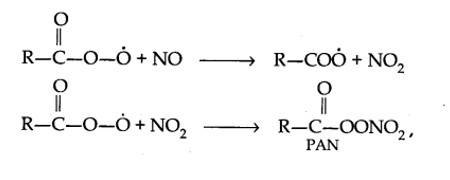
14.7. Write down the reactions involved during the formation of photochemical smog.
Mechanism of formation of photochemical smog:

 Upvote
 3.27. Use periodic table to answer the following questions:
(a) Identify the element with five electrons in the outer sub shell.
(b) Identify the element that would tend to lose two electrons.
(c) Identify the element that would tend to gain two electrons.
3.27. Use periodic table to answer the following questions:
(a) Identify the element with five electrons in the outer sub shell.
(b) Identify the element that would tend to lose two electrons.
(c) Identify the element that would tend to gain two electrons.
3.27. (a) Element belonging to nitrogen family (group 15) e.g., nitrogen.
(b) Element belonging to alkaline earth family (group 2) e.g., magnesium.
(c) Element belonging to oxygen family (group 16) e.g., oxygen.
Upvote 14.6. What is smog? How is classical smog different from photochemical smogs?
14.6. What is smog? How is classical smog different from photochemical smogs?
The word smog is a combination of smoke and fog. It is a type of air pollution that occurs in many cities throughout the world. Classical smog occurs in a cool, humid climate. It is also called reducing smog. Whereas photochemical smog (photo means light) occurs in warm and dry sunny climates. It ha
Upvote