Ncert Solutions Chemistry Class 11th

Get insights from 2k questions on Ncert Solutions Chemistry Class 11th, answered by students, alumni, and experts. You may also ask and answer any question you like about Ncert Solutions Chemistry Class 11th

  • 2k

    Questions

  • 0

    Discussions

  • 0

    Active Users

  • 29

    Followers

Have a question about Ncert Solutions Chemistry Class 11th? Ask our experts

Ask Your Question

Keep it short & simple. Type complete word. Avoid abusive language.

New answer posted•a year ago
S
a year ago

This is a Short Answer Type Questions as classified in NCERT Exemplar

For an isolated system w = 0, q = 0

Since ΔU= q + w = 0 + 0 = 0, ΔU= 0

Thumbs Up IconUpvote Thumbs Down Icon
New answer posted•a year ago
S
a year ago

This is a Short Answer Type Questions as classified in NCERT Exemplar

Gibbs energy for a reaction in which all reactants and products are in standard state. ΔrG° is related to the equilibrium constant of the reaction as follows

ΔrG = ArG° + RT In K

At equilibrium, 0 = ΔrG° + RT InA– ( {ΔrG = 0) or&nbs

...Read more

Thumbs Up IconUpvote Thumbs Down Icon
New question posted•a year ago
New answer posted•a year ago
S
a year ago

This is a Short Answer Type Questions as classified in NCERT Exemplar

Molar enthalpy of vaporization is more for water due to hydrogen bonding between water molecules.

Thumbs Up IconUpvote Thumbs Down Icon
New answer posted•a year ago
S
a year ago

This is a Short Answer Type Questions as classified in NCERT Exemplar

State functions: Enthalpy, entropy, temperature, free energy Path functions: Heat, work.

Thumbs Up IconUpvote Thumbs Down Icon
New answer posted•a year ago
S
a year ago

This is a Short Answer Type Questions as classified in NCERT Exemplar

The standard molar entropy of H20 (1) is 70 J K-1 mol-1. The solid form of H20 is ice. In ice, molecules of H20 are less random than in liquid water. Thus, molar entropy of H20 (s) < molar entropy of H20 (1). The standard molar entropy of H20 (s) is l

...Read more

Thumbs Up IconUpvote Thumbs Down Icon
New answer posted•a year ago
S
a year ago

This is a Short Answer Type Questions as classified in NCERT Exemplar

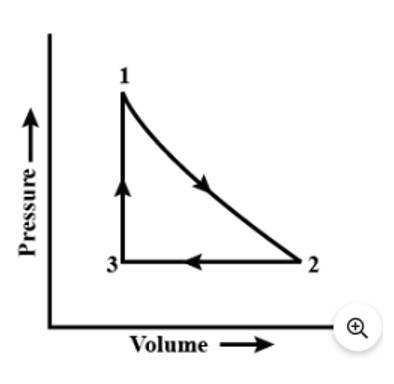
During cyclic process, change in internal energy is zero.

ΔU = 0

and no work is said to be done, as system returns to the initial state.
For a steady state cyclic process at any given stage enthalpy is one single value however, at dif

...Read more

Thumbs Up IconUpvote Thumbs Down Icon
New answer posted•a year ago
S
a year ago

This is a Short Answer Type Questions as classified in NCERT Exemplar

ΔrG° = -RT ln Kp

= -RT ln (0.98)

Since In (0.98) is negative

.’. ΔrG° is positive the reaction is non spontaneous

Thumbs Up IconUpvote Thumbs Down Icon
New answer posted•a year ago
S
a year ago

This is a Short Answer Type Questions as classified in NCERT Exemplar

Yes, when the system and the surroundings are in thermal equilibrium, their temperatures are the same.

Thumbs Up IconUpvote Thumbs Down Icon
New answer posted•a year ago
S
a year ago

This is a Short Answer Type Questions as classified in NCERT Exemplar

Heat has a randomising influence on a system and temperature is the measure of average chaotic motion of particles in the system. The mathematical relation which relates these three parameters is? S = qrev/ T

Here? S = change in ent

...Read more

Thumbs Up IconUpvote Thumbs Down Icon