

Ncert Solutions Chemistry Class 12th
Get insights from 2.6k questions on Ncert Solutions Chemistry Class 12th, answered by students, alumni, and experts. You may also ask and answer any question you like about Ncert Solutions Chemistry Class 12th
Follow Ask QuestionQuestions
Discussions
Active Users
Followers
New answer posted
a year agoContributor-Level 10
This is a short answer type question as classified in NCERT Exemplar
In O? C? O, the dipole moment is zero, hence non-polar while in R—O—R the dipole moment is non-zero due to which it is polar.
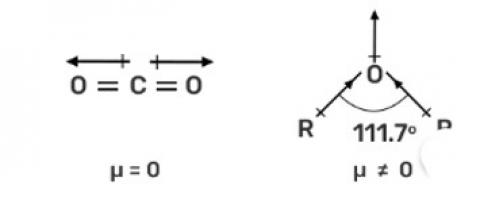
The CO2 is a linear molecule and the dipole moment is equal and in the opposite direction due to which the dipole moment is zero. While in R—O—R, has bent structure and lone pair of electrons due to which the net dipole moment is nonzero and hence, it is a polar molecule.
The CO2 is a linear molecule and the dipole moment is equal and in the opposite direction due to which the dipole moment is zero. While in R—O—R, has bent
New answer posted
a year agoContributor-Level 10
This is a short answer type question as classified in NCERT Exemplar
Step 1: Protonation of alkene due to the presence of double bond which attacks the H3O+ ion and forms carbocation.
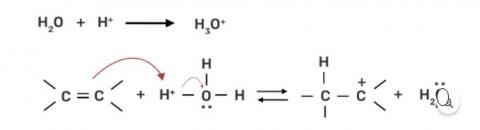
Step 2: Water molecule act as nucleophile and attack the carbocation.

Step 3: Deprotonation occur to get the alcohol and hydronium ion forms

New answer posted
a year agoContributor-Level 10
This is a short answer type question as classified in NCERT Exemplar
The C-OH bond in phenols has double bond character due to resonance of electron pairs of oxygen atom with the pi electrons of phenyl ring, which makes the C-OH bond strong and hence, the nucleophilic substitution of a nucleophile with the -OH group of alcohol is not possible as the C-OH does not break easily.
New answer posted
a year agoContributor-Level 10
This is a short answer type question as classified in NCERT Exemplar
The electron pairs of oxygen atom of hydroxyl (-OH) group in phenols are in conjugation with the pi electrons of phenyl ring and hence, the bond C-OH bond has double bond character due to which OH group in phenols more strongly held as compared to OH group in alcohols.

Resonance in phenol
New answer posted
a year agoContributor-Level 10
This is a short answer type question as classified in NCERT Exemplar
The alcohol with molecular formula C4H10O is butanol has 4 isomers, these are:
(a) CH3-CH2CH2-CH2OH (Butane-1-ol)
(b) CH3-C*H-CH2-CH3 (Butane-2-ol)
|
OH
(c) CH3-CH-CH2-OH (2-methylpropane-1-ol)
|
CH3
CH3
&nbs
New answer posted
a year agoContributor-Level 10
This is a short answer type question as classified in NCERT Exemplar
The propan-2-one can be converted into tert-butyl alcohol by using CH3MgBr grignard reagent to form the additional product tert-butyl alcohol.

New answer posted
a year agoContributor-Level 10
This is a short answer type question as classified in NCERT Exemplar
The enzyme invertase, which is present in yeast, is used to convert sucrose to glucose and fructose. The glucose and fructose are further converted to ethanol by zymase enzyme (also present in yeast).

New answer posted
a year agoContributor-Level 10
This is a short answer type question as classified in NCERT Exemplar
The decreasing order of acidity:
H2O > ROH > HC ≡ CH
The more the stability of the conjugate base of the given compounds, the more acidity will be.
? OH > ? O-R > ? C ≡ CH
The negative charge on the electronegative oxygen atom is more stable than carbon atom. The + I effect of the alkyl group does not stabilize the negative charge on the electronegative oxygen atom, hence less stable than ? OH.
New answer posted
a year agoContributor-Level 10
This is a short answer type question as classified in NCERT Exemplar
When benzene diazonium chloride is heated with water, it forms phenol along with nitrogen and hydrochloric acid as by-products as shown below:

New answer posted
a year agoContributor-Level 10
This is a short answer type question as classified in NCERT Exemplar
The decreasing order of reactivity of alcohol with sodium metal:
Tertiary Alcohols > Secondary Alcohols > Primary Alcohols
When alcohol reacts with active metals e.g. Na. K etc., the O-H bond of alcohols breaks to form the corresponding alkoxide. The alkyl group is electron donating and has +I effect due to which the O-H bond becomes strong and hence, the reactivity of alcohol decreases.

Fig: +I effect of alkyl group of alcohol
Taking an Exam? Selecting a College?
Get authentic answers from experts, students and alumni that you won't find anywhere else
Sign Up on ShikshaOn Shiksha, get access to
- 67k Colleges
- 1.2k Exams
- 718k Reviews
- 1850k Answers