
Ncert Solutions Chemistry Class 12th
Get insights from 2.6k questions on Ncert Solutions Chemistry Class 12th, answered by students, alumni, and experts. You may also ask and answer any question you like about Ncert Solutions Chemistry Class 12th
- 2.6k
Questions
- 0
Discussions
- 0
Active Users
- 79
Followers
Have a question about Ncert Solutions Chemistry Class 12th? Ask our experts
Keep it short & simple. Type complete word. Avoid abusive language.
Assertion: Order and molecularity are same.
Reason: Order is determined experimentally, and molecularity is the sum of the stoichiometric coefficient of rate determining elementary step.
Choose the correct answer out of the following choices.
A. Both assertion and reason are correct, and the reason is correct of assertion.
B. Both assertion and reason are correct, but reason does not explain assertion.
C. Assertion is correct, but reason is incorrect
D. Both assertion and reason are incorrect.
E. Assertion is incorrect, but reason is correct.
This is a Assertion and Reason Type as classified in NCERT Exemplar
Correct option: E
The order and molecularity may or may not be the same, assertion is false, but reason is right. The sum of the power of the reactants is the order of reaction, which may be easily determined. The total of the stoichi
 Upvote

Assertion: Conductivity of all electrolytes decreases on dilution
Reason: On dilution the number of ions per unit volume decreases.
Assertion: Conductivity of all electrolytes decreases on dilution
Reason: On dilution the number of ions per unit volume decreases.
This is a Assertion and Reason Type as classified in NCERT Exemplar
Correct Option: (i)
Ans: (i) Conductivity is due to the movement of ions. The number of ions present per unit volume decides the conductivity. It decreases on dilution. The number of ions per unit volume decreases on dilution. S
Upvote Assertion: Order of the reaction can be zero or fractional.
Reason: We cannot determine order from balanced chemical equation.
Choose the correct answer out of the following choices.
A. Both assertion and reason are correct, and the reason is correct of assertion.
B. Both assertion and reason are correct, but reason does not explain assertion.
C. Assertion is correct, but reason is incorrect
D. Both assertion and reason are incorrect.
E. Assertion is incorrect, but reason is correct.
Assertion: Order of the reaction can be zero or fractional.
Reason: We cannot determine order from balanced chemical equation.
Choose the correct answer out of the following choices.
A. Both assertion and reason are correct, and the reason is correct of assertion.
B. Both assertion and reason are correct, but reason does not explain assertion.
C. Assertion is correct, but reason is incorrect
D. Both assertion and reason are incorrect.
E. Assertion is incorrect, but reason is correct.
This is a Assertion and Reason Type as classified in NCERT Exemplar
Correct option: B
Both assertion and reason are valid, but reason does not explain assertion because the order of reaction can be zero or even fractional because the order of reaction is proportional to the total of the power of the r
Upvote Assertion: Ecell should have a positive value for the cell to function
Reason: Ecathode < Eannode
Assertion: Ecell should have a positive value for the cell to function
Reason: Ecathode < Eannode
This is a Assertion and Reason Type as classified in NCERT Exemplar
Ans: Correct Option: (iii)
(i)A chemical reaction is spontaneous when the Gibbs free energy is negative. This is possible when Ecell is positive. Ecathode < Eannode .Therefore, the assertion is correct and the reason is incorrect
Upvote Assertion: Cu is less reactive than hydrogen.
Reason: E Cu2+/Cu is negative.
Assertion: Cu is less reactive than hydrogen.
Reason: E Cu2+/Cu is negative.
This is a Assertion and Reason Type as classified in NCERT Exemplar
Ans: Correct Option: (iii)
(i)The electrode potential of Cu2+/Cu is negative. The electrode potential of 2H+/H2 is 0.00V. Therefore, the assertion is correct and the reason is incorrect and the reason is not a correct exp
Upvote 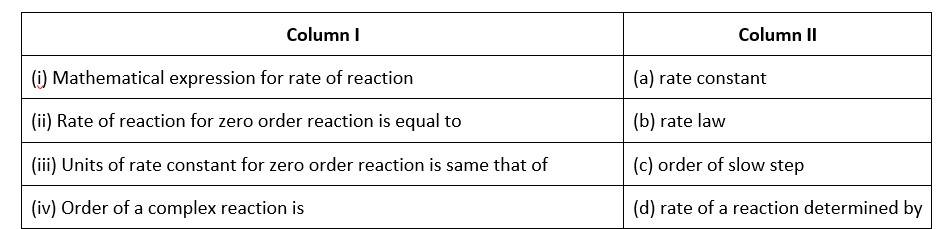
This is a Matching Type Question as classified in NCERT Exemplar
(i)- (b) ; (ii)- (a) ; (iii)- (d); (iv)- (c)
The rate rule was discovered experimentally and can be used to predict the reaction rate and reactant concentrations.
The rate constant is the proportionality constant that describes the
Upvote Match the items of Column I and Column II based on data given below:
Column I
Column II
(i)F2
(a)metal is the strongest reducing agent
(ii)Li
(b)metal ion which is the weakest oxidizing agent
(iii)Au 3+
(c)non-metal which is the best oxidizing agent
(iv)Br −
(d)unreactive metal
(v)Au
(e)anion that can be oxidized by Au 3+
(vi)Li+
(f)anion which is the weakest reducing agent
(vii)F−
(g)metal which is an oxidising agent
E F2/F=2.87V E Li/Li= 3.5V EAu3+/Au = 1.4V E Br2/Br- = 1.09V
Match the items of Column I and Column II based on data given below:
|
Column I |
Column II |
|
(i)F2 |
(a)metal is the strongest reducing agent |
|
(ii)Li |
(b)metal ion which is the weakest oxidizing agent |
|
(iii)Au 3+ |
(c)non-metal which is the best oxidizing agent |
|
(iv)Br − |
(d)unreactive metal |
|
(v)Au |
(e)anion that can be oxidized by Au 3+ |
|
(vi)Li+ |
(f)anion which is the weakest reducing agent |
|
(vii)F− |
(g)metal which is an oxidising agent |
E F2/F=2.87V E Li/Li= 3.5V EAu3+/Au = 1.4V E Br2/Br- = 1.09V
This is a Matching Type Questions as classified in NCERT Exemplar
Ans: (i) F2 is a non-metal which is the best oxidizing agent since the standard reduction potential of F2 is 2.87V.
(ii)Liis a metal and the strongest reducing agent because the standard reduction potential of Li is −3.05V.
(iii
Upvote 
This is a Matching Type Question as classified in NCERT Exemplar
(i)- (b) ; (ii)- (c) ; (iii)- (a)
The rate of conversion in diamond is normally imperceptible.
Long-term rate at a moment's notice
The average rate is only for a short time.
Upvote Match the items of column I and column II
Column I
Column II
(i)Lechlanche cell
(a)cell reaction
(ii)Ni−Cd
(b) does not involve any ion in solution and is used in hearing aids.
(iii)Fuel cell
(c)rechargeable
(iv)Mercury cell
(d)reaction at anode
(e) converts energy of combustion into electrical energy
Match the items of column I and column II
|
Column I |
Column II |
|
(i)Lechlanche cell |
(a)cell reaction |
|
(ii)Ni−Cd |
(b) does not involve any ion in solution and is used in hearing aids. |
|
(iii)Fuel cell |
(c)rechargeable |
|
(iv)Mercury cell |
(d)reaction at anode |
|
(e) converts energy of combustion into electrical energy |
This is a Matching Type Questions as classified in NCERT Exemplar
Ans: (i)The reaction occurring at Lechlanche cells are
At anode: Zn→Zn2+ + 2e−
At cathode: MnO2 + NH4+ + e−→MnO (OH)+NH3
(ii)Ni−Cd is rechargeable. So it has a longer lifetime.
(iii) Energy in the fuel cell is due to the comb
Upvote Match the statements given in Column I and Column II

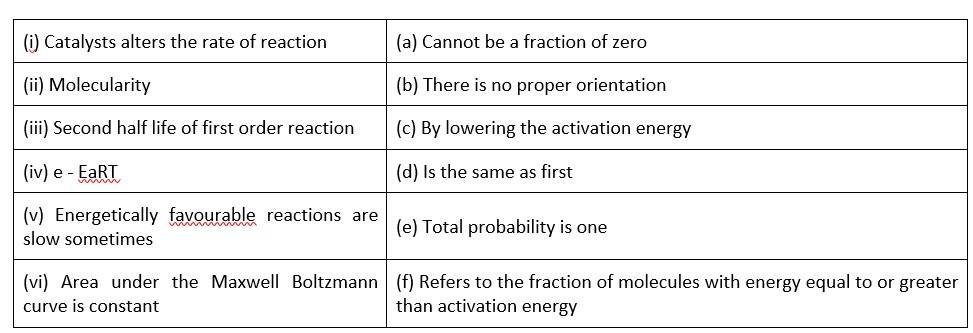
Match the statements given in Column I and Column II
This is a Matching Type Question as classified in NCERT Exemplar
(i)- (c) ; (ii)- (a) ; (iii)- (d); (iv)- (f); (v)- (b); (vi)- (b)
A catalyst can influence the rate of a process by lowering the activation energy
When it comes to molecularity, there can't be a fraction or a zero.
The second half life of
Upvote