
Ncert Solutions Chemistry Class 12th
Get insights from 2.6k questions on Ncert Solutions Chemistry Class 12th, answered by students, alumni, and experts. You may also ask and answer any question you like about Ncert Solutions Chemistry Class 12th
- 2.6k
Questions
- 0
Discussions
- 0
Active Users
- 79
Followers
Have a question about Ncert Solutions Chemistry Class 12th? Ask our experts
Keep it short & simple. Type complete word. Avoid abusive language.
This is a Short Answer Type Questions as classified in NCERT Exemplar
Ans: At the stage of equilibrium E? Cell =0. So according to the relation,
ΔrG =−nFEcell
ΔrG =−n×F×0
ΔrG =0
 Upvote

In a reaction if the concentration of reactant A is tripled, the rate of reaction becomes twenty-seven times. What is the order of the reaction?
In a reaction if the concentration of reactant A is tripled, the rate of reaction becomes twenty-seven times. What is the order of the reaction?
This is a Short Answer Type Question as classified in NCERT Exemplar
Let order of reaction be = n
rate = k [A]n- (i)
27r = k [3A]n- (ii)
Divide (ii) by (i)
= k [3A]nn
3n = 27
n = 3
Upvote Can EᶱCell or ΔrG for cell reactions to ever be equal to zero?
Can EᶱCell or ΔrG for cell reactions to ever be equal to zero?
This is a Short Answer Type Questions as classified in NCERT Exemplar
Ans: E? Cell can never be zero. For a feasible reaction E? Cell should be positive or ΔrGshould be negative and at the stage of equilibrium, both of these parameters are zero.
Upvote For which type of reactions, order and molecularity have the same value?
For which type of reactions, order and molecularity have the same value?
This is a Short Answer Type Question as classified in NCERT Exemplar
The order and molecularity of elementary reactions are the same. As a result of a single collision between two molecules or ions, a complicated process occurs. A reaction mechanism is a set of elementary reactions.
Upvote Can the absolute electrode potential of an electrode be measured?
Can the absolute electrode potential of an electrode be measured?
This is a Short Answer Type Questions as classified in NCERT Exemplar
Ans:No, the difference in potentials of the electrodes is measured. A reference electrode is to be taken while measuring the electrode potential of the electrode.
Upvote How can you determine the rate law of the following reaction?
2NO(g) + O2(g)→2NO2(g)
How can you determine the rate law of the following reaction?
2NO(g) + O2(g)→2NO2(g)
This is a Short Answer Type Question as classified in NCERT Exemplar
Experimentally, the reaction's rate law can be calculated.
Step 1
2NO (g) + O2 (g)→2NO2 (g)
O2 (g) is taken in excess
x molecules of NO number reacting with excess of O2
r = k [NO]x
Step 2
2NO (g) + O2 (g)→2NO2 (g)
When 2No
Upvote What is the relationship between Gibbs free energy of the cell reaction in a galvanic cell and the emf of the cell? When will the maximum work be obtained from a galvanic cell?
What is the relationship between Gibbs free energy of the cell reaction in a galvanic cell and the emf of the cell? When will the maximum work be obtained from a galvanic cell?
This is a Long Answer Type Questions as classified in NCERT Exemplar
Ans: The relation between Gibbs free energy and the emf of the cell is as follows;
ΔG=−nFEcell
E cell s the cell potential
is the standard emf of the cell
Maximum work obtained from the galvanic cell is nFE .
Upvote Write the rate equation for the 2A + B→C if the order of the reaction is zero
Write the rate equation for the 2A + B→C if the order of the reaction is zero
This is a Short Answer Type Question as classified in NCERT Exemplar
Given: Order of the reaction = 0
We know that a zero order reaction is a chemical reaction that occurs regardless of the reactant's concentration.
The rate law of 2A + B→C is
r = k [A]0 [B]0
For a zero- order reaction
r = k
Upvote Consider Fig. 3.2 and answer the questions (i) to (vi) given below
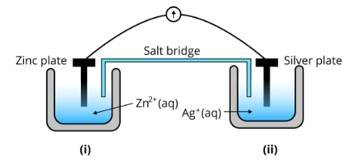
(i) Redraw the diagram to show the direction of electron flow.
(ii) Is silver plate the anode or cathode?
(iii) What will happen if the salt bridge is removed?
(iv) When will the cell stop functioning?
(v) How will the concentration of Zn2+ ions and Ag+ ions be affected when the cell functions?
(vi) How will the concentration of Zn2+ ions and Ag+ ions be affected after the cell becomes ‘dead?
Consider Fig. 3.2 and answer the questions (i) to (vi) given below
(i) Redraw the diagram to show the direction of electron flow.
(ii) Is silver plate the anode or cathode?
(iii) What will happen if the salt bridge is removed?
(iv) When will the cell stop functioning?
(v) How will the concentration of Zn2+ ions and Ag+ ions be affected when the cell functions?
(vi) How will the concentration of Zn2+ ions and Ag+ ions be affected after the cell becomes ‘dead?
This is a Long Answer Type Questions as classified in NCERT Exemplar
Ans: (i) The diagram is as follows;
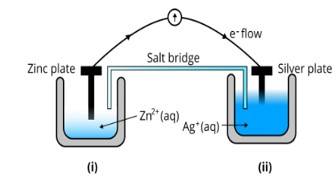
(ii) Agis cathode where the reduction process is taking place where Ag+ takes electrons and deposits them at the cathode
(iii) Potential is zero when the salt bridge is suddenly removed.
(iv) Cel
Upvote State a condition under which a bimolecular reaction is kinetically first order reaction.
State a condition under which a bimolecular reaction is kinetically first order reaction.
This is a Short Answer Type Question as classified in NCERT Exemplar
A bimolecular reaction occurs when two particles collide. The product of the concentrations of both elements determines the rate of reaction. If one of the reactants is taken in substantial excess in such a way that its concentratio
Upvote