Ncert Solutions Chemistry Class 12th

Get insights from 2.6k questions on Ncert Solutions Chemistry Class 12th, answered by students, alumni, and experts. You may also ask and answer any question you like about Ncert Solutions Chemistry Class 12th

Follow Ask Question
2.6k

Questions

0

Discussions

1

Active Users

79

Followers

New answer posted

7 months ago

0 Follower 37 Views

R
Raj Pandey

Contributor-Level 9

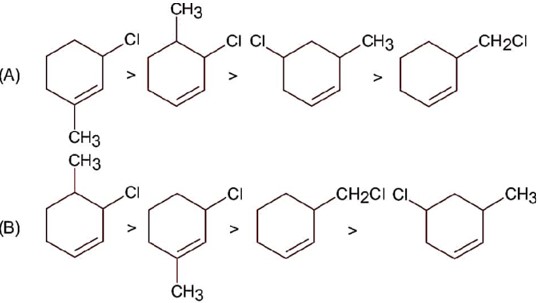
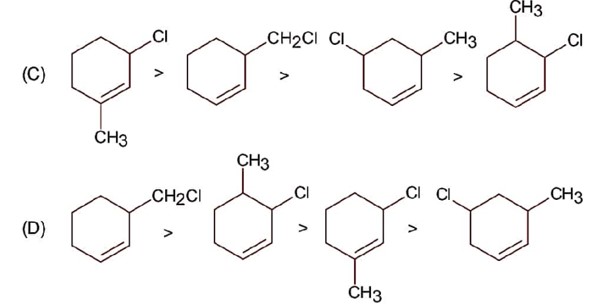
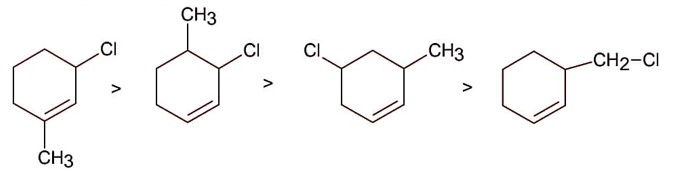
Compound react with SN1 mechanism in presence of polar protic solvent, which follows carbocation forming path.

Hence correct order is.
 

New answer posted

7 months ago

0 Follower 1 View

R
Raj Pandey

Contributor-Level 9

In electrolytic reduction of Al2O3, cryolite (Na3AlF6) is used to increase conductivity & decrease melting point. Oxidation state of Al in cryolite (Na3AlF6) is (+3).

New answer posted

7 months ago

0 Follower 1 View

R
Raj Pandey

Contributor-Level 9

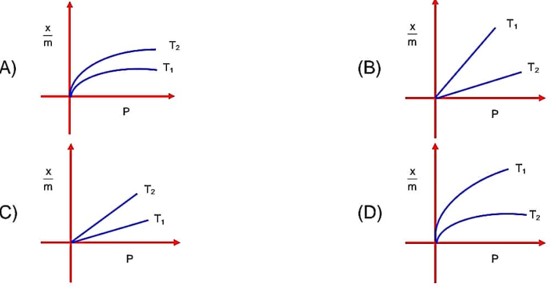
By increases in temperature absorption decreases, T1 > T2 means higher absorption at T2 temperature.

New answer posted

7 months ago

0 Follower 1 View

R
Raj Pandey

Contributor-Level 9

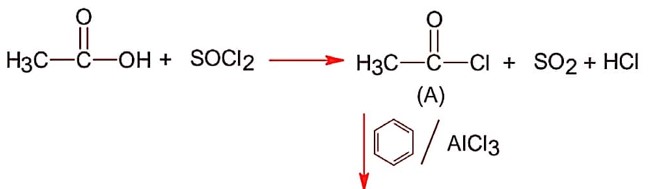
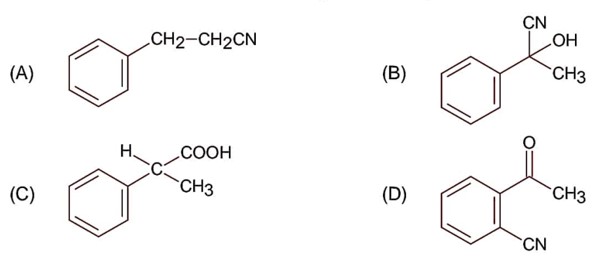
Kindly consider the following Image.


New answer posted

7 months ago

0 Follower 2 Views

R
Raj Pandey

Contributor-Level 9

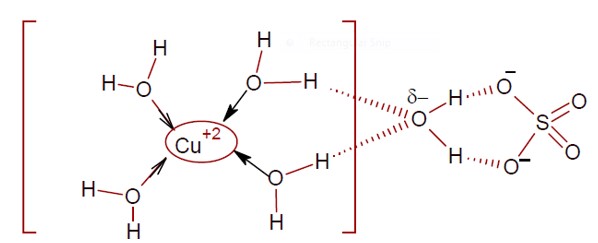
One water molecule is associated with hydrogen bond.

Ans. = 1

New answer posted

7 months ago

0 Follower 1 View

R
Raj Pandey

Contributor-Level 9

Cl, Br & I form halic (V) acid i.e. HClO3, HBrO3 & HlO3.

New answer posted

7 months ago

0 Follower 8 Views

R
Raj Pandey

Contributor-Level 9

HgS, PbS, CuS, Sb2S3, As2S3, & CdS are given sulphides

              CdS, PbS, As2S3 & CuS are soluble in 50% HNO3 but Sb2S3 & HgS are not soluble.

              Ans. = 4
New answer posted

7 months ago

0 Follower 11 Views

R
Raj Pandey

Contributor-Level 9

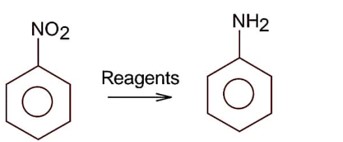
Reagents can be used are Þ       (1) Sn/HCl

                                                                        (2) Fe/HCl


...more

New answer posted

8 months ago

0 Follower 3 Views

A
alok kumar singh

Contributor-Level 10

Energy of emitted photon in 0.1 sec = 10-4 J

n * h c λ = 1 0 4

n * 6 . 6 3 * 1 0 3 4 * 3 * 1 0 8 1 0 0 0 * 1 0 9 = 1 0 4

n = 5 . 0 2 * 1 0 1 4 = 5 0 . 2 * 1 0 1 3 5 0 * 1 0 1 3


New answer posted

8 months ago

0 Follower 5 Views

A
alok kumar singh

Contributor-Level 10

Applying : ( n 1 + n 2 ) i n i t i a l = ( n 1 + n 2 ) f i n a l  

Assuming the system attains a final temperature of T (Such that 300 < T < 60)

(Heat lost by N2 of container l) = (Heat gained by N2 of container II)

n 1 C m ( 3 0 0 T ) = n 2 C m ( T 6 0 )  

( 2 . 8 2 8 ) ( 3 0 0 T ) = 0 . 2 2 8 ( T 6 0 )  

14 (300 – T) = T – 60

P = ( 3 2 8 ) * 8 . 3 1 * 2 8 4 3 * 1 0 3 * 1 0 5 b a r = 0 . 8 4 2 8 7 b a r

P = 8 4 . 2 8 * 1 0 2 b a r

8 4 * 1 0 2 b a r  


Get authentic answers from experts, students and alumni that you won't find anywhere else

Sign Up on Shiksha

On Shiksha, get access to

  • 66k Colleges
  • 1.2k Exams
  • 687k Reviews
  • 1800k Answers

Share Your College Life Experience

×

This website uses Cookies and related technologies for the site to function correctly and securely, improve & personalise your browsing experience, analyse traffic, and support our marketing efforts and serve the Core Purpose. By continuing to browse the site, you agree to Privacy Policy and Cookie Policy.