Ncert Solutions Maths class 11th

Get insights from 1.6k questions on Ncert Solutions Maths class 11th, answered by students, alumni, and experts. You may also ask and answer any question you like about Ncert Solutions Maths class 11th

  • 1.6k

    Questions

  • 0

    Discussions

  • 0

    Active Users

  • 83

    Followers

Have a question about Ncert Solutions Maths class 11th? Ask our experts

Ask Your Question

Keep it short & simple. Type complete word. Avoid abusive language.

New answer posted•a year ago
A
a year ago

60. Given, f (x) = sinx+cosxsinx−cosx

So, f?(x) = sinx−cosxddx(sinx+cosx)−(sinx+cos2)ddx(sinx−cosx)(sinx−cosx)2

Let g(x) = cos x and p(x) = sin x.

{from so g’(x) A ) (upto equation 3)

Let g(x) = cos2 and p(x) = sin x.

So, g?(x) = limh→0g(x+h)−g(x)h
=limh→01h[cos(x+h)−cosx]

=limh→01h[−2·sin(x+h+x2)sin(x+h−x2)]

=limh→01h[−2sin(2x+h2)sin(h2)]

=−sin(2x+02)×1

= -sin x ______ (2)

And p?(x) = limh→0p(x+h)−p(x)h

=limh→0sin(x+h)−sinxh

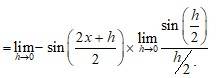
=limh→01h⋅2cos(2x+h2)sin(h2)

=limh→0cos(2x+h2)×limh→0sin(h2)(h2)

= cos x _____ (3)

Putting (2) and (3) in (1) we get,

f′(x)=(sinx−cosx)[cosx−sinx]−(csinx+cosx)[cosx+sinx](sinx−cosx)2

=−(sinx−cosx)2−(sinx+cosx)2(sinx−cosx)2

=−(sin2x+cos2x)+2sinxcosx−(sin2x+cos2x)−2sinxcosx(sinx−cosx)2

=−1−1(sinx−cosx)2=−2(sinx−cosx)2

Thumbs Up IconUpvote Thumbs Down Icon
New answer posted•a year ago
A
a year ago

59. Given, f (x) = cosx1+sinx

So, f?(x) = (1+sinx)ddx(cosx)−cosxddx(1+sinx)(1+sinx)2

Putting (2) and (3) in (1) we get,

f′(x)=(1+sinx)(−sinx)−cosx(cosx)(1+sinx)2

=sinx−sin2x−cos2x(1+sinx)2

=−sinx−(sin2x+cos2x)(1+sinx)2

=−(sinx+1)(1+sinx)2=−11+sinx.

Thumbs Up IconUpvote Thumbs Down Icon
New answer posted•a year ago
A
a year ago

58. Given f (x) = cosec x. cot x.

By Leibnitz product rule,

So, g(x) = limh→0g(x+h)−g(x)h

=limh→0cot(x+h)−cotxh

=limh→01h[cos(x+h)sin(x+h)−cosxsinx]

=limh→01h[sinxcos(x+h)−cosxsin(x+h)sinxsin(x+h)]

=limh→01h[sin(x−(x+h))sinxsin(x+h)] [?csin (A−B)=sinAcosB−cosAsinB]

=limh→01h  [sin (−h)sin x. sin (x+h)]

=limh→01sinxsin(x+h)×(−1)limh→0sinhh

=1sinxsin(x+0)×(−1)

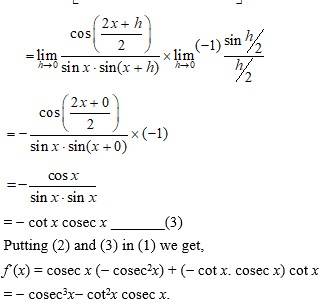
= -cosec2x.______(2)

And hx) = limh→0h(x+h)−h(x)h

=limh→0cosec(x+h)−cosecxh

=limh→01h[1sin(x+h)−1sinx]

=limh→01h[sinx−sin(x+h)sinx·sin(x+h)]

=limh→01h[2cos(x+x+h2)sin(x−(x+h)2)sinxsin(x+h).]

Thumbs Up IconUpvote Thumbs Down Icon
New answer posted•a year ago
A
a year ago

57. Given, f (x) = sin (x + a)

So, f (x) = limh→0f (x+h)−f (x)h

=limh→0sin (x+h+a)−sin (x+a)h

=limh→01h·2  cos (x+h+a+x+a2)sin (x+h+a− (x+a)2)

=limh→0cos (2x+2a+h2)limh→0sin (h2)h2

=cos (2x+2a+0)2×1

= cos (x + a)

Thumbs Up IconUpvote Thumbs Down Icon
New answer posted•a year ago
A
a year ago

56. Given, f (x) = (ax + b)n (cx + d)m

So, f’(x) = (ax+b)nddx(cx+d)n+(cx+d)mddx(ax+b)n

=(ax+b)x·mc(cx+d)m−1+(cx+d)mna(ax+b)x−1

=(ax+b)n−1(cx+d)m−1[(ax+b)·mc+(cx+d)na]

=(ax+b)n−1(cx+d)m−1[mc(ax+b)+na(cx+d)]

Thumbs Up IconUpvote Thumbs Down Icon
New answer posted•a year ago
A
a year ago

55. Given, f (x) = (ax + b)n

Chain rule,  ddxu (x)n=nu (x)n−1dudxu (x) where

u (x) is a function of x.

So, f (x) = ddx (ax+b)n

=n (ax+b)n−1ddx (ax+b)

=na (ax+b)n−1

Thumbs Up IconUpvote Thumbs Down Icon
New answer posted•a year ago
A
a year ago
54. 

So f? (x) = ddx (4−2)

=ddx (4)−ddx (2)

=4ddx (x12)−0=4×12x12−1=2x−12=2


Thumbs Up IconUpvote Thumbs Down Icon
New answer posted•a year ago
A
a year ago

53. Given, f (x) = =ax4−bx+cosx

So, f(x) = limh→0f(x+h)−f(x)h

=limh→01h[a(x+n)4−b(x+h)2+cos(x+h)−(ax4−bx2+cosx)]

=limh→0  ah  [1(x+h)4−1x4]−limh→0bh[1(x+h)2−1x2]+limh→01h[cos(x+h)−cosx]

=limh→0ah[x4−(x+h)4(x+h)4·x4]−limh→0bh[x2−(x+h)2(x+h)2·x2]+

limh→01h[−2sin(x+h+x2)sin(x+h−x2)]

=limh→0ah[x4−x4−4x3h−6x2h2−4xh3−h3x4·(x+h)4]−limh→0bh[x2−x2−h2−2xhx2(x+h)2]

+limh→0ah[−2sin(2x+h2)sinh2]

=limh→0ah[h(−4x3−6x2h−4xh2−h2)x4(x+h)4]−limh→0  bh   [h(−h−2x)x2(x+h)2]

−limh→0sin(2x+h2)limh→0sinh2h2

=limh→0a(−4x3−6x2h−4xh2−h2)x4(x+h)4−limh→0b(−h−2x)x2(x+h)2

sin(2x+02)×1

=a(−4x3)x4·x4−b(−2x)x2·x2−sinx.

=−4ax5+2bx3−sinx

Thumbs Up IconUpvote Thumbs Down Icon
New answer posted•a year ago
A
a year ago

52. Given, f (x) = px2+qx+rax+b

f′(x)=(ax+b)ddx(px2+qx+r)−(px2+qx+r)ddx(ax+b)(ax+b)2

=(ax+b)(2xp+q)−(px2+qx+r)(a)(ax+b)2

=2apx2+2bpx+aqx+bq−apx2−aqx−ar(ax+b)2

=apx2+2bpx+bq−ar(ax+b)2

Thumbs Up IconUpvote Thumbs Down Icon
New answer posted•a year ago
A
a year ago

51. Given, f (x) = (ax+b)px2+qx+r

So, f(x) = (px2+qx+r)ddx(ax+b)−(ax+b)ddx(px2+qx+r)(px2+qx+r)2

 =(px2+qx+r)a−(ax+b)(2xp+q)(px2+qx+r)2

=apx2+aqx+ar−2apx2−aqx−2bpx−b(px2+qx+9)2q.

=− apx2−2bpx+ar−bq(px2+qx+r)2

Thumbs Up IconUpvote Thumbs Down Icon