
Ncert Solutions Maths class 12th
Get insights from 2.5k questions on Ncert Solutions Maths class 12th, answered by students, alumni, and experts. You may also ask and answer any question you like about Ncert Solutions Maths class 12th
- 2.5k
Questions
- 0
Discussions
- 1
Active Users
- 65
Followers
Have a question about Ncert Solutions Maths class 12th? Ask our experts
Keep it short & simple. Type complete word. Avoid abusive language.
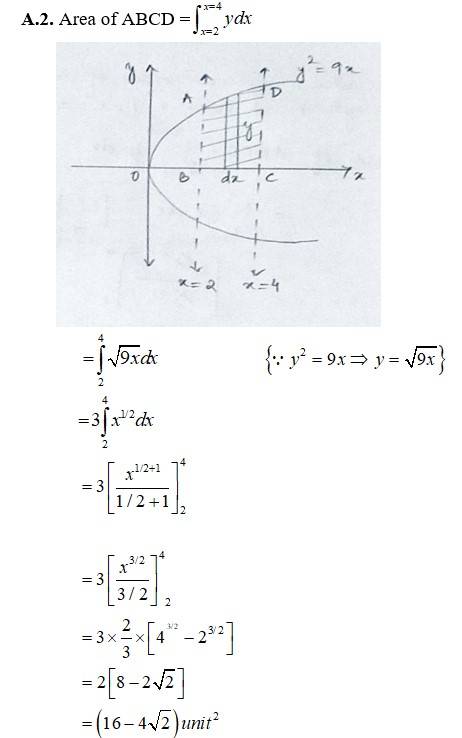
2. Find the area of the region bounded by the curve y² = 9x and the lines x=2,x=4 and x-axis in the first quadrant.
2. Find the area of the region bounded by the curve y² = 9x and the lines x=2,x=4 and x-axis in the first quadrant.
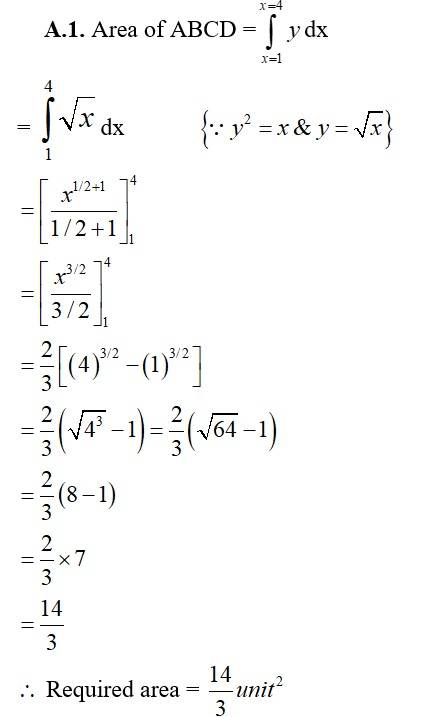
1. Find the area of the region bounded by the curve y² = x the lines x=1, x = 4 and x-axis.
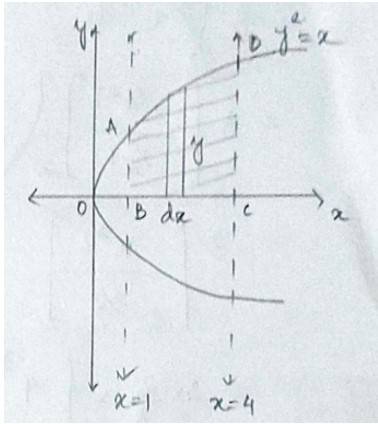
1. Find the area of the region bounded by the curve y² = x the lines x=1, x = 4 and x-axis.

113. The general solution of the differential equation is:
113. The general solution of the differential equation is:
The given differential equation is:
This is a linear differential equation of the form
The general solution of the given differential equation is given by,
Therefore, option (c) is correct.
 Upvote

112. The general equation of a differential equation of the type
112. The general equation of a differential equation of the type
The integrating factor of the given differential equation
The general solution of the differential equation is given by,
Hence, the correct answer is C.
Upvote Choose the correct answer:
111. The general solution of the differential equation is:
Choose the correct answer:
111. The general solution of the differential equation is:
The given differential equation is:
Integration both sides, we get:
Therefore, option (C) is correct.
Upvote 110. The population of a village increases continuously at the rate proportional to the number of its inhabitants present at any time. If the population of the village was 20,000 in 1999 and 25,000 in the year 2004, what will be the population of the village in 2009?
110. The population of a village increases continuously at the rate proportional to the number of its inhabitants present at any time. If the population of the village was 20,000 in 1999 and 25,000 in the year 2004, what will be the population of the village in 2009?
Let the population at any instant (t) be y.
It is given that the rate of increase of population is proportional to the number of inhabitants at any instant.
(k is constant)
Integration both sides, we get:
In the year
Therefore, we get:
In the year
Therefore, we get:
In the year&n
Upvote 109. Find the particular solution of the differential equation given that y = 0 when x = 0
109. Find the particular solution of the differential equation given that y = 0 when x = 0
Integrating both sides, we get:
Substituting this value in equation (1), we get:
Now, at x=0& y=0, equation (2) becomes:
Substituting in equation (2), we get:
This is the required particular solution of the given differential equation.
Upvote 108. Find the particular solution of the differential equation
given that y = 0 when x = π/2
108. Find the particular solution of the differential equation
given that y = 0 when x = π/2
The given differential equation is:
This equation is a linear equation of the form
The general solution of the given differential equation is given by,
Therefore, equation (1) becomes:
Substituting in equation (1), we get:
This is the required particular solution of the given differential equa
Upvote 
