
Physics Electrostatic Potential and Capacitance
Get insights from 131 questions on Physics Electrostatic Potential and Capacitance, answered by students, alumni, and experts. You may also ask and answer any question you like about Physics Electrostatic Potential and Capacitance
- 131
Questions
- 0
Discussions
- 0
Active Users
- 0
Followers
Have a question about Physics Electrostatic Potential and Capacitance? Ask our experts
Keep it short & simple. Type complete word. Avoid abusive language.
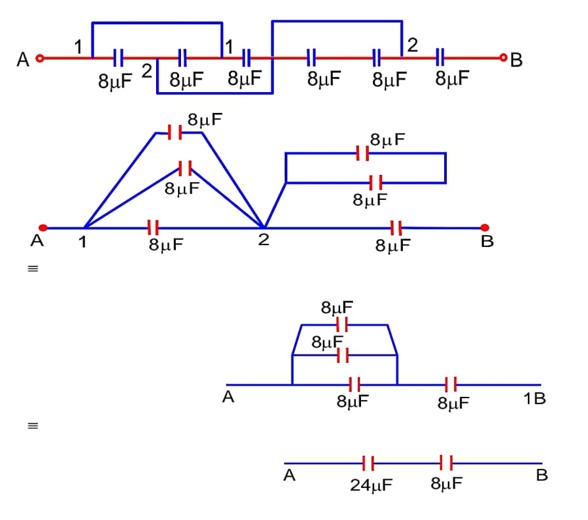
The equivalent capacitance between points A and B in below shown figure will be………….
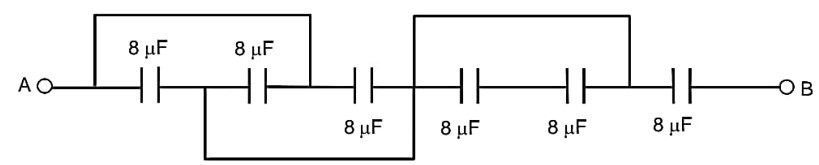
The equivalent capacitance between points A and B in below shown figure will be………….
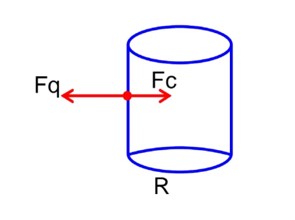
A long cylindrical volume contains a uniformly distributed charge of density <!-- [if gte mso 9]><xml>
A long cylindrical volume contains a uniformly distributed charge of density <!-- [if gte mso 9]><xml>
If the charge on a capacitor is increased by 2C, the energy stored in it increases by 44%. The original charge on the capacitor is (in C)
If the charge on a capacitor is increased by 2C, the energy stored in it increases by 44%. The original charge on the capacitor is (in C)
Uf = 1.44 Ui
Qf = Q + 2
0.2 Q = 2
Q = 10 C
 Upvote

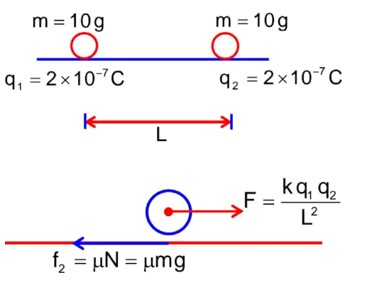
Two identical charged particles each having a mass 10g and charge 2.0 × 10⁻⁷ C are placed on a horizontal table with a separation of L between them such that they stay in limited equilibrium. If the coefficient of friction between each particle and the table is 0.25, find the value of L. [Use g = 10ms-2]
Two identical charged particles each having a mass 10g and charge 2.0 × 10⁻⁷ C are placed on a horizontal table with a separation of L between them such that they stay in limited equilibrium. If the coefficient of friction between each particle and the table is 0.25, find the value of L. [Use g = 10ms-2]
Two point charge Q each are placed at a distance d apart. A third point charge q is placed at a distance x from mid-point on the perpendicular bisector. The value of x at which charge q will experience the maximum Coulomb’s force is:
Two point charge Q each are placed at a distance d apart. A third point charge q is placed at a distance x from mid-point on the perpendicular bisector. The value of x at which charge q will experience the maximum Coulomb’s force is:
According to question, we can write
For maxima of force
Upvote A positive charge particle of 100mg is thrown in opposite direction to a uniform electric field of strength 1 × 10⁵ NC-1, If the charge on the particle is <!-- [if gte mso 9]><xml>
A positive charge particle of 100mg is thrown in opposite direction to a uniform electric field of strength 1 × 10⁵ NC-1, If the charge on the particle is <!-- [if gte mso 9]><xml>
a =
= 40 * 103 m/sec2
v2 = u2 + 2a s
&n
Upvote A source of potential difference V is connected to the combination of two identical capacitors as shown in the figure. When key ‘K’ is closed, the total energy stored across the combination is E1. Now key ‘K’ is opened and dielectric of dielectric constant 5 is introduced between the plates of the capacitors. The total energy stored across the combination is now E2. The ratio E1/E2 will be:

A source of potential difference V is connected to the combination of two identical capacitors as shown in the figure. When key ‘K’ is closed, the total energy stored across the combination is E1. Now key ‘K’ is opened and dielectric of dielectric constant 5 is introduced between the plates of the capacitors. The total energy stored across the combination is now E2. The ratio E1/E2 will be:
I > When switch is closed
Ceq = 2C
Energy E1 =
E1 = CV2
II > When switch is opened
Upvote Two uniformly charged spherical conductors A and B of radii 5mm and 10mm are separated by a distance of 2cm. If the spheres are connected by a conducting wire, then in equilibrium condition, the ratio of the magnitudes of the electric fields at the surface of the sphere A and B will be:
Two uniformly charged spherical conductors A and B of radii 5mm and 10mm are separated by a distance of 2cm. If the spheres are connected by a conducting wire, then in equilibrium condition, the ratio of the magnitudes of the electric fields at the surface of the sphere A and B will be:
A capacitor is fully charged with voltage . After disconnecting the voltage source, it is connected in parallel with another uncharged capacitor of capacitance. . The energy loss in the process after the charge is distributed between the two capacitor is:
A capacitor is fully charged with voltage . After disconnecting the voltage source, it is connected in parallel with another uncharged capacitor of capacitance. . The energy loss in the process after the charge is distributed between the two capacitor is: