
Physics Gravitation
Get insights from 158 questions on Physics Gravitation, answered by students, alumni, and experts. You may also ask and answer any question you like about Physics Gravitation
- 158
Questions
- 0
Discussions
- 0
Active Users
- 4
Followers
Have a question about Physics Gravitation? Ask our experts
Keep it short & simple. Type complete word. Avoid abusive language.
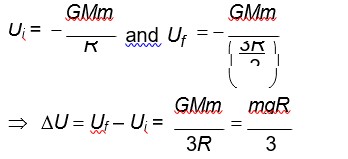
Gravitational force between two point masses is found to be F when both are in vacuum. If both the masses are immersed in water, new gravitational force will be:
Gravitational force between two point masses is found to be F when both are in vacuum. If both the masses are immersed in water, new gravitational force will be:
Gravitational force does not depend on the surrounding medium.
 Upvote

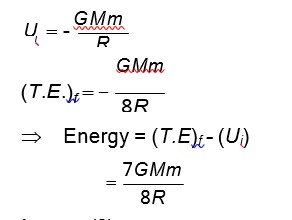
Consider the following two statements .
<!-- [if !supportLists]-->(A)<!--[endif]-->The gravitational force on a particle inside a spherical shell is zero.
<!-- [if !supportLists]-->(B) <!--[endif]-->Total mechanical energy of a body on earth’s surface may be positive.
Which of the following options is correct?
Inside a spherical shell gravitational field is zero, so net force acting on a particle placed inside it is also zero.
Total energy of a bound system is always negative.
Upvote The potential energy of a body of mass 3 kg on the surface of a planet is 54 joule. The escape velocity will be
The potential energy of a body of mass 3 kg on the surface of a planet is 54 joule. The escape velocity will be
By given
By conservation of mechanical energy law
v= 6m/s
Upvote 
