
Physics Gravitation
Get insights from 158 questions on Physics Gravitation, answered by students, alumni, and experts. You may also ask and answer any question you like about Physics Gravitation
- 158
Questions
- 0
Discussions
- 0
Active Users
- 4
Followers
Have a question about Physics Gravitation? Ask our experts
Keep it short & simple. Type complete word. Avoid abusive language.
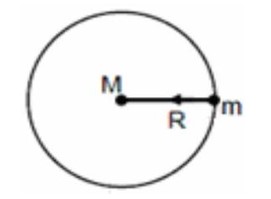
The mass density of a spherical galaxy varies as K/r over a large distance 'r' from its center. In that region, a small star is in a circular orbit of radius R. Then the period of revolution, T depends on R as:
The mass density of a spherical galaxy varies as K/r over a large distance 'r' from its center. In that region, a small star is in a circular orbit of radius R. Then the period of revolution, T depends on R as:
M = ∫ ρdV
M = ∫? (k/r) 4πr²dr
M = 4πkR?²/2 = 2πkR?²
F? = GMm/R?² = 2ω?²R
 Upvote

A satellite is in an elliptical orbit around a planet P. It is observed that the velocity of the satellite when it is farthest from the planet is 6 times less than that when it is closest to the planet. The ratio of distances between the satellite and the planet at closest and farthest points is:
<!-- [if !supportLineBreakNewLine]-->
<!--[endif]-->
v_max/v_min = (1+e)/ (1-e)
r_max/r_min = (1+e)/ (1-e) = 6
Upvote The acceleration due to gravity on the earth's surface at the poles is g an and angular velocity of the earth about the axis passing through the pole is ω. An object is weight at the equator and at a height h above the poles by using a spring balance. If the weights are found to be same, then h is : (h << R, where R is the radius of the earth)
<!-- [if !supportLineBreakNewLine]-->
<!--[endif]-->
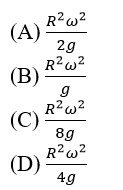
The acceleration due to gravity on the earth's surface at the poles is g an and angular velocity of the earth about the axis passing through the pole is ω. An object is weight at the equator and at a height h above the poles by using a spring balance. If the weights are found to be same, then h is : (h << R, where R is the radius of the earth)
<!-- [if !supportLineBreakNewLine]-->
<!--[endif]-->
g_e = g - Rω²
g? = g - (2gh/R)
Now Rω² = 2gh/R
h = R²ω²/2g
Upvote 
<p><strong>Consider two solid spheres of radii <span class="mathml" contenteditable="false"> <math> <msub> <mrow> <mrow> <mi>R</mi> </mrow> </mrow> <mrow> <mrow> <mn>1</mn> </mrow> </mrow> </msub> <mo>=</mo> <mn>1</mn> <mtext> </mtext> <mi mathvariant="normal">m</mi> </math> </span><math><msub><mrow><mrow></mrow></mrow><mrow><mrow></mrow></mrow></msub><mtext></mtext></math> , <span class="mathml" contenteditable="false"> <math> <msub> <mrow> <mrow> <mi>R</mi> </mrow> </mrow> <mrow> <mrow> <mn>2</mn> </mrow> </mrow> </msub> <mo>=</mo> <mn>2</mn> <mi>m</mi> </math> </span><math><msub><mrow><mrow></mrow></mrow><mrow><mrow></mrow></mrow></msub></math> and masses <span class="mathml" contenteditable="false"> <math> <msub> <mrow> <mrow> <mi>M</mi> </mrow> </mrow> <mrow> <mrow> <mn>1</mn> </mrow> </mrow> </msub> </math> </span><math><msub><mrow><mrow></mrow></mrow><mrow><mrow></mrow></mrow></msub></math> and<span class="mathml" contenteditable="false"> <math> <msub> <mrow> <mrow> <mi>M</mi> </mrow> </mrow> <mrow> <mrow> <mn>2</mn> </mrow> </mrow> </msub> </math> </span> <math><msub><mrow><mrow></mrow></mrow><mrow><mrow></mrow></mrow></msub></math> , respectively. The gravitational field due to sphere (1) and (2) are shown. The value of <span class="mathml" contenteditable="false"> <math> <mfrac> <mrow> <mrow> <msub> <mrow> <mrow> <mi>M</mi> </mrow> </mrow> <mrow> <mrow> <mn>1</mn> </mrow> </mrow> </msub> </mrow> </mrow> <mrow> <mrow> <msub> <mrow> <mrow> <mi>M</mi> </mrow> </mrow> <mrow> <mrow> <mn>2</mn> </mrow> </mrow> </msub> </mrow> </mrow> </mfrac> </math> </span><math><mfrac><mrow><mrow><msub><mrow><mrow></mrow></mrow><mrow><mrow></mrow></mrow></msub></mrow></mrow><mrow><mrow><msub><mrow><mrow></mrow></mrow><mrow><mrow></mrow></mrow></msub></mrow></mrow></mfrac></math> is:</strong></p>
<div class="photo-widget-full">
<div class="figure"><picture><source srcset="" media="(max-width: 500px)"><img src="https://images.shiksha.com/mediadata/images/1755770888phpBsHxa0.jpeg" alt="" width="239" height="178" loading="lazy"></picture></div>
</div>
<p> </p>
A satellite of mass is launched vertically upwards with an initial speed from the surface of the earth. After it reaches height radius of the earth), it ejects a rocket of mass so that subsequently the satellite moves in a circular orbit. The kinetic energy of the rocket is ( is the gravitational constant ; is the mass of the earth)
A satellite of mass is launched vertically upwards with an initial speed from the surface of the earth. After it reaches height radius of the earth), it ejects a rocket of mass so that subsequently the satellite moves in a circular orbit. The kinetic energy of the rocket is ( is the gravitational constant ; is the mass of the earth)
Transverse velocity of rocket
Radial velocity of rocket
Kinetic energy
Upvote 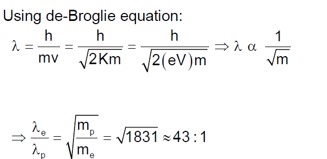
Two identical particles of mass 1 kg each go round a circle of radius R, under the action of their mutual gravitational attraction. The angular speed of each particle is:
<!-- [if !supportLineBreakNewLine]-->
<!--[endif]-->
Two identical particles of mass 1 kg each go round a circle of radius R, under the action of their mutual gravitational attraction. The angular speed of each particle is:
<!-- [if !supportLineBreakNewLine]-->
<!--[endif]-->
F = Gm²/ (2R)² = mω²R Given m = 1kg
⇒ ω² = Gm/ (4R³)
⇒ ω = (1/2)√ (G/R³)
Upvote The planet Mars has two moons, if one of them has a period 7 hours, 30 minutes and an orbital radius of 9.0 × 10³ km. Find the mass of Mars.
{Given 4π²/G = 6 × 10¹¹ N⁻²kg²}
The planet Mars has two moons, if one of them has a period 7 hours, 30 minutes and an orbital radius of 9.0 × 10³ km. Find the mass of Mars.
{Given 4π²/G = 6 × 10¹¹ N⁻²kg²}
T² = (4π²r³)/GM
⇒ M = (4π²r³)/ (G T²)
⇒ M = 6 × 10¹¹ × (9 × 10? )³ / (450 × 60)²
= 6.48 x 10²³ kg
(Note: There is a calculation error in the source image. Using the formula and given values: M = (6e11 * (9e6)^3) / (27000)^2 = 6e23 kg)
Upvote