Physics Gravitation
Get insights from 158 questions on Physics Gravitation, answered by students, alumni, and experts. You may also ask and answer any question you like about Physics Gravitation
- 158
Questions
- 0
Discussions
- 0
Active Users
- 4
Followers
Have a question about Physics Gravitation? Ask our experts
Keep it short & simple. Type complete word. Avoid abusive language.
A body is moving in a low circular orbit about a planet of mass M and radius R. The radius of the orbit can be taken to be R itself. Then the ratio of the speed of this body in the orbit to the escape velocity from the planet is :
A body is moving in a low circular orbit about a planet of mass M and radius R. The radius of the orbit can be taken to be R itself. Then the ratio of the speed of this body in the orbit to the escape velocity from the planet is :
Escape velocity = √ (2GM/R) = v? f
Orbital speed = √ (GM/R) = V?
V? /V? = 1/√2
 Upvote

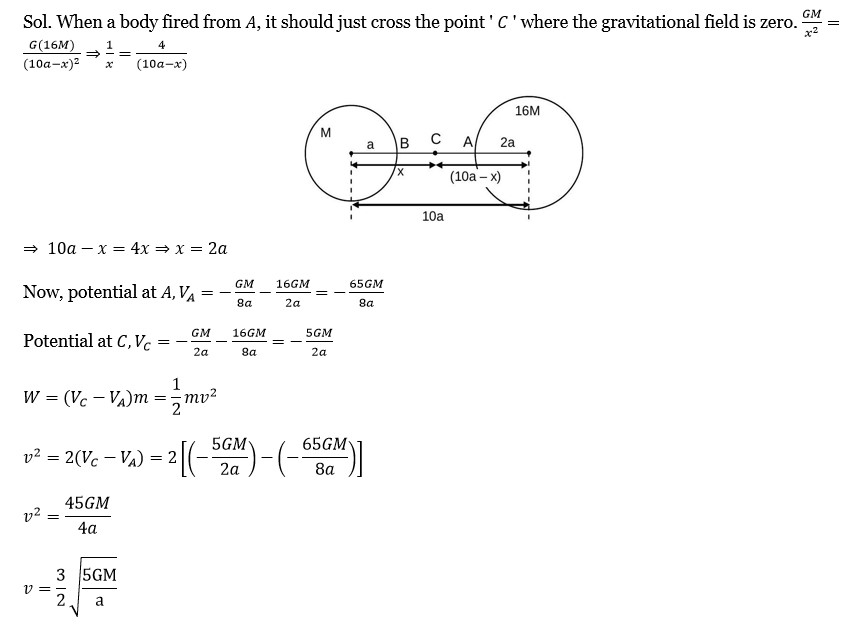
Two planets have masses M and 16M and their radii are a and 2a, respectively. The separation between the centres of the planets is 10a. A body of mass m is fired from the surface of the larger planet towards the smaller planet along the line joining their centres. For the body to be able to reach at the surface of smaller planet, the minimum firings speed needed is:
<!-- [if !supportLineBreakNewLine]-->
<!--[endif]-->
On the x-axis and at a distance x from the origin, the gravitational field due to a mass distribution is given by Ax/(x²+a²)³/² in the x-direction. The magnitude of gravitational potential on the x-axis at a distance x, taking its value to be zero at infinity is:
<!-- [if !supportLineBreakNewLine]-->
<!--[endif]-->
g = Ax / (x² + a²)³?²
⇒ ∫? dV = -∫?^∞ gdx
⇒ 0 - V = -∫?^∞ [Ax / (a² + x²)³?²] dx
Let, a² + x² = t²
⇒ 2xdx = 2tdt
⇒ xdx = tdt
⇒ V = ∫?^∞ (Atdt / t³) ⇒ [-A / t]?^∞ ⇒ [-A / √(a² + x²)]?^∞
⇒ V = A / √(a² + x²)
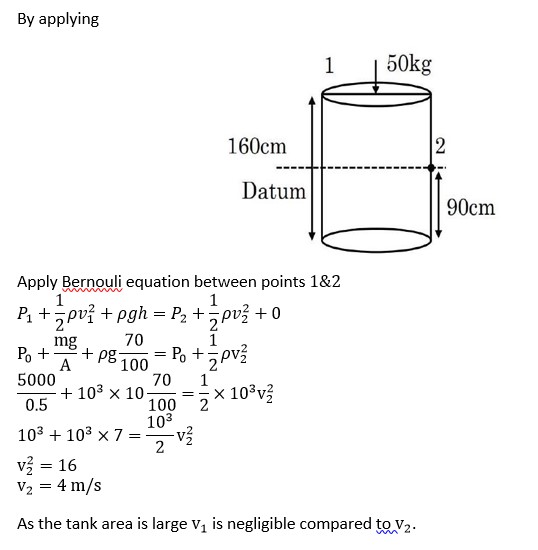
Upvote Consider a completely full cylindrical water tank of height 1.6 m and cross-sectional area 0.5 m². It has a small hole in its side at a height 90 cm from the bottom. Assume, the cross-sectional area of the hole to be negligibly small as compared to that of the water tank. If a load 50 kg is applied at the top surface of the water in the tank then the velocity of the water coming out at the instant when the hole is opened is : (g = 10 m/s²)
<!-- [if !supportLineBreakNewLine]-->
<!--[endif]-->
Consider a completely full cylindrical water tank of height 1.6 m and cross-sectional area 0.5 m². It has a small hole in its side at a height 90 cm from the bottom. Assume, the cross-sectional area of the hole to be negligibly small as compared to that of the water tank. If a load 50 kg is applied at the top surface of the water in the tank then the velocity of the water coming out at the instant when the hole is opened is : (g = 10 m/s²)
<!-- [if !supportLineBreakNewLine]-->
<!--[endif]-->
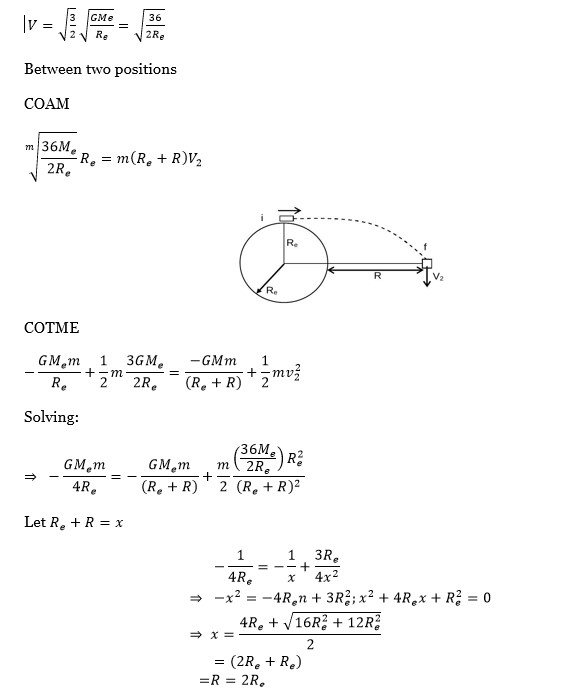
A satellite is moving in a low nearly circular orbit around the earth. Its radius is roughly equal to that of the earth's radius Rₑ. By firing rockets attached to it, its speed is instantaneously increased in the direction of its motion so that it become √(3/2) times larger. Due to this the farthest distance from the centre of the earth that the satellite reaches is R. Value of R is:
A satellite is moving in a low nearly circular orbit around the earth. Its radius is roughly equal to that of the earth's radius Rₑ. By firing rockets attached to it, its speed is instantaneously increased in the direction of its motion so that it become √(3/2) times larger. Due to this the farthest distance from the centre of the earth that the satellite reaches is R. Value of R is: