

Physics
Get insights from 5.6k questions on Physics, answered by students, alumni, and experts. You may also ask and answer any question you like about Physics
Follow Ask QuestionQuestions
Discussions
Active Users
Followers
New answer posted
a year agoContributor-Level 10
R_eq = (R? )/ (R? +R? ) ⇒ p (l)/ (2A) = [ (p? l/A) (p? l/A)] / [ (p? l/A) + (p? l/A)]
⇒ ρ/2 = (p? )/ (p? +p? ) ⇒ ρ = (2p? p? )/ (p? +p? ) = (2 * 6 * 3)/9 = 4 Ωcm
New answer posted
a year ago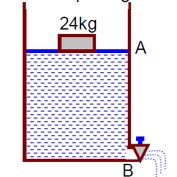
Contributor-Level 10
v? ²/2 + P? /ρ + gh? = v? ²/2 + P? /ρ + gh?
⇒ v? ²/2 + (P? + ρgh + mg/A)/ρ + g * 0 = v? ²/2 + P? /ρ + g * 0
⇒ v? ²/2 + (ρgh + mg/A)/ρ = v? ²/2 . (1)
Using Continuity equation, we can write
Av? = av? ⇒ v? = (a/A)v?
Putting the value of v? in equation (1), we have
(a²/A²)v? ²/2 + (ρgh + mg/A)/ρ = v? ²/2 ⇒ (A² - a²)/A² * v? ²/2 = (ρgh + mg/A)/ρ
⇒ v? = √ [ (A²/ (A²-a²) * 2 (ρgh + mg/A)/ρ] = 3.09 m/s ≈ 3 m/s
New answer posted
a year agoContributor-Level 10
d_lm = Distance covered by transmitting antenna + Distance covered by receiving antenna
⇒ d_lm = √ (2Rh_transmitting) + √ (2Rh_receiving)
⇒ d_lm = √ (2 * 64 * 10? * 20) + √ (2 * 64 * 10? * 5) = 16000 + 8000 = 24000m
When h_receiving = 0 then
d_2m = √ (2 * 64 * 10? * 20) = 16000m
% increment = (8000/16000) * 100 = 50
New answer posted
a year agoContributor-Level 10
v_rms = √ (3RT/M) and v_av = √ (8RT/πM)
⇒ v_rms / v_av = √ [ (3RT/M) / (8RT/πM)] = √ (3π/8)
New answer posted
a year ago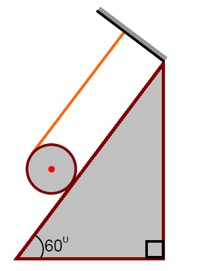
Contributor-Level 10
μ_min = (I tanθ)/ (I + mR²)
= [ (mR²/2)tanθ] / [mR²/2 + mR²] = (tanθ)/3 = (tan 60°)/3 = √3/3 = 1.732/3 = 0.5773
Since given coefficient of static friction is less than μ_min, so body will perform rolling with slipping and kinetic friction will act
F? = μN = μmg cosθ = (0.4) * mg cos 60° = mg/5
New answer posted
a year agoContributor-Level 10
As we know that direction of propagation of electromagnetic wave is perpendicular to plane containing mutually perpendicular electric field and magnetic field, so option D will be correct answer.
New answer posted
a year agoContributor-Level 10
z = √ [R² + (X? - X? )²] = √ [6² + (4-10)²] = 6√2 Ω
Power factor = cosφ = R/z = 6/ (6√2) = 1/√2
New answer posted
a year agoContributor-Level 10
With the help of definition of e, we can write
e = v? /v? = 2v/u ⇒ u = 2v/e . (2)
Putting the value of e in equation (1), we have
m? (2v/e) = (m? - m? )v ⇒ 2m? = em? - em? ⇒ m? /m? = (2+e)/e = 1 + 2/e > 2
Taking an Exam? Selecting a College?
Get authentic answers from experts, students and alumni that you won't find anywhere else
Sign Up on ShikshaOn Shiksha, get access to
- 67k Colleges
- 1.2k Exams
- 718k Reviews
- 1850k Answers