

Physics
Get insights from 5.6k questions on Physics, answered by students, alumni, and experts. You may also ask and answer any question you like about Physics
Follow Ask QuestionQuestions
Discussions
Active Users
Followers
New answer posted
a year agoContributor-Level 10
I? = I? + I? ⇒ I? /I? = 1 + I? /I? ⇒ 1/α = 1 + 1/β = (β+1)/β ⇒ α = β/ (1+β)
⇒ 1/β = 1/α - 1 = (1-α)/α ⇒ β = α/ (1-α)
New answer posted
a year agoContributor-Level 10
g? = g - ω²R ⇒ 0 = g - ω²R ⇒ ω = √ (g/R)
⇒ T = 2π/ω = 2π√ (R/g) = 2 * 3.14 * √ (6400 * 10³)/10)
New answer posted
a year agoContributor-Level 10
(A) sin (ωt) + cos (ωt) = √2 sin (ωt + π/4) ⇒ T = 2π/ω
(B) sin² (ωt) = 1/2 - (1/2)cos (2ωt) ⇒ T = 2π/ (2ω) = π/ω
(C) 3cos (π/4 - 2ωt) ⇒ T = 2π/ (2ω) = π/ω
(D) cos (ωt) + cos (2ωt) + cos (3ωt)
Time period of cos (ωt) = 2π/ω
Time period of cos (2ωt) = 2π/ (2ω)
Time period of cos (3ωt) = 2π/ (3ω)
Time period of combined function = 2π/ω
New answer posted
a year agoContributor-Level 10
A = Area swept ⇒ dA/dt = (1/2)r² (dθ/dt) = (1/2) (Mr²ω)/M = L / (2M)
New answer posted
a year ago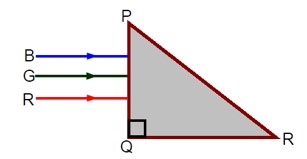
Contributor-Level 10
θ? > I = θ ⇒ sinθ? > sinθ ⇒ 1/μ > sinθ
⇒ μ < 1/sin
Note: If we assume θ = 45° ⇒ μ < 1.414, then red colour light ray will come out from face PR of prism.
New answer posted
a year agoContributor-Level 10
PV? = C ⇒ V? (dP/dV) + P (γV^ (γ-1) = 0 ⇒ dP/dV = -γ (P/V) ⇒ dP/P = -γ (dV/V)
New answer posted
a year ago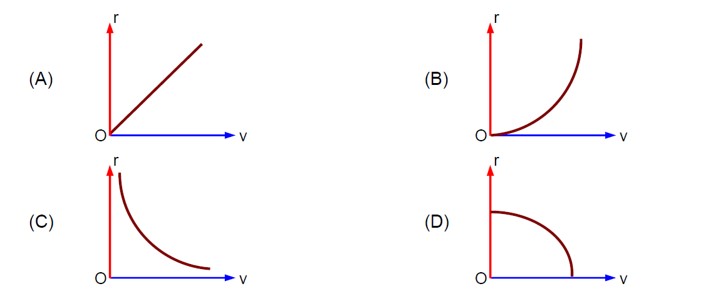
Contributor-Level 10
U = mV (r) = -Cm/r
F = -dU/dr = -Cm/r² ⇒ The force which provides required centripetal force
⇒ mv²/r = Cm/r² ⇒ r = C/v²
New answer posted
a year agoContributor-Level 10
I = (V/R) (1 - e^ (-t/τ) where τ = L/R
E = (1/2)LI² = (1/2)L (V²/R²) (1 - e^ (-t/τ)² ⇒ Energy stored in inductor
According to Question, we can write
(1/4) * (1/2) (LV²/R²) = (1/2) (LV²/R²) (1 - e^ (-t/τ)²
⇒ 1/4 = (1 - e^ (-t/τ)² ⇒ 1/2 = 1 - e^ (-t/τ) ⇒ e^ (-t/τ) = 1/2
⇒ t/τ = ln (2) ⇒ t = τln (2) = (L/R)ln (2)
Taking an Exam? Selecting a College?
Get authentic answers from experts, students and alumni that you won't find anywhere else
Sign Up on ShikshaOn Shiksha, get access to
- 67k Colleges
- 1.2k Exams
- 718k Reviews
- 1850k Answers