

Physics
Get insights from 5.6k questions on Physics, answered by students, alumni, and experts. You may also ask and answer any question you like about Physics
Follow Ask QuestionQuestions
Discussions
Active Users
Followers
New answer posted
a year agoContributor-Level 10
It's because gas molecules constantly move around at super high speeds. They randomly bump into each other constantly. Gravity does pull on them. The pulling effect is not much, however. When we consider the distance from the floor to the ceiling, gravity's pull is overcome by the molecular kinetic energy. So they just spread out and move from one place to another. They can't settle down.
New answer posted
a year agoContributor-Level 10
P = constant
m (dv/dt) = P
∫? vdv = P/m ∫? dt
v²/2 = Pt/m ⇒ v = (2Pt/m)¹/²
dx/dt = √ (2P/m) t¹/²
∫? dx = √ (2P/m) ∫? t¹/² dt
x = √ (2P/m) (t³/² / (3/2) = √ (2P/m) * (2/3) * t³/²
= (2/3) * 27 = 18
New answer posted
a year agoContributor-Level 10
V_rms = √ (3RT/M)
V_N? = V_H?
√ (3RT_N? / M_N? ) = √ (3RT_H? / M_H? )
573/28 = T_H? /2
⇒ T_H? = 40.928
New answer posted
a year agoContributor-Level 10
E? = φ + K?
E? = φ + K?
E? - E? = K? - K?
Now V? /V? = 2
K? /K? = 4; K? = 4K?
Now from equation (2)
⇒ 4 - 2.5 = 4K? - K?
1.5 = 3K?
K? = 0.5eV
Now putting this
Value in equation (2)
2.5 = φ + 0.5eV
φ = 2eV
New answer posted
a year ago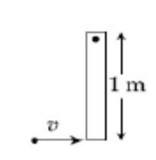
Contributor-Level 10
L_i = L_f
mvL = Iω
mvL = (ML³/3 + mL²)ω
Before collision
After collision
0.1 * 80 * 1 = (0.9 * 1²)/3 + 0.1 * 1²)ω
8 = (3/10 + 1/10)ω 8 = (4/10)ω ω = 20 rad/sec
New answer posted
a year agoContributor-Level 10
Let us assume the potential at A = V_A = 0.
Now at junction C, according to KCL
i? + i? = i?
1 A + i? = 2 A
i? = 2 A
Now analyse potential along ACDB
V_A + 1 + i? (2) - 2 = V_B
0 + 1 + 2 (1) - 2 = V_B
V_B = 3 - 2
V_B = 1amp.
New answer posted
a year agoContributor-Level 10
x = 1/√ (µ? ε? ) = speed ⇒ [x] = [L¹T? ¹]
y = E/B = speed ⇒ [y] = [L¹T? ¹]
z = l/ (RC) = l/τ ⇒ [z] = [L¹T? ¹]
So, x, y, z all have the same dimensions.
New answer posted
a year agoContributor-Level 10
Area of OABS is A?
Area of SCD is A?
Distance = |A? | + |A? |
A? = (1/2) [13/3 + 1]4 = 32/3
A? = (1/2) * 5/3 * 2 = 5/3
Distance = |A? | + |A? |
= 32/3 + 5/3 = 37/3
Taking an Exam? Selecting a College?
Get authentic answers from experts, students and alumni that you won't find anywhere else
Sign Up on ShikshaOn Shiksha, get access to
- 67k Colleges
- 1.2k Exams
- 718k Reviews
- 1850k Answers