

Physics
Get insights from 5.6k questions on Physics, answered by students, alumni, and experts. You may also ask and answer any question you like about Physics
Follow Ask QuestionQuestions
Discussions
Active Users
Followers
New answer posted
a year agoContributor-Level 10
In adiabatic process
PV? = constant
P (m/ρ)? = constant
As mass is constant
P ∝ ρ?
P_f/P_i = (ρ_f/ρ_i)? = (32)? /? = 2? = 128
New answer posted
a year ago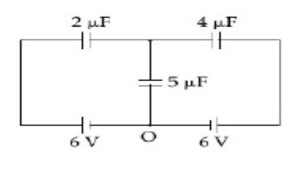
Contributor-Level 10
Now, using junction analysis
We can say, q? + q? + q? = 0
2 (x - 6) + 4 (x - 6) + 5 (x) = 0
x = 36/11, q? = 36 (5)/11 = 180/11
q? = 16.36µC
New answer posted
a year agoContributor-Level 10
At T°C L = L? + L?
At T +? T Leq = L'? + L'?
where L'? = L? (1 + α? T)
L'? = L? (1 + α? T)
Leq = (L? + L? ) (1 + αavg? T)
⇒ (L? + L? ) (1 + αavg? T) = L? + L? + L? α? T + L? α? T
⇒ (L? + L? )αavg = L? α? + L? α?
⇒ αavg = (L? α? + L? α? )/ (L? + L? )
New answer posted
a year ago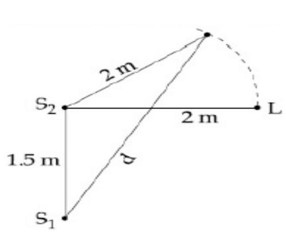
Contributor-Level 10
Initially S? L = 2m
S? L = √2² + (3/2)²
S? L = 5/2 = 2.5 m
? x = S? L - S? L = 0.5 m
So since λ = 1 m. ∴? x = λ/2
So white listener moves away from S? Then? x (= S? L − S? L) increases and hence, at? x = λ first maxima will appear.? x = λ = S? L − S? L.
1 = d - 2 ⇒ d = 3 m.
New answer posted
a year agoContributor-Level 10
Initially S? L = 2m
S? L = √2² + (3/2)²
S? L = 5/2 = 2.5 m
? x = S? L - S? L = 0.5 m
So since λ = 1 m. ∴? x = λ/2
So white listener moves away from S? Then? x (= S? L − S? L) increases and hence, at? x = λ first maxima will appear.? x = λ = S? L − S? L.
1 = d - 2 ⇒ d = 3 m.
New question posted
a year agoTaking an Exam? Selecting a College?
Get authentic answers from experts, students and alumni that you won't find anywhere else
Sign Up on ShikshaOn Shiksha, get access to
- 67k Colleges
- 1.2k Exams
- 718k Reviews
- 1850k Answers