

Physics
Get insights from 5.6k questions on Physics, answered by students, alumni, and experts. You may also ask and answer any question you like about Physics
Follow Ask QuestionQuestions
Discussions
Active Users
Followers
New answer posted
a year agoContributor-Level 10
r = 0.5Å = 0.5*10? ¹? m
v = 2.2*10? m/s
I =?
t = 2πr/v
I = e/t = ev/2πr = (1.6*10? ¹? * 2.2*10? )/ (2 * 22/7 * 0.5*10? ¹? )
I ≈ 1.12*10? ³ A = 1.12 mA = 112 * 10? ² mA
New answer posted
a year ago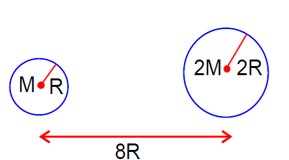
Contributor-Level 10
We have to find the point where the gravitational field must be zero.
EG = 0
GM/x² = G (9M)/ (8R-x)²
1/x² = 9/ (8R-x)²
8R - x = 3x => x = 2R
Potential at A (surface of first planet), VA = -GM/R - G (9M)/7R = -16GM/7R
Potential at point x, Vx = -GM/x - G (9M)/ (8R-x) = -GM/2R - G (9M)/6R = -2GM/R
ΔV = Vx - VA = -2GM/R - (-16GM/7R) = (-14+16)GM/7R = 2GM/7R
Using conservation of mechanical energy
ΔKE = ΔU = mΔV
½mv² = m (2GM/7R)
v² = 4GM/7R
v = √ (4GM/7R) => a = 4
New answer posted
a year agoContributor-Level 10
M = 9.85*10? ² A/m²
I = 5*10? kg-m²
T = 5s/10osc = 0.5 sec
B =?
T = 2π√ (I/MB)
B = 4π²I/ (MT²) = (4*9.85*5*10? )/ (9.85*10? ² * 0.5²)
B = (20*10? )/ (10? ² * 0.25) = 800*10? = 0.8*10? ³ T = 8mT
New answer posted
a year agoContributor-Level 10
Amplitude of sidebands = µAc/2
Here µ = Am/Ac = 5/15 = 1/3
Amplitude = (1/3) (15)/2 = 2.5 V
a/10 = 2.5 => a = 25
b/10 = 2.5 => b = 25
a/b = 1
New answer posted
a year agoContributor-Level 10
For photon, λ? = h/p = 6.6*10? ³? /10? ²? = 6.6*10? m
For a particle, λ? = h/mv = 6.6*10? ³? / (9.1*10? ³¹ * 10? ) ≈ 7.25*10? ¹? m
λ? /λ? = 6.6*10? / 7.25*10? ¹? ≈ 910
New answer posted
a year agoContributor-Level 10
Loss in elastic potential energy = Gain in KE
½ (YA/L)x² = ½mv²
0.5 * (0.5*10? * 10? / 0.1) * (0.04)² = 20*10? ³ v²
0.5 * (5*10²) * 1.6*10? ³ = 20*10? ³ v²
0.4 = 20*10? ³ v²
v² = 20 => v = √20 ≈ 4.47 m/s
(Re-checking calculations)
0.5 * ( (0.5e9 * 1e-6) / 0.1) * (0.04)^2 = 0.5 * (5e2) * 1.6e-3 = 4.
0.5 * 20e-3 * v^2 = 10e-3 v^2
4 = 10e-3 v^2
v^2 = 400 => v = 20 m/s
New answer posted
a year ago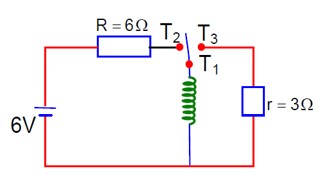
Contributor-Level 10
When T? & T? are connected, at steady state current, I becomes
I = 6V/6Ω = 1A
Now when T? & T? are connected, the current through the inductor, just after connecting, remains same. So
V? Ω = 1A * 3Ω = 3volt.
New answer posted
a year ago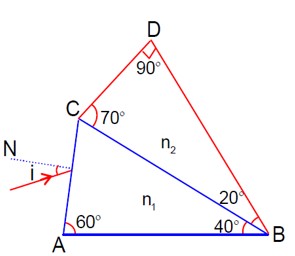
Contributor-Level 10
Light rays travel undeviated if the refractive index of the medium does not change for any value of angle of incidence.
i.e. n? = n?
1.2 + 10.8*10? ¹? /λ² = 1.45 + 1.8*10? ¹? /λ²
9.0*10? ¹? /λ² = 0.25
λ² = 36*10? ¹?
λ = 6*10? m = 600 nm
New answer posted
a year agoContributor-Level 9
ε = |dΦ/dt| = A|dB/dt|
Given B (t), dB/dt = (4/π) * 10? ³ * (-1/100)
ε = (π * 1²) * | (4/π) * 10? ³ * (-1/100)|
= 4 * 10? V
To find when B=0:
B = 0 ⇒ 1 - t/100 = 0
⇒ t = 100 second
Energy Dissipated, E = P * t = (ε²/R) * t
E = (4*10? )² / (2*10? ) * 100 = 80mJ
New answer posted
a year agoContributor-Level 10
As we know, β = Ic/Ib = 24 (Given)
R = 1000Ω, ΔV = 0.6V, Ic = ΔV/R = 0.6/1000 = 6*10? A
So, Ib = Ic/β = (6*10? )/24 = 25*10? A
or Ib = 25µA
Taking an Exam? Selecting a College?
Get authentic answers from experts, students and alumni that you won't find anywhere else
Sign Up on ShikshaOn Shiksha, get access to
- 67k Colleges
- 1.2k Exams
- 718k Reviews
- 1850k Answers