

Physics
Get insights from 5.6k questions on Physics, answered by students, alumni, and experts. You may also ask and answer any question you like about Physics
Follow Ask QuestionQuestions
Discussions
Active Users
Followers
New answer posted
a year ago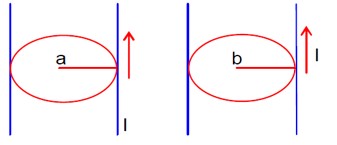
Contributor-Level 10
As b > a
The magnetic field inside the wire (r
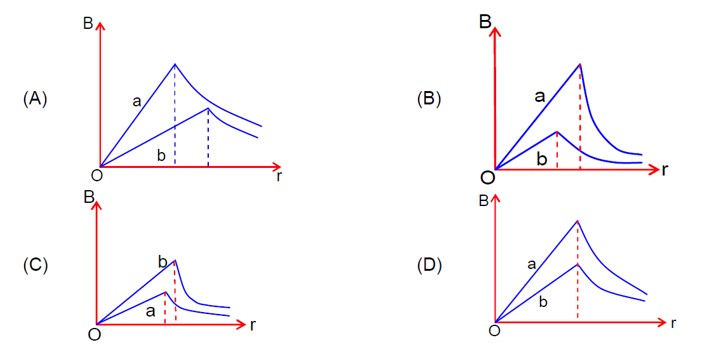
For wire with radius a, B increases linearly to r=a, then decreases. For wire with radius b, B increases linearly to r=b, then decreases. Since a
B? = µ? I / 2πa
B? = µ? I / 2πb
(Note: The question is likely asking for the graph representation, which is option A based on the formulas.)
New answer posted
a year agoContributor-Level 10
At terminal speed
Mg = Fv = 6πηRv
⇒ V = mg / 6πηR
V = (4/3)πR³ρg / 6πηR
⇒ V = (2/9) * (ρR²g/η)
= (2/9) * (1000 * (0.2 * 10? ³)² * 10) / (1.8 * 10? )
= 4.94 m/s
New answer posted
a year agoContributor-Level 10
T² = (4π²r³)/GM
⇒ M = (4π²r³)/ (G T²)
⇒ M = 6 * 10¹¹ * (9 * 10? )³ / (450 * 60)²
= 6.48 x 10²³ kg
(Note: There is a calculation error in the source image. Using the formula and given values: M = (6e11 * (9e6)^3) / (27000)^2 = 6e23 kg)
New answer posted
a year agoContributor-Level 10
A = A? (1/2)?
A/A? = 1/8 = (1/2)³ ⇒ n = 3
t = n T½
30 = 3 T½
T½ = 10 years
New answer posted
a year agoContributor-Level 10
ni² = ne * nh
(1.5*10¹? )² = ne * (4.5*10²²)
ne = (2.25 * 10³²)/ (4.5 * 10²²) = 0.5 * 10¹? = 5 * 10? / m³
New answer posted
a year agoContributor-Level 10
Mean free path:
λ ∝ 1/ (nd²)
λA/λB = (d_B²/d_A²) = (5²/10²) = 25/100 = 25 * 10? ²
New answer posted
a year agoContributor-Level 10
K = hc/λ - W?
K = (20*10? ²? )/ (500*10? ) - 1.25 * 1.6*10? ¹?
K = 4*10? ¹? - 2*10? ¹? = 2*10? ¹? J
R = √ (2mK)/ (eB)
B = √ (2mK)/ (eR) = √ (2 * 9*10? ³¹ * 2*10? ¹? ) / (1.6*10? ¹? * 30*10? ²)
B = √ (36*10? ) / (48*10? ²¹) = (6*10? ²? ) / (4.8*10? ²? ) = 1.25 * 10? T
B = 125 * 10? T
New answer posted
a year agoContributor-Level 10
Power dissipated is same
P? = P?
P_R = P_RLC
(V²/R) = (V²/Z)cos (φ) = (V²/Z) (R/Z) = V²R/Z²
R = R²/Z² => Z² = R²
R² + (ωL - 1/ωC)² = R²
ωL = 1/ωC
ω = 1/√ (LC) = 1/√ (0.1 * 40 * 10? ) = 1/√ (4 * 10? ) = 1/ (2 * 10? ³) = 500 rad/s
New answer posted
a year agoContributor-Level 10
C = 200µF, R
Q/A = constant [Given]
A = A? e? & Q = Q? e? /?
Q/A = (Q? /A? ) e^ (-t/RC + λt) = constant
For this to be constant, the exponent must be zero.
-t/RC + λt = 0
1/RC = λ
R = 1/ (λC) =
Taking an Exam? Selecting a College?
Get authentic answers from experts, students and alumni that you won't find anywhere else
Sign Up on ShikshaOn Shiksha, get access to
- 67k Colleges
- 1.2k Exams
- 718k Reviews
- 1850k Answers