

Physics
Get insights from 5.6k questions on Physics, answered by students, alumni, and experts. You may also ask and answer any question you like about Physics
Follow Ask QuestionQuestions
Discussions
Active Users
Followers
New answer posted
a year agoContributor-Level 10
ω = 2πf = 1/√ (LC)
L = 1/ (4π²f²C) = 1/ (4π² * 60² * 0.1*10? ) = 70.3 mH
New answer posted
a year ago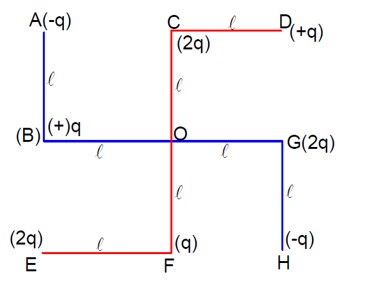
Contributor-Level 10
E? (due to A and G) = 2 * (kq/l²)cos (45) = √2 kq/l² (downwards)
E? (due to B and F) = 2 * (kq/l²)cos (45) = √2 kq/l² (towards left)
E? (due to C and H) = 0
E? (due to D and E) = 0
Resultant E = √ (E? ²+E? ²) = √ (2 (kq/l²)²+2 (kq/l²)²) = 2kq/l²
(Solution in the image seems to be different.)
New answer posted
a year agoContributor-Level 10
T = 2π√ (m/k)
0.2 = 2π√ (0.5/k)
k = (0.5) (2π/0.2)² = 50π² ≈ 500
x = A sin (ωt) = 5 sin (2π/T * t)
At t=T/4, x = 5 sin (π/2) = 5cm
PE = ½kx² = ½ * 500 * (0.05)² = 250 * 0.0025 = 0.625 J
New answer posted
a year agoContributor-Level 10
Energy of electron = 3 eV
It forms H atom in n=3 state. Energy released E = 3 - (-13.6/9) = 3 + 1.51 = 4.51 eV.
Photon Energy = 4.51 eV
Threshold energy = hc/λ = 12400eVÅ / 4000Å = 3.1 eV.
kE_max = 4.51 - 3.1 = 1.41 eV
New answer posted
a year agoContributor-Level 10
η_A = W_A/Q? = 1 - T/T?
η_B = W_B/Q? ' = 1 - T? /T
W_A = Q? (1 - T/T? ) = Q? - Q?
W_B = Q? ' (1 - T? /T) = Q? /2 (1 - T? /T)
Given W_A = W_B
Q? (1 - T/T? ) = (Q? /2) (1 - T? /T)
Q? (T? /T) (1-T/T? ) = (Q? /2) (1-T? /T)
(T? /T - 1) = (1/2) (1-T? /T)
2T? /T - 2 = 1 - T? /T
2T? /T + T? /T = 3
T = (2T? +T? )/3
New answer posted
a year agoContributor-Level 10
Degrees of freedom (f) = 3 translational + 3 rotational + (2 * 4) vibrational = 14
γ = 1 + 2/f = 1 + 2/14 = 8/7
W = nR? T/ (γ-1) = (1 * 8.3 * (310-300)/ (8/7 - 1) = (83)/ (1/7) = 581 J
As W is positive, work is done by the gas. The solution says W<0, work done on the gas. This implies? T is negative. The question states temperature rises, so work is done on the gas. W = -582J.
New answer posted
a year ago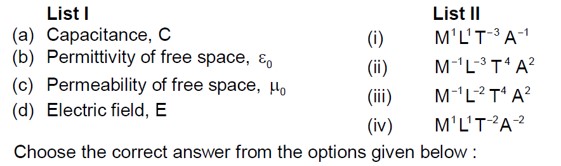
Contributor-Level 10
[C] = Q/V = Q/ (W/Q) = Q²/W = (A²T²)/ (M¹L²T? ²) = M? ¹L? ²T? A²
[ε? ] = C/ (4πr²) * (Fr²/q²) = M? ¹L? ³T? A²
[µ? ] = 4πrF/I²l = M¹L¹T? ²A? ²
[E] = F/q = (MLT? ²)/ (AT) = MLT? ³A? ¹
New answer posted
a year agoContributor-Level 10
F = Gm²/ (2R)² = mω²R Given m = 1kg
⇒ ω² = Gm/ (4R³)
⇒ ω = (1/2)√ (G/R³)
New answer posted
a year agoContributor-Level 10
R = R? [1 + α? T]
⇒ 16 = R? [1 + α (15 - T? )]
20 = R? [1 + α (100 - T? )]
Assuming T? = 0°C:
16 = R? (1 + 15α)
20 = R? (1 + 100α)
Dividing the equations:
16/20 = (1+15α)/ (1+100α)
16 + 1600α = 20 + 300α
1300α = 4
α = 4/1300 ≈ 0.003 °C? ¹
Taking an Exam? Selecting a College?
Get authentic answers from experts, students and alumni that you won't find anywhere else
Sign Up on ShikshaOn Shiksha, get access to
- 67k Colleges
- 1.2k Exams
- 718k Reviews
- 1850k Answers