

Polymers
Get insights from 155 questions on Polymers, answered by students, alumni, and experts. You may also ask and answer any question you like about Polymers
Follow Ask QuestionQuestions
Discussions
Active Users
Followers
New answer posted
a year agoContributor-Level 10
This is a short answer type question as classified in NCERT Exemplar
Cis-polyisoprene has a coiled structure which consists of various chains held together by weak Van there Waals force of attraction. It can be stretched like a spring and thus, has elastic properties.
New answer posted
a year agoContributor-Level 10
This is a short answer type question as classified in NCERT Exemplar
A vulcanisation process is used to improve the physical properties of natural rubber. This process consists of heating a mixture of raw rubber with sulphur and an appropriate additive at a temperature range between 373 K to 415 k. Sulphur forms cross links at the reactive sites of double bonds during vulcanization, stiffening the rubber.
New answer posted
a year ago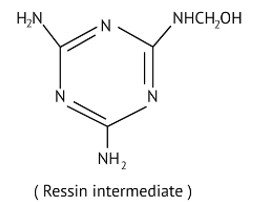
Contributor-Level 10
This is a short answer type question as classified in NCERT Exemplar
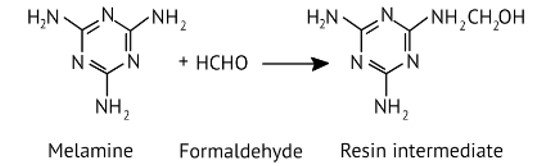
Melamine formaldehyde polymer is formed by the condensation polymerization of melamine and formaldehyde. This is resin intermediate.
New answer posted
a year agoContributor-Level 10
This is a short answer type question as classified in NCERT Exemplar
Yes, nucleic acids, proteins, and starch can be considered step growth polymers because this type of polymerization involves a condensation reaction between two monomers. Loss of simple molecules such as water, alcohol results in this type of polymerization and it results in the formation of high molecular mass polymers.
New answer posted
a year agoContributor-Level 10
This is a short answer type question as classified in NCERT Exemplar
Enzymes are biocatalysts that are present in the body. They are basically proteins, and they are also considered as polymers.
New answer posted
a year agoContributor-Level 10
This is a short answer type question as classified in NCERT Exemplar
Rubber is a natural polymer. It is also known as an elastomer due to its elastic properties. It is manufactured from rubber latex.
New answer posted
a year ago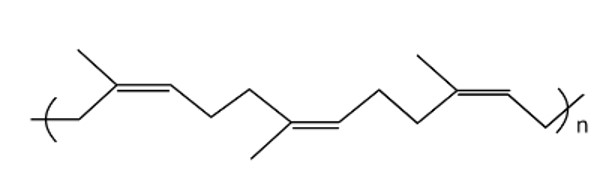
Contributor-Level 10
This is a short answer type question as classified in NCERT Exemplar
The cis-polyisoprene molecule is made up of several chains that are held together by weak van there Waals interactions and has a coiled structure. Thus, it can be stretched like a spring and exhibits elastic properties.
New answer posted
a year ago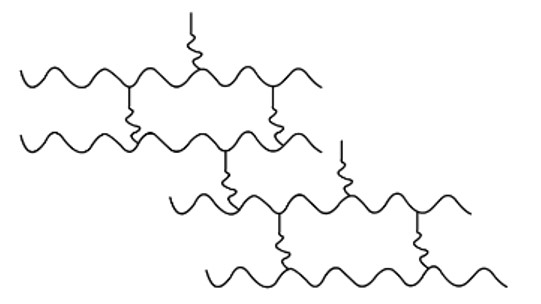
Contributor-Level 10
This is a short answer type question as classified in NCERT Exemplar
The polymer shown above is cross-linked or network polymer. They are formed from bi or tri-functional monomers that contain strong covalent bond between polymer chains.
New answer posted
a year agoContributor-Level 10
This is a short answer type question as classified in NCERT Exemplar
This is a type of chain-growth polymerization. The molecules of the same monomer or different monomer are added together to form this type of polymer.
New answer posted
a year agoContributor-Level 10
This is a short answer type question as classified in NCERT Exemplar
Addition polymers formed by the polymerization from two different monomers are co-polymers. The above-given polymer is a co-polymer. For example Buna-N, Buna-S.
Taking an Exam? Selecting a College?
Get authentic answers from experts, students and alumni that you won't find anywhere else
Sign Up on ShikshaOn Shiksha, get access to
- 66k Colleges
- 1.2k Exams
- 714k Reviews
- 1850k Answers