
Polymers
Get insights from 155 questions on Polymers, answered by students, alumni, and experts. You may also ask and answer any question you like about Polymers
- 155
Questions
- 0
Discussions
- 1
Active Users
- 0
Followers
Have a question about Polymers? Ask our experts
Keep it short & simple. Type complete word. Avoid abusive language.
Assertion : Network polymers are thermosetting.
Reason : Network polymers have high molecular mass.
(i) Assertion and reason both are correct statement but reason does not explain assertion.
(ii) Assertion and reason both are correct statements and reason explains the assertion.
(iii) Both assertion and reason are wrong statement.
(iv) Assertion is correct statement and reason is wrong statement. (v) Assertion is wrong statement and reason is correct statement.
This is a assertion and reason answer type question as classified in NCERT Exemplar
(i) Assertion and reason both are correct statements but reason does not explain assertion.
Explanation: Thermosetting polymers are cross linked polymers. They are highly branched polymers with high molecular masses.
 Upvote

Assertion : For making rubber synthetically, isoprene molecules are polymerised.
Reason : Neoprene (a polymer of chloroprene) is a synthetic rubber.
(i) Assertion and reason both are correct statement but reason does not explain assertion.
(ii) Assertion and reason both are correct statements and reason explains the assertion.
(iii) Both assertion and reason are wrong statement.
(iv) Assertion is correct statement and reason is wrong statement. (v) Assertion is wrong statement and reason is correct statement.
This is a assertion and reason answer type question as classified in NCERT Exemplar
(v) Assertion is wrong statement and reason is correct statement.
Explanation: Synthetic rubber is a type of rubber polymer that are capable of getting stretched to twice of its length. They are homopolymers of either
Upvote Assertion : Polyamides are best used as fibres because of high tensile strength.
Reason : Strong intermolecular forces (like hydrogen bonding within polyamides) lead to close packing of chains and increase the crystalline character, hence, provide high tensile strength to polymers.
(i) Assertion and reason both are correct statement but reason does not explain assertion.
(ii) Assertion and reason both are correct statements and reason explains the assertion.
(iii) Both assertion and reason are wrong statement.
(iv) Assertion is correct statement and reason is wrong statement. (v) Assertion is wrong statement and reason is correct statement.
Assertion : Polyamides are best used as fibres because of high tensile strength.
Reason : Strong intermolecular forces (like hydrogen bonding within polyamides) lead to close packing of chains and increase the crystalline character, hence, provide high tensile strength to polymers.
(i) Assertion and reason both are correct statement but reason does not explain assertion.
(ii) Assertion and reason both are correct statements and reason explains the assertion.
(iii) Both assertion and reason are wrong statement.
(iv) Assertion is correct statement and reason is wrong statement. (v) Assertion is wrong statement and reason is correct statement.
This is a assertion and reason answer type question as classified in NCERT Exemplar
(ii) Assertion and reason both are correct statements and reason explains the assertion.
Explanation: Polyamides are best used as fibres because of high tensile strength. They have the strongest intermolecular forces
Upvote Assertion : Olefinic monomers undergo addition polymerisation.
Reason : Polymerisation of vinylchloride is initiated by peroxides/ persulphates.
(i) Assertion and reason both are correct statement but reason does not explain assertion.
(ii) Assertion and reason both are correct statements and reason explains the assertion.
(iii) Both assertion and reason are wrong statement.
(iv) Assertion is correct statement and reason is wrong statement. (v) Assertion is wrong statement and reason is correct statement.
Assertion : Olefinic monomers undergo addition polymerisation.
Reason : Polymerisation of vinylchloride is initiated by peroxides/ persulphates.
(i) Assertion and reason both are correct statement but reason does not explain assertion.
(ii) Assertion and reason both are correct statements and reason explains the assertion.
(iii) Both assertion and reason are wrong statement.
(iv) Assertion is correct statement and reason is wrong statement. (v) Assertion is wrong statement and reason is correct statement.
This is a assertion and reason answer type question as classified in NCERT Exemplar
(i) Assertion and reason both are correct statement but reason does not explain assertion.
Explanation: Olefinic monomers undergo addition polymerisation. The molecules of the same monomer or different monomer are add
Upvote Assertion : Most of the Synthetic polymers are not biodegradable.
Reason : Polymerisation process induces toxic character in organic molecules.
(i) Assertion and reason both are correct statement but reason does not explain assertion.
(ii) Assertion and reason both are correct statements and reason explains the assertion.
(iii) Both assertion and reason are wrong statement.
(iv) Assertion is correct statement and reason is wrong statement. (v) Assertion is wrong statement and reason is correct statement.
Assertion : Most of the Synthetic polymers are not biodegradable.
Reason : Polymerisation process induces toxic character in organic molecules.
(i) Assertion and reason both are correct statement but reason does not explain assertion.
(ii) Assertion and reason both are correct statements and reason explains the assertion.
(iii) Both assertion and reason are wrong statement.
(iv) Assertion is correct statement and reason is wrong statement. (v) Assertion is wrong statement and reason is correct statement.
This is a assertion and reason answer type question as classified in NCERT Exemplar
(iv) Assertion is correct statement and reason is wrong statement. (v) Assertion is wrong statement and reason is correct statement.
Explanation: Most of the Synthetic polymers are not biodegradable. A large num
Upvote Note : In the following questions a statement of assertion followed by a statement of reason is given.
Choose the correct answer out of the following choices.
Assertion : Rayon is a semi synthetic polymer and is taken as a better choice than cotton fabric.
Reason : Mechanical and aesthetic properties of cellulose can be improved by acetylation.
(i) Assertion and reason both are correct statement but reason does not explain assertion.
(ii) Assertion and reason both are correct statements and reason explains the assertion.
(iii) Both assertion and reason are wrong statement.
(iv) Assertion is correct statement and reason is wrong statement. (v) Assertion is wrong statement and reason is correct statement.
Note : In the following questions a statement of assertion followed by a statement of reason is given.
Choose the correct answer out of the following choices.
Assertion : Rayon is a semi synthetic polymer and is taken as a better choice than cotton fabric.
Reason : Mechanical and aesthetic properties of cellulose can be improved by acetylation.
(i) Assertion and reason both are correct statement but reason does not explain assertion.
(ii) Assertion and reason both are correct statements and reason explains the assertion.
(iii) Both assertion and reason are wrong statement.
(iv) Assertion is correct statement and reason is wrong statement. (v) Assertion is wrong statement and reason is correct statement.
This is a assertion and reason answer type question as classified in NCERT Exemplar
(ii) Assertion and reason both are correct statements and reason explains the assertion.
Explanation: Rayon is a semi synthetic polymer. It is preferred over cotton fabric because its properties are improved by
Upvote Match the polymers given in Column I with their repeating units given in Column II.
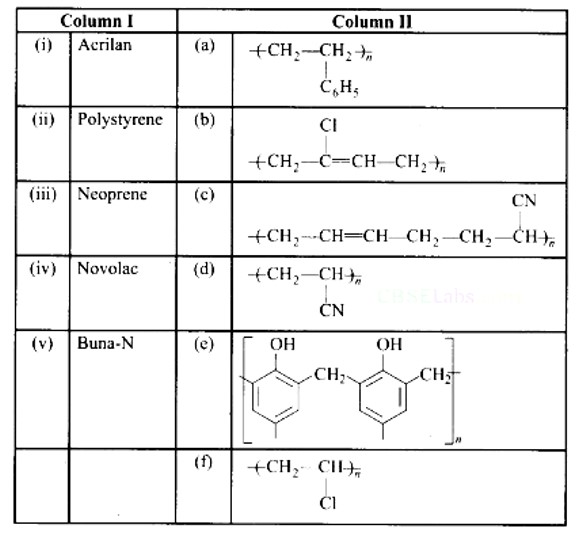
Match the polymers given in Column I with their repeating units given in Column II.
This is a matching answer type question as classified in NCERT Exemplar
(i) → (d) (ii) → (a) (iii) → (b) (iv) → (e) (v) → (c)
Upvote Match materials given in Column I with the polymers given in Column II.
Column I
Column II
i. Natural rubber latex
a. Nylon
ii. Wood laminates
b. Neoprene
iii. Ropes and fibers
c. Dacron
iv. Polyester fabric
d. Melamine-formaldehyde resins
v. Synthetic rubber
e. Urea-formaldehyde resins
vi. Unbreakable crockery
f. cis-polyisoprene
Match materials given in Column I with the polymers given in Column II.
|
Column I |
Column II |
|
i. Natural rubber latex |
a. Nylon |
|
ii. Wood laminates |
b. Neoprene |
|
iii. Ropes and fibers |
c. Dacron |
|
iv. Polyester fabric |
d. Melamine-formaldehyde resins |
|
v. Synthetic rubber |
e. Urea-formaldehyde resins |
|
vi. Unbreakable crockery |
f. cis-polyisoprene |
This is a matching answer type question as classified in NCERT Exemplar
(i) → (f) (ii) → (e) (iii) → (a) (iv) → (c) (v) → (b) (vi) → (d)
Upvote Match the polymers given in Column I with the type of linkage present in them given in Column II.
Column I
Column II
i. Terylene
a. Glycosidic linkage
ii. Nylon
b. Ester linkage
iii. Cellulose
c. Phosphodiester linkage
iv. Protein
d. Amide linkage
v. RNA
Match the polymers given in Column I with the type of linkage present in them given in Column II.
|
Column I |
Column II |
|
i. Terylene |
a. Glycosidic linkage |
|
ii. Nylon |
b. Ester linkage |
|
iii. Cellulose |
c. Phosphodiester linkage |
|
iv. Protein |
d. Amide linkage |
|
v. RNA |
This is a matching answer type question as classified in NCERT Exemplar
(i) → (b) (ii) → (d) (iii) → (a) (iv) → (d) (v) → (c)
Upvote Match the polymers given in Column I with the preferred mode of polymerisation followed by their monomers.
Column I
Column II
i. Nylon-6,6
a. Free radical polymerisation
ii. PVC
b. Ziegler-Natta polymerisation or coordination polymerisation
iii. HDP
c. Anionic polymerisation
d. Condensation polymerisation
Match the polymers given in Column I with the preferred mode of polymerisation followed by their monomers.
|
Column I |
Column II |
|
i. Nylon-6,6 |
a. Free radical polymerisation |
|
ii. PVC |
b. Ziegler-Natta polymerisation or coordination polymerisation |
|
iii. HDP |
c. Anionic polymerisation |
|
d. Condensation polymerisation |
This is a matching answer type question as classified in NCERT Exemplar
(i) → (d) (ii) → (a) (iii) → (b)
Upvote