
Statistics
Get insights from 161 questions on Statistics, answered by students, alumni, and experts. You may also ask and answer any question you like about Statistics
- 161
Questions
- 0
Discussions
- 16
Active Users
- 0
Followers
Have a question about Statistics? Ask our experts
Keep it short & simple. Type complete word. Avoid abusive language.
If the variance of the following frequency distribution :
is 50 , then is equal to:
If the variance of the following frequency distribution :
is 50 , then is equal to:
The mean and variance of the data 4, 5, 6, 6, 7, 8, x, y, where x < y, are 6 and respectively. Then is equal to.
The mean and variance of the data 4, 5, 6, 6, 7, 8, x, y, where x < y, are 6 and respectively. Then is equal to.
…. (i)
And variance
……. (ii)
From (i) and (ii)
x = 4 and y = 8
 Upvote

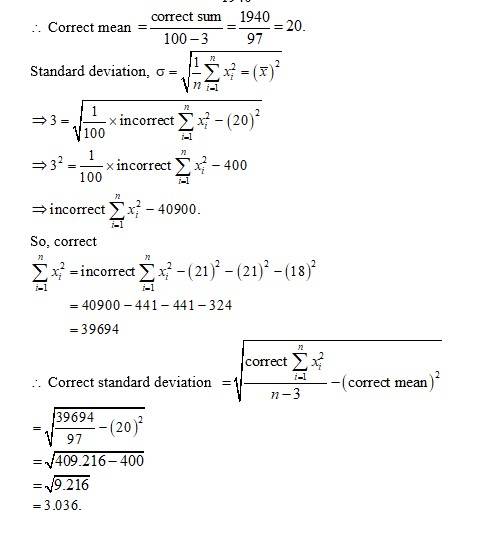
34. The mean and standard deviation of a group of 100 observations were found to be 20 and 3, respectively. Later on it was found that three observations were incorrect, which were recorded as 21, 21 and 18. Find the mean and standard deviation if the incorrect observations are omitted.
34. The mean and standard deviation of a group of 100 observations were found to be 20 and 3, respectively. Later on it was found that three observations were incorrect, which were recorded as 21, 21 and 18. Find the mean and standard deviation if the incorrect observations are omitted.
34. Given, n = 100.
incorrect mean ( ) = 20.
incorrect standard deviation (σ) = 3
We know that,
So, incorrect sum of observation = 2000
Correct sum of observation
= 1940
Upvote 33. The mean and standard deviation of marks obtained by 50 students of a class in three subjects, Mathematics, Physics and Chemistry are given below:
Subject Mathematics Physics Chemistry
Mean 42 32 40.9
Standard 12 15 20
deviation
Which of the three subjects shows the highest variability in marks and which shows the lowest?
33. The mean and standard deviation of marks obtained by 50 students of a class in three subjects, Mathematics, Physics and Chemistry are given below:
Subject Mathematics Physics Chemistry
Mean 42 32 40.9
Standard 12 15 20
deviation
Which of the three subjects shows the highest variability in marks and which shows the lowest?
33. C.V in mathematics =
C.V in Physics =
C.V in chemistry =
Chemistry has the highest variability and mathematics has the lowest variability.
Upvote 32. The mean and standard deviation of 20 observations are found to be 10 and 2, respectively. On rechecking, it was found that an observation 8 was incorrect. Calculate the correct mean and standard deviation in each of the following cases:
(i) If wrong item is omitted.
(ii) If it is replaced by 12.
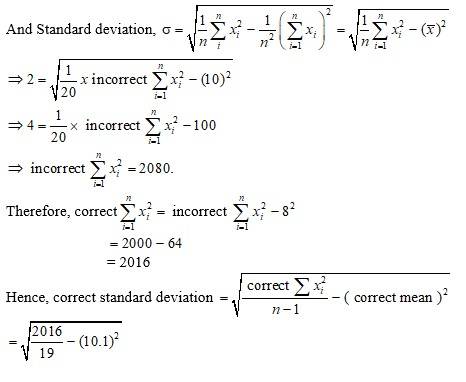
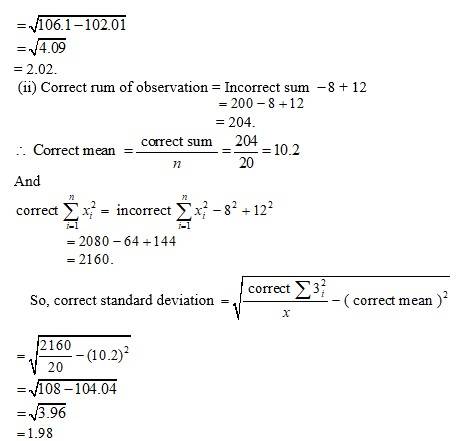
32. The mean and standard deviation of 20 observations are found to be 10 and 2, respectively. On rechecking, it was found that an observation 8 was incorrect. Calculate the correct mean and standard deviation in each of the following cases:
(i) If wrong item is omitted.
(ii) If it is replaced by 12.
32. (i) Given, n = 20.
Incorrect mean
Incorrect standard deviation
We know that,
So, incorrect sum of observation = 200.
correct sum of observation =200 – 8 = 192
And correct mean
Upvote 31. Given that is the mean and σ2 is the variance of n observations x1, x2, .,xn. Prove that the mean and variance of the observations ax1, ax2, ax3, ., axn are a and a2 σ2, respectively, (a ≠ 0).
31. Given that is the mean and σ2 is the variance of n observations x1, x2, .,xn. Prove that the mean and variance of the observations ax1, ax2, ax3, ., axn are a and a2 σ2, respectively, (a ≠ 0).
31. For n observations x1, x2,……., xn .
We have mean =
and variance =
Let yi be the new observations with same n.
So, yi = axi (3)
Now mean,
So
And, putting (3) and (4) in (2) we get,
Hence, the mean and variance of ax1, ax2, ……,
Upvote 30. The mean and standard deviation of six observations are 8 and 4, respectively. If each observation is multiplied by 3, find the new mean and new standard deviation of the resulting observations.
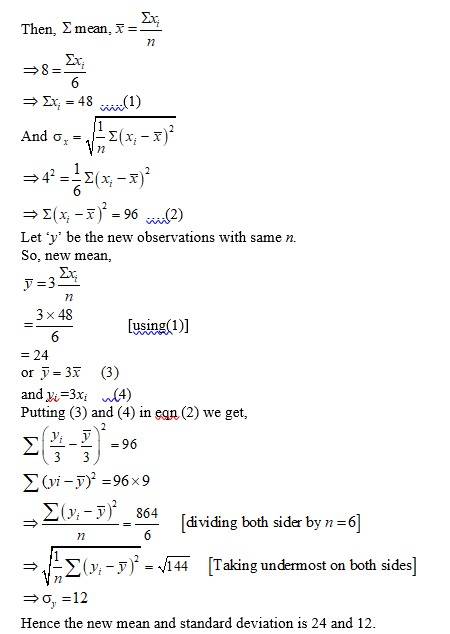
30. The mean and standard deviation of six observations are 8 and 4, respectively. If each observation is multiplied by 3, find the new mean and new standard deviation of the resulting observations.
30. Let 'x' be the given observations with n = 6.
Upvote 
26. The following is the record of goals scored by team A in a football session:
No. of goals scored
0
1
2
3
4
No. of matches
1
9
7
5
3
For the team B, mean number of goals scored per match was 2 with a standard deviation 1.25 goals. Find which team may be considered more consistent?
26. The following is the record of goals scored by team A in a football session:
|
No. of goals scored |
0 |
1 |
2 |
3 |
4 |
|
No. of matches |
1 |
9 |
7 |
5 |
3 |
For the team B, mean number of goals scored per match was 2 with a standard deviation 1.25 goals. Find which team may be considered more consistent?
26. For team A.
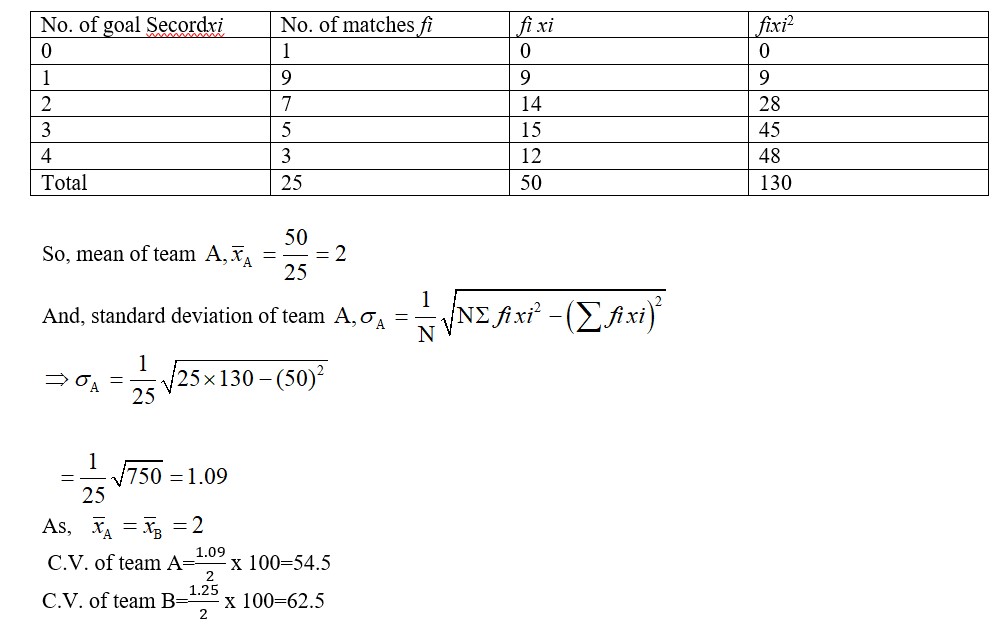
Hence, we conclude that team A is more consistent.
Upvote