

Surface Chemistry
Get insights from 216 questions on Surface Chemistry, answered by students, alumni, and experts. You may also ask and answer any question you like about Surface Chemistry
Follow Ask QuestionQuestions
Discussions
Active Users
Followers
New answer posted
a year agoContributor-Level 10
Thin layer chromatography is another type of adsorption chromatography silica gel of proper size spread over glass plate also acts as an adsorbent in thin layer chromatography size of 0.2 mm thick.
New answer posted
a year ago
Contributor-Level 10
(i) Foam - Froth (e)
(ii) Gel - Jellies (c)
(iii) Aerosol - smoke (a)
(iv) Emulsion - milk (f)
New answer posted
a year agoContributor-Level 10
Potential difference between fixed layer and mobile layer of lyophobic colloid is called zeta potential or electro kinetic potential.
This potential difference is related to charge on the surface of colloidal particles.
New answer posted
a year agoContributor-Level 10
This is the method of preparation of lyophilic solution as condition is given.
New answer posted
a year ago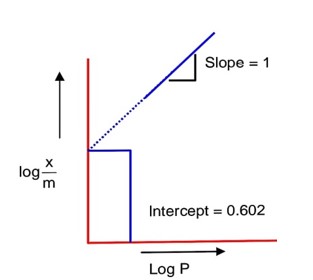
Contributor-Level 10
Using, Freundlich adsorption isotherm ;
………………. (i)
Comparing with y = mx + C
Slope =
Intercept, log k = 0.602
log k = log 4
k = 4
from equation (i)
= 0.12
= 12 * 10-2
So, 12 * 10-2 g of gas is adsorbed per gram of adsorbent,
New answer posted
a year agoContributor-Level 10
This is a Assertion and Reason Type Questions as classified in NCERT Exemplar
Ans: Detergents with low CMC are more economical to use as they involve formation of micelle which is used for cleaning of oil and dirt from our cloth. Micelle formation takes place when the concentration of the detergent becomes equal to the CMC so the answer is (i).
New answer posted
a year agoContributor-Level 10
This is a Assertion and Reason Type Questions as classified in NCERT Exemplar
Ans: Greater the valence of the flocculating ion added, the greater is its power to cause precipitation. This is known as Hardy schulze rule. In the coagulation of a negative sol, the flocculating
New answer posted
a year agoContributor-Level 10
This is a Assertion and Reason Type Questions as classified in NCERT Exemplar
Ans: Colloidal particle shows Brownian movement. The Brownian movement has a stirring effect which does not permit the particles to settle and thus, is responsible for the stability of sols so the answer is (v).
New answer posted
a year agoContributor-Level 10
This is a Assertion and Reason Type Questions as classified in NCERT Exemplar
Ans: Colloidal particles being bigger aggregates, the number of particles in a colloidal solution is comparatively small as compared to a true solution. Hence, the values of colligative properties (osmotic pressure, lowering in vapour pressure, depression in freezing point and elevation in boiling point) are of small order as compared to values shown by true solutions at same concentration hence the answer is (i).
Taking an Exam? Selecting a College?
Get authentic answers from experts, students and alumni that you won't find anywhere else
Sign Up on ShikshaOn Shiksha, get access to
- 67k Colleges
- 1.2k Exams
- 716k Reviews
- 1850k Answers