
Surface Chemistry
Get insights from 216 questions on Surface Chemistry, answered by students, alumni, and experts. You may also ask and answer any question you like about Surface Chemistry
- 216
Questions
- 0
Discussions
- 0
Active Users
- 0
Followers
Have a question about Surface Chemistry? Ask our experts
Keep it short & simple. Type complete word. Avoid abusive language.
Sodium stearate CH?(CH?)?COO?Na? is an anionic surfactant which forms micelles in oil. Choose the correct statement for it from the following:
<!-- [if !supportLineBreakNewLine]-->
<!--[endif]-->
Sodium stearate CH?(CH?)?COO?Na? is an anionic surfactant which forms micelles in oil. Choose the correct statement for it from the following:
<!-- [if !supportLineBreakNewLine]-->
<!--[endif]-->
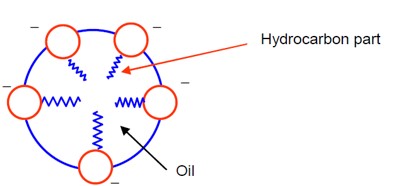
[Diagram of a micelle formed by sodium stearate in oil]
Spherical micelles forms and hydrocarbon part are water repelling and attracted by oily part.
 Upvote

Match List – I with List – II:
| List - I (Example of Colloids) | List - II (Classification) |
| (a) Cheese | (i) dispersion of liquid in liquid |
| (b) Pumice stone | (ii) dispersion of liquid in gas |
| (c) Hair cream | (iii) dispersion of gas in solid |
| (d) Cloud | (iv) dispersion of liquid in solid |
Choose the most appropriate answer from the option given below:
Phase | Medium | Colloid Type |
| (1) Cheese | liquid | solid | Gel |
| (2) Pumice stone | gas | solid | Solid sol |
| (3) Hair cream
Upvote 3.12g of oxygen is adsorbed on 1.2g of platinum metal. The volume oxygen adsorbed per gram of the adsorbent at 1 atm and 300 K in L is-----------.
[R = 0.0821 L atm K-1 mole-1]
3.12g of oxygen is adsorbed on 1.2g of platinum metal. The volume oxygen adsorbed per gram of the adsorbent at 1 atm and 300 K in L is-----------.
[R = 0.0821 L atm K-1 mole-1]
PV = nRT
1 × V =
V = 2.4 litre
Vol of O2 adsorbed per gm = 2.4 / 1.2 = 2 litre
Upvote
Match List – I with List – II
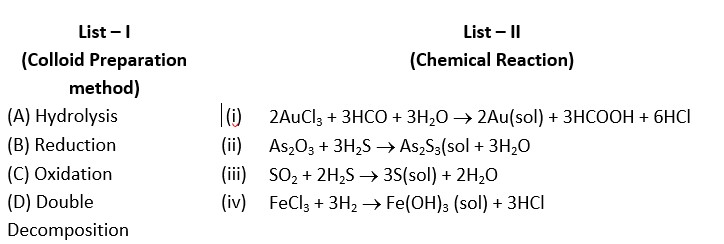
Match List – I with List – II
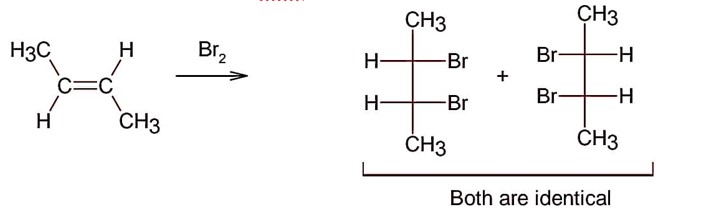
Electrophilic addition of bromine to an alkene is anti-addition, in which cis-alkene gives two enantiomers and trans – alkene gives meso form
Here; trans-but-2-ene will give meso products
Upvote The nature of charge on resulting colloidal particles when FeCl3 is added to excess of hot water is:
The nature of charge on resulting colloidal particles when FeCl3 is added to excess of hot water is:
In Freundlich adsorption isotherm, slope of AB line is:
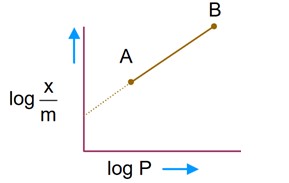
In Freundlich adsorption isotherm, slope of AB line is:
Freundlich adsorption isotherm
Comparing with y = mx + C
so, slope of given graph is
Upvote In Freundlich adsorption isotherm at moderate pressure, the extent of adsorption <!-- [if gte mso 9]><xml>
In Freundlich adsorption isotherm at moderate pressure, the extent of adsorption <!-- [if gte mso 9]><xml>
Freundlich adsorption Isotherm
At moderate pressure ;
So,
Upvote Which one of the following statements is FALSE for hydrophilic sols?
Which one of the following statements is FALSE for hydrophilic sols?
Viscosity of the hydrophilic sol is always higher than H2O, because dispersed phase particle attracted by dispersion medium.
Upvote When silver nitrate solution is added to potassium iodide solution then the sol produced is:
When silver nitrate solution is added to potassium iodide solution then the sol produced is:
When AgNO3 is added to Kl solution, precipitate of Agl is formed which adsorb I- ion from
Dispersion medium to give negatively charged sol
Agl/l-- negatively charged sol.
Upvote The wavelength of electrons accelerated from rest through a potential difference of 40 kV is x × 10-12m. The value of x is________. (Nearest Integer)
Given : Mass of electron = 9.1 × 10⁻³¹kg
Charge on an electron = 1.6 × 10⁻¹⁹C
Planck’s constant = 6.63 × 10⁻³⁴Js
The wavelength of electrons accelerated from rest through a potential difference of 40 kV is x × 10-12m. The value of x is________. (Nearest Integer)
Given : Mass of electron = 9.1 × 10⁻³¹kg
Charge on an electron = 1.6 × 10⁻¹⁹C
Planck’s constant = 6.63 × 10⁻³⁴Js
Here,
[the nearest integer = 6]
Upvote