
Surface Chemistry
Get insights from 216 questions on Surface Chemistry, answered by students, alumni, and experts. You may also ask and answer any question you like about Surface Chemistry
- 216
Questions
- 0
Discussions
- 0
Active Users
- 0
Followers
Have a question about Surface Chemistry? Ask our experts
Keep it short & simple. Type complete word. Avoid abusive language.
Using very little soap while washing clothes, does not serve the purpose of cleaning of clothes, because:
Using very little soap while washing clothes, does not serve the purpose of cleaning of clothes, because:
Micelles are not formed because it formed above CMC.
 Upvote

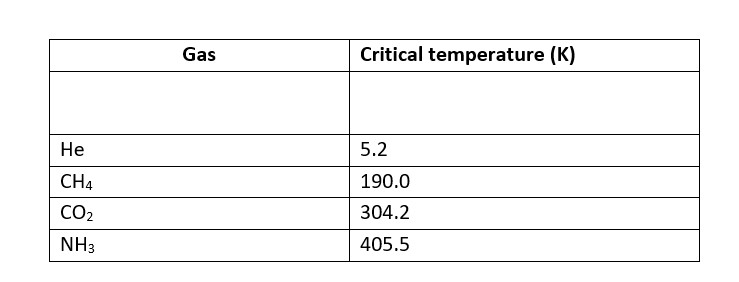
Given below are the critical temperature of some of the gases:
Gas
Critical temperature (K)
He
5.2
CH4
190.0
CO2
304.2
NH3
405.5
The gas showing least adsorption on a definite amount of charcoal is
Given below are the critical temperature of some of the gases:
|
Gas |
Critical temperature (K) |
|
He |
5.2 |
|
CH4 |
190.0 |
|
CO2 |
304.2 |
|
NH3 |
405.5 |
The gas showing least adsorption on a definite amount of charcoal is
Higher adsorbtion of gas is corresponds to higher liquefaction and higher liquefaction is directly proportional to the higher critical temperature.
Upvote For micelle formation, which of the following statements are correct?
A. Micelle formation is an exothermic process.
B. Micelle formation is an endothermic process.
C. The entropy change is positive.
D. The entropy change is negative.
For micelle formation, which of the following statements are correct?
A. Micelle formation is an exothermic process.
B. Micelle formation is an endothermic process.
C. The entropy change is positive.
D. The entropy change is negative.
During micelle formation,
Micelle formation is endothermic at low temperature and exothermic at high temperature.
At room temperature ⇒ Micelle formation is endothermic.
Upvote Match the List-I with List-II
List – I List – II
(A) Lyophilic colloid (I) Liquid – liquid colloid
(B) Emulsion (II) Protective colloid
(C) Positively charged colloid (II) FeCl3 + NaOH
(D) Negatively charged colloid (IV) FeCl3 + hot water
Choose the correct answer from the option given below:
Match the List-I with List-II
List – I List – II
(A) Lyophilic colloid (I) Liquid – liquid colloid
(B) Emulsion (II) Protective colloid
(C) Positively charged colloid (II) FeCl3 + NaOH
(D) Negatively charged colloid (IV) FeCl3 + hot water
Choose the correct answer from the option given below:
Emulsion are liquid colloids, protective colloids are lyophilic, FeCl3 + H2O charged colloids and FeCl3 + NaOH (-ve)ly charged colloids.
Upvote Given below are two statements. One is labeled as Assertion A and the other is labeled as Reason R.
Assertion A: Activated charcoal adsorbs SO2 more efficiency than CH4.
Reason R: Gases with lower critical temperature are readily adsorbed by activated charcoal.
In the light of the above statements, choose the correct answer from the options given below:
Given below are two statements. One is labeled as Assertion A and the other is labeled as Reason R.
Assertion A: Activated charcoal adsorbs SO2 more efficiency than CH4.
Reason R: Gases with lower critical temperature are readily adsorbed by activated charcoal.
In the light of the above statements, choose the correct answer from the options given below:
SO2 is absorbed to a greater extent then CH4 on activated charcoal under same Gases with higher critical temperature are readily absorbed by activated charcoal.
Upvote For kinetic study of the reaction of iodide ion with H2O2 at room temperature:
(A) Always use freshly prepared starch solution.
(B) Always keep the concentration of sodium thiosulphate solution less than that of Kl solution.
(C) Record the time immediately after the appearance of blue colour.
(D) Record the time immediately before the appearance of blue colour.
(E) Always keep the concentration of sodium thiosulphate solution more than that of Kl solution.
Choose the correct answer from the options given below:
For kinetic study of the reaction of iodide ion with H2O2 at room temperature:
(A) Always use freshly prepared starch solution.
(B) Always keep the concentration of sodium thiosulphate solution less than that of Kl solution.
(C) Record the time immediately after the appearance of blue colour.
(D) Record the time immediately before the appearance of blue colour.
(E) Always keep the concentration of sodium thiosulphate solution more than that of Kl solution.
Choose the correct answer from the options given below:
Always fresh solution of starch used and recorded immediately after the blue colour appears. Na2S2O3 is used in limited amount.
Upvote Given below are the critical temperature of some of the gases:
Given below are the critical temperature of some of the gases:
Higher adsorbtion of gas is corresponds to higher liquefaction and higher liquefaction is directly proportional to the higher critical temperature.
Upvote <p><strong>Given below are the critical temperature of some of the gases:</strong></p>
<div class="photo-widget-full">
<div class="figure"><strong><picture><source srcset="" media="(max-width: 500px)"><img src="https://images.shiksha.com/mediadata/images/1753713029php2yn3J5.jpeg" alt="" width="608" height="209" loading="lazy"></picture></strong></div>
<div class="figure">
<p><strong>The gas showing least adsorption on a definite amount of charcoal is</strong></p>
</div>
</div>
<p> </p>
→ number of electrons = 10
Br → number of electrons = 36
→ number of electrons = 2
→ number of electrons = 18
→ number of electrons = 2
→ number of electrons = 18
K+ → number of electrons = 18
O-2 → number of electrons = 10
Mg+2 → number of electrons = 10
O-2 & Mg+2 are isoelectronic with Al+3
Upvote