
Thermodynamics
Get insights from 325 questions on Thermodynamics, answered by students, alumni, and experts. You may also ask and answer any question you like about Thermodynamics
- 325
Questions
- 0
Discussions
- 0
Active Users
- 0
Followers
Have a question about Thermodynamics? Ask our experts
Keep it short & simple. Type complete word. Avoid abusive language.
1 mole of rigid diatomic gas performs a work of <!-- [if gte mso 9]><xml>
[R = universal gas constant]
1 mole of rigid diatomic gas performs a work of <!-- [if gte mso 9]><xml>
[R = universal gas constant]
The volume V of a given mass of monoatomic gas changes with temperature T according to the relation <!-- [if gte mso 9]><xml>
[R = universal gas constant]
The volume V of a given mass of monoatomic gas changes with temperature T according to the relation <!-- [if gte mso 9]><xml>
[R = universal gas constant]
The internal energy (U), pressure (P) and volume (V) of an ideal gas are related as U = 3PV + 4. The gas is:
The internal energy (U), pressure (P) and volume (V) of an ideal gas are related as U = 3PV + 4. The gas is:
If one mole of an ideal gas at (P1 V1) is allowed to expand reversibly and isothermally (A to B) its pressure is reduced to one- half of the original pressure (see figure). This is followed by a constant volume cooling till its pressure is reduced to one-fourth of the initial value (B ® C). Then it is restored to its initial state by a reversible adiabatic compression (C to A). The net work done by the gas is equal to:
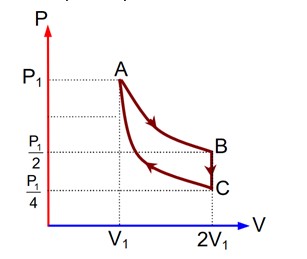
If one mole of an ideal gas at (P1 V1) is allowed to expand reversibly and isothermally (A to B) its pressure is reduced to one- half of the original pressure (see figure). This is followed by a constant volume cooling till its pressure is reduced to one-fourth of the initial value (B ® C). Then it is restored to its initial state by a reversible adiabatic compression (C to A). The net work done by the gas is equal to:
In a certain thermodynamical process, the pressure of a gas depends on its volume as kV3. The work done when the temperature change from 100°C to 300°C will be……………. nR, where n denotes number of moles of a gas.
In a certain thermodynamical process, the pressure of a gas depends on its volume as kV3. The work done when the temperature change from 100°C to 300°C will be……………. nR, where n denotes number of moles of a gas.
P = kV3 Þ PV-3 = k Þ Polytropic Process with index m = -3
W =
 Upvote

A diatomic gas, having CP <!-- [if gte mso 9]><xml>
A diatomic gas, having CP <!-- [if gte mso 9]><xml>
At constant pressure,
dW = nRdT
dU : dQ : dW = 5 : 7 : 2
Upvote The temperature of 3.00 mol of an ideal diatomic gas in increased by 40.0°C without changing the pressure of the gas. The molecules in the gas rotate but do not oscillate. If the ratio of change in internal energy of the gas to the amount of work done by the gas is Then the value of x (round off to the nearest integer) is________.
(Given R = 8.31 J mol-1K-1)
The temperature of 3.00 mol of an ideal diatomic gas in increased by 40.0°C without changing the pressure of the gas. The molecules in the gas rotate but do not oscillate. If the ratio of change in internal energy of the gas to the amount of work done by the gas is Then the value of x (round off to the nearest integer) is________.
(Given R = 8.31 J mol-1K-1)
Since process is isochoric
So
And external work
Upvote In 5 minutes, a body cools from 75°C to 65°C at room temperature of 25°C. The temperature of body at the end of next 5 minutes is__________°C.
In 5 minutes, a body cools from 75°C to 65°C at room temperature of 25°C. The temperature of body at the end of next 5 minutes is__________°C.
from newtan’s law of cooling :
Using average value :
Upvote What will be the average value of energy for a monatomic gas in thermal equilibrium at temperature T?
What will be the average value of energy for a monatomic gas in thermal equilibrium at temperature T?
Total energy of monoatomic gas at equilibrium
Upvote