
Thermodynamics
Get insights from 325 questions on Thermodynamics, answered by students, alumni, and experts. You may also ask and answer any question you like about Thermodynamics
- 325
Questions
- 0
Discussions
- 0
Active Users
- 0
Followers
Have a question about Thermodynamics? Ask our experts
Keep it short & simple. Type complete word. Avoid abusive language.
The change in the magnitude of the volume of an ideal gas when a small additional pressure ΔP is applied at a constant temperature, is the same as the change when the temperature is reduced by a small quantity ΔT at constant pressure. The initial temperature and pressure of the gas were 300 K and 2 atm. respectively. If |ΔT| = C|ΔP| then value of C in (K/atm) is ….
<!-- [if !supportLineBreakNewLine]-->
<!--[endif]-->
The change in the magnitude of the volume of an ideal gas when a small additional pressure ΔP is applied at a constant temperature, is the same as the change when the temperature is reduced by a small quantity ΔT at constant pressure. The initial temperature and pressure of the gas were 300 K and 2 atm. respectively. If |ΔT| = C|ΔP| then value of C in (K/atm) is ….
<!-- [if !supportLineBreakNewLine]-->
<!--[endif]-->
T = constant
P = constant
PV = nRT
PdV = nRdT
PdV + VdP = 0
ΔV = nRΔT/P
dV = (-)VdP/P
|ΔV| = V (ΔP/P)
V/P ΔP = nRΔT/P
ΔT = V/nR ΔP
C = V/nR T/P = 300/2 = 150
 Upvote

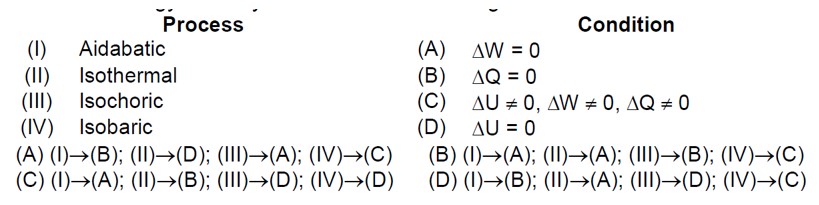
Match the thermodynamics processes taking place in a system with the correct conditions. In the table: ΔQ is the heat supplied, ΔW is the work done and ΔU is change in internal energy of the system. Match the following:
<!-- [if !supportLineBreakNewLine]-->
<!--[endif]-->
Match the thermodynamics processes taking place in a system with the correct conditions. In the table: ΔQ is the heat supplied, ΔW is the work done and ΔU is change in internal energy of the system. Match the following:
<!-- [if !supportLineBreakNewLine]-->
<!--[endif]-->
ΔQ = heat supplied
ΔW = work done
ΔU = change in internal energy
(i) adiabatic (B) Δθ = 0
(ii) isothermal (D) ΔU = 0
(iii) isochoric (A) ΔW = 0
(iv) isobaric (C) ΔU ≠ 0, ΔW ≠ 0, ΔQ ≠ 0
Upvote A closed vessel contains 0.1 mole of a monatomic ideal gas at 200 K. If 0.05 mole of the same gas at 400 K is added to it, the final equilibrium temperature (in K ) of the gas in the vessel will be close to
A closed vessel contains 0.1 mole of a monatomic ideal gas at 200 K. If 0.05 mole of the same gas at 400 K is added to it, the final equilibrium temperature (in K ) of the gas in the vessel will be close to
n? T? + n? T? = nT
⇒ (0.1) (200) + (0.05) (400) = (0.15)T
⇒ T = 266.67
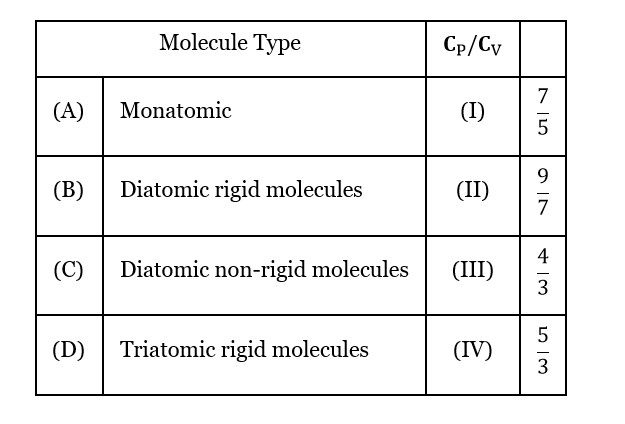
Upvote Match the Cp/Cv ratio for ideal gases with different type of molecules:
|
Match the correct option?
<!-- [if !supportLineBreakNewLine]-->
<!--[endif]-->
Match the Cp/Cv ratio for ideal gases with different type of molecules:
|
Match the correct option?
<!-- [if !supportLineBreakNewLine]-->
<!--[endif]-->
Mono atomic → Cv = 3R/2, Cp = 5R/2
Di-atomic → Cv = 5R/2, Cp = 7R/2
(Rigid)
Di-atomic → Cv = 7R/2, Cp = 9R/2
(Non-Rigid)
Tri-atomic → Cv = 3R, Cp = 4R
(Rigid)
Upvote The specific heat of water = 4200 J kg⁻¹ K⁻¹ and the latent heat of ice = 3.4 × 10⁵ J kg⁻¹. 100 grams of ice at 0°C is placed in 200 g of water at 25°C. The amount of ice that will melt as the temperature of water reaches 0°C is close to (in grams):
The specific heat of water = 4200 J kg⁻¹ K⁻¹ and the latent heat of ice = 3.4 × 10⁵ J kg⁻¹. 100 grams of ice at 0°C is placed in 200 g of water at 25°C. The amount of ice that will melt as the temperature of water reaches 0°C is close to (in grams):
m(L) = m?S?(ΔT)
⇒ m(3.4 × 10?) = (200)(4200)(25)
⇒ m = 61.7
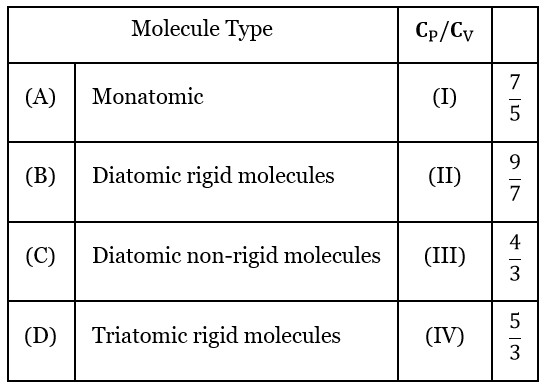
Upvote Match the ratio for ideal gases with different type of molecules:
Match the correct option?
Match the ratio for ideal gases with different type of molecules:
Match the correct option?
To raise the temperature of a certain mass of gas by at a constant pressure, 160 calories of heat is required. When the same mass of gas is cooled by at constant volume, 240 calories of heat is released. How many degrees of freedom does each molecule of this gas have (assume gas to be ideal)?
To raise the temperature of a certain mass of gas by at a constant pressure, 160 calories of heat is required. When the same mass of gas is cooled by at constant volume, 240 calories of heat is released. How many degrees of freedom does each molecule of this gas have (assume gas to be ideal)?